VAT Registration and Filing for UAE Smart Free Zones: A 2026 Compliance Guide
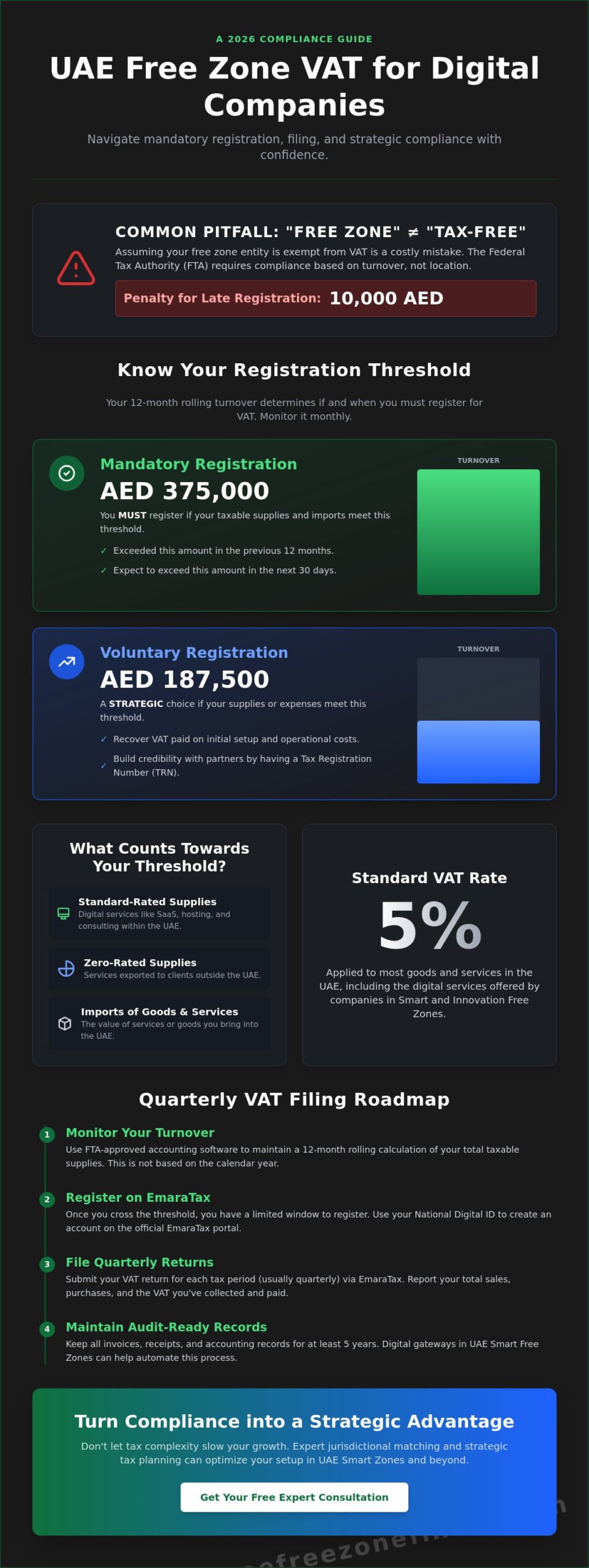
Operating in a tax-free zone doesn’t mean you’re exempt from the Federal Tax Authority’s reach. In fact, assuming your digital company setup UAE is completely off the hook for taxes is the fastest way to trigger a 10,000 AED penalty for late registration. It’s a common trap for entrepreneurs. You likely chose UAE smart free zones or UAE innovation free zones for the world-class incentives and cutting-edge environment, not to become a tax expert overnight. We understand that the complexity of cross-border digital service taxation feels overwhelming when you’re trying to scale.
This 2026 compliance guide provides the steady hand you need. You’ll gain a clear understanding of mandatory registration thresholds and a repeatable process for quarterly filing that eliminates the fear of unexpected audits. We’ll show you how to maintain full regulatory compliance for your Dubai technology free zones entity or any UAE advanced infrastructure business. By the end of this roadmap, you’ll have the confidence to focus on global expansion while managing the nuances of the UAE’s evolving tax landscape with of.
Key Takeaways
- Identify whether your business meets the mandatory AED 375,000 registration threshold or if you should opt for voluntary registration at AED 187,500 to protect your startup’s early growth.
- Clear up the confusion between Designated and Non-Designated zones to ensure you apply the correct VAT treatment for both physical goods and digital services within innovation hubs.
- Master the nuances of operating within UAE smart free zones, digital company setup UAE, and UAE innovation free zones to ensure your Dubai technology free zones entity or UAE advanced infrastructure business remains fully compliant by 2026.
- Follow a methodical, step-by-step roadmap for filing your quarterly returns via the EmaraTax portal using your national digital ID to avoid costly administrative penalties.
- Learn how expert jurisdictional matching can optimize your tax position and transform complex regulatory hurdles into a strategic advantage for your international expansion.
Understanding VAT in the Context of UAE Smart Free Zones
Value Added Tax (VAT) functions as a consumption tax applied at every stage of the supply chain. It’s not a tax on your business profits, but rather a levy collected by businesses on behalf of the government. Since its introduction on January 1, 2018, the Federal Tax Authority (FTA) has managed this system to ensure national commerce remains transparent and diversified. Many entrepreneurs launching in UAE innovation free zones or Dubai technology free zones assume that “Free Zone” status equals “Tax Free” status. This is a common misconception that can lead to expensive penalties. While these jurisdictions offer incredible benefits like 100% ownership and customs exemptions, they still operate within the broader UAE VAT system.
The standard VAT rate is 5% and applies to most goods and services. For tech-heavy businesses, this includes digital services such as software-as-a-service (SaaS), data hosting, and electronic marketplace fees. If your taxable supplies and imports exceed the mandatory threshold of AED 375,000 over a 12-month period, registration isn’t optional. You can also choose to register voluntarily if your expenses or sales hit AED 187,500, which is often a smart move for startups looking to recover VAT paid on their initial setup costs.
The Evolution of UAE Advanced Infrastructure Business
The UAE advanced infrastructure business model has shifted the way companies handle compliance. High-speed digital networks in UAE smart free zones aren’t just for operational speed; they facilitate real-time tax reporting. By 2026, the integration of fintech tools within these zones has made automated record-keeping the standard rather than the exception. Most smart zones now provide digital gateways that sync directly with FTA-approved accounting software. This digital-first environment ensures that every transaction is logged accurately, allowing you to generate audit-ready reports with a few clicks. It’s a system designed to remove the friction from corporate administration, letting you focus on scaling your technology.
Why Digital Company Setup Requires Early Tax Planning
A successful digital company setup UAE involves more than just getting a trade license. You’ve got to think about your tax footprint before the first invoice is even sent. Value Added Tax is a 5% indirect tax on most goods and services. Ignoring this until your first audit is a high-risk strategy that rarely ends well. Beyond staying on the right side of the law, early VAT registration builds significant credibility. When you deal with international tech giants or major vendors, having a Tax Registration Number (TRN) signals that your business is a legitimate, compliant entity. It shows you’ve cleared the FTA’s vetting process, making you a more attractive partner for long-term contracts and global collaborations.
Determining Your Registration Threshold: Mandatory vs. Voluntary
Operating within UAE smart free zones requires a clear grasp of the Federal Tax Authority (FTA) rules. You can’t just ignore VAT because you’re in a specialized hub; the law applies based on your turnover, not just your location. The mandatory registration threshold is set at AED 375,000. If your taxable supplies and imports exceeded this amount over the previous 12 months, you must register. You also have to register if you expect your supplies to cross this line in the next 30 days. The law is precise, and the FTA expects you to be just as diligent with your records.
For a digital company setup UAE, calculating “taxable supplies” involves more than just physical sales. It includes all standard-rated supplies, zero-rated supplies, and even the value of goods and services you’ve imported. If you’re running a SaaS platform or providing software licenses to local clients, these are standard-rated at 5%. If you’re exporting those services to clients outside the UAE, they are often zero-rated. Both count toward that AED 375,000 limit. You should monitor your 12-month rolling turnover every single month. Don’t wait for the calendar year to end. Missing the 30-day registration window after hitting the threshold usually triggers a late registration penalty of AED 10,000.
VAT Registration for Tech Startups and AI Companies
Many early-stage ventures in UAE innovation free zones benefit from voluntary registration once they hit AED 187,500 in taxable supplies or even taxable expenses. This is a strategic move for AI firms and tech startups that haven’t reached high revenue yet but are spending heavily on R&D. By registering voluntarily, you can claim back the 5% VAT paid on high-value servers, AI chips, and specialized hardware. It’s a vital way to protect your cash flow. Before you dive into tax planning, you’ll need to finalize your free zone company formation to obtain the necessary trade license for your FTA application.
The Interplay Between VAT and Corporate Tax
It’s vital to remember that VAT and Corporate Tax are separate compliance tracks with different rules. While VAT is a consumption tax based on turnover, Corporate Tax is a direct tax on your profits. For businesses in Dubai technology free zones, the Corporate Tax rate is 9% on profits exceeding AED 375,000. Even if your VAT registration is sorted, you still need to manage your corporate tax obligations separately. You can find a detailed breakdown of these requirements in our corporate tax registration guide. Managing both effectively ensures your UAE advanced infrastructure business remains fully compliant and ready for growth.
VAT Treatment in Designated vs. Non-Designated Free Zones
Understanding where your business sits geographically is half the battle for tax compliance. In 2026, the distinction between a Designated Zone (DZ) and a Non-Designated Free Zone remains a critical factor for your tax liability. While most UAE innovation free zones provide incredible perks, their VAT status depends on specific Cabinet Decisions that list certain areas as being “outside the UAE” for tax purposes. If your zone isn’t on that list, it’s treated exactly like the mainland for VAT, even if it’s a free zone for ownership and licensing purposes.
The primary difference lies in how the Federal Tax Authority (FTA) views the movement of goods versus services. Goods kept within a Designated Zone are generally not subject to VAT until they’re imported into the mainland. However, services are almost always considered supplied within the UAE. This means a software firm in a digital company setup UAE framework might still need to charge 5% VAT on services provided to a local client, regardless of their zone’s designated status.
Navigating the Designated Zone Framework
To qualify as a Designated Zone in 2026, a free zone must meet strict criteria. It must be a fenced area with specific security measures and customs controls to monitor the movement of people and goods. If you’re operating within these boundaries, you’ll find that B2B transactions involving goods between two DZs are typically VAT-free, provided the goods aren’t released for local consumption.
- Criteria for DZ Status: Must be specifically named in a Cabinet Decision and maintain a functional customs border.
- B2B Goods: 0% VAT when moving goods between two Designated Zones with proper documentation.
- Mainland Sales Pitfall: Selling digital services from a DZ to a mainland company usually triggers a 5% VAT charge. Don’t assume your “outside the UAE” status applies to your service contracts.
VAT for Digital Commerce and Innovation Hubs
For a UAE advanced infrastructure business, the “Export of Services” rule is a powerful tool. Under Article 31 of the Executive Regulations, you can zero-rate your services if the recipient is based outside the UAE and has no place of residence here. This is a massive advantage for Dubai technology free zones that serve international clients in Europe or Asia. You won’t charge 5% VAT, but you can still recover the VAT you paid on your local business expenses.
When you import tech services, such as cloud hosting or specialized software from abroad, you’ll likely use the Reverse Charge Mechanism (RCM). This allows you to account for the 5% VAT on your tax return without an immediate cash outflow, as you simultaneously claim it back as input tax. To keep the FTA happy, your tax invoices must be precise. They must show your 15-digit TRN, the date of supply, and the total amount in UAE Dirham (AED, symbol: د.إ). Keeping these records organized ensures your cross-border trade remains audit-ready and professional.
The Step-by-Step VAT Filing Process for Digital Entities
Operating within UAE smart free zones requires more than just innovative ideas; it demands rigorous administrative discipline. The Federal Tax Authority (FTA) expects precision, especially for businesses utilizing the UAE advanced infrastructure business model. You’ll typically file your returns quarterly, though the FTA might assign monthly periods for high-turnover entities. Missing these windows isn’t just a minor slip; it’s a compliance risk that can affect your license standing.
The process begins with data consolidation. You must gather every tax invoice, credit note, and purchase record from the specific tax period. Digital entities often handle high volumes of micro-transactions, so having a centralized digital ledger is vital. Once your data is ready, you’ll access the EmaraTax portal. Most founders now use their UAE PASS for a quick, secure login. This portal is the nerve center for your tax obligations, and it’s designed to be relatively intuitive for tech-savvy entrepreneurs.
Inside the portal, you’ll complete the VAT 201 return form. This requires you to categorize your supplies carefully. You’ll list standard-rated sales at 5% and identify zero-rated exports, which is common for software companies serving global clients from Dubai technology free zones. Before hitting submit, verify your input tax deductions. You can only claim VAT back on legitimate business expenses. If you’ve accidentally included a personal dinner or a non-business subscription, remove it immediately to avoid red flags.
The final step is the payment. Your return and the full tax liability must reach the FTA by the 28th of the month following your tax period. If the 28th falls on a weekend or public holiday, the deadline usually moves to the next business day. Don’t leave this until the last hour. Bank transfers can occasionally lag, and the FTA records the date the funds arrive, not the date you sent them.
Documentation and Record-Keeping Best Practices
The law requires you to keep records for a minimum of five years. This includes tax invoices, credit notes, and customs declarations for any physical hardware imported. For those involved in a digital company setup UAE, we strongly recommend cloud-based accounting software. Ensure your software is configured for UAE tax laws so it automatically generates FTA-compliant files. This prevents the stress of a manual “re-build” if you’re ever selected for a random audit. It’s also worth noting that if you ever decide to wind down operations, engaging professional company liquidation services ensures your VAT and tax records are properly deregistered with the FTA, protecting you from ongoing liabilities.
Common Mistakes to Avoid During Filing
One of the costliest errors is claiming VAT on personal or non-business expenses, such as entertainment or personal mobile plans. The penalty structure is strict; late filing or submitting incorrect data can result in fines starting at AED 1,000 and increasing significantly for repeat errors. To manage these payments smoothly, many founders seek corporate bank account opening assistance to ensure their banking facility is optimized for tax transfers and government payments within UAE innovation free zones.
Ready to streamline your operations? Get expert guidance on your UAE business setup today.
Strategic Compliance: How UAE Free Zone Finder Optimizes Your Position
Compliance in the Emirates is a moving target. With the 2024 implementation of corporate tax and the evolving VAT landscape, you need more than a service provider; you need a partner who understands the nuances of UAE smart free zones. We don’t just process paperwork. We act as your strategic guide, ensuring your digital company setup UAE is structured to maximize tax efficiency from day one. Choosing between various Dubai technology free zones or other UAE innovation free zones involves more than comparing license costs. It requires a deep dive into how each jurisdiction handles input tax recovery and cross-border digital services.
Our expert consultants identify the most tax-efficient jurisdiction for your specific license. We look at your supply chain, your target markets, and your 2026 growth projections to ensure your UAE advanced infrastructure business isn’t overpaying on non-recoverable VAT. This level of insider knowledge prevents the common pitfalls that many international entrepreneurs face when they try to navigate the Federal Tax Authority (FTA) requirements alone.
Comprehensive Support Beyond Incorporation
Our relationship with your business doesn’t end when the trade license is issued. We offer retainer-based accounting services designed to ensure year-round compliance. This isn’t just about data entry; it’s about maintaining a clean audit trail that satisfies the FTA’s rigorous standards. Our team handles all direct FTA communications on your behalf, managing clarifications and filing requirements so you can focus on your core operations. We invite you to a consultation today to assess your 2026 tax readiness. Waiting until a deadline is looming often leads to errors; proactive planning is the only way to guarantee peace of mind.
Your Partner in UAE Business Growth
We operate on an “Expert Matching” philosophy. This means we don’t push a one-size-fits-all solution. We find the specific free zone that fits your business model like a glove. We’re committed to total transparency, breaking down complex bureaucratic hurdles into a few manageable steps. Our ongoing PRO and government liaison services ensure that your tax matters, visa renewals, and license updates happen behind the scenes. We make the impossible feel attainable by providing a steady hand in a complex regulatory environment. You deserve a partner who values your time and your investment as much as you do.
Secure Your Digital Enterprise for the 2026 Tax Landscape
Navigating Federal Tax Authority regulations doesn’t have to be a hurdle for your growth. Understanding whether your entity sits within a Designated Zone or a Non-Designated Zone is the first step to avoiding costly penalties. It’s vital to monitor your taxable turnover against the AED 375,000 mandatory threshold. You must be compliant before the 2026 deadlines hit. Succeeding within UAE smart free zones, digital company setup UAE, UAE innovation free zones, Dubai technology free zones, UAE advanced infrastructure business requires a balance of innovative drive and strict regulatory discipline.
We bring the heritage of the UAE Free Zone Finder Group, founded in 2009, to your boardroom. Our team acts as your expert VAT and Corporate Tax liaison, providing dedicated accounting support specifically designed for digital startups. We’ve helped thousands of entrepreneurs find their perfect fit since our inception. You don’t need to tackle complex filings alone when you have a partner who understands the shortcuts and the pitfalls of the local regulatory environment. And when the time comes to restructure or exit a venture, our company liquidation services ensure a clean, fully compliant wind-down that protects your next business move.
Simplify Your UAE VAT Compliance Today
The UAE remains one of the world’s most competitive markets for innovation. With the right tax strategy in place, your business is ready to scale across the Emirates and beyond.
Frequently Asked Questions
Is VAT registration mandatory for all Free Zone companies in 2026?
VAT registration isn’t mandatory for every business. It only becomes a legal requirement once your taxable turnover hits AED 375,000 over a 12 month period. Companies in UAE innovation free zones can also choose to register voluntarily if their turnover or expenses exceed AED 187,500. It’s a strategic move if you want to claim back tax on your initial investments and professional fees.
Can a digital company in the UAE claim back VAT on startup costs?
You can definitely reclaim VAT on eligible business expenses incurred before your digital company setup UAE is fully operational. This process is called input tax recovery. You’ll need to keep all original tax invoices from the six months prior to registration to claim these costs on your first return. It helps reduce the initial financial weight of launching in Dubai technology free zones.
What is the penalty for late VAT registration or filing in the UAE?
The Federal Tax Authority (FTA) imposes a flat penalty of AED 1,000 for the first late filing or registration. If the error happens again within 24 months, the fine increases to AED 2,000. There’s also a monthly penalty of 4% on any unpaid tax balance. These costs add up quickly, so we suggest staying ahead of the 28 day deadline following your tax period.
Do I need to charge VAT to clients located outside of the UAE?
You don’t charge VAT to clients located outside the UAE because these services are usually treated as zero-rated exports. For any business using UAE advanced infrastructure business tools to serve global markets, this means a 0% tax rate on international invoices. You must keep documentation, such as contracts or wire transfer records, to prove the client is truly based overseas.
How often does a tech startup need to file VAT returns?
Most tech startups file their VAT returns on a quarterly basis. The FTA assigns your specific tax period when you register, which is usually based on your annual turnover. If your revenue exceeds AED 150 million, you’ll likely be moved to a monthly filing schedule. Most entrepreneurs in UAE smart free zones find the three month cycle provides enough time to organize their books.
What is the difference between a Tax Registration Number (TRN) and a Trade License?
A Trade License is your legal permission to operate, while a Tax Registration Number (TRN) is a 15 digit code used specifically for tax reporting. Your license is issued by the free zone authority, but the FTA issues your TRN. You can’t apply for a TRN without an active trade license. Think of the license as your company’s identity and the TRN as its tax identification.
Can I manage my own VAT filing through the EmaraTax portal?
You can manage your own filing through the EmaraTax portal, which was launched by the FTA on December 5, 2022. The platform is built for efficiency and allows you to submit returns and pay liabilities directly. While the interface is helpful, many investors still choose to work with a tax agent to ensure they don’t miss complex deductions or new regulatory updates.
Does the UAE Golden Visa impact my VAT obligations as an investor?
The UAE Golden Visa doesn’t change your corporate VAT obligations at all. VAT is based on the business’s taxable activity rather than the owner’s residency status. Whether you hold a 10 year visa or a standard residency permit, your company must follow the same FTA rules. The visa offers you personal stability, but your business in a UAE smart free zone remains a separate legal entity for tax purposes.
Disclaimer
The information provided in this article is intended for general informational purposes only and reflects conditions as understood at the time of publication. Free zone regulations, fees, and requirements in the UAE are subject to change. Readers are advised to verify details with the relevant free zone authority or regulatory body before making any business decisions. For personalised guidance, our business setup experts at UAE Free Zone Finder are available to assist — contact us at info@uaefreezonefinder.com or call +971-507864823.