

What if a single administrative oversight on the EmaraTax portal could trigger a 10,000 AED penalty before your business even begins its first tax year? It’s a question many UAE entrepreneurs are asking as the Federal Tax Authority (FTA) moves toward full enforcement of the new regime. You’ve likely felt the weight of this transition, especially when trying to decipher the specific requirements for corporate tax registration while managing your daily operations. The fear of missing a deadline or miscalculating your Qualifying Free Zone status is a common concern in the local business community.
We’re here to bridge that gap with the quiet confidence of an industry insider. You’ll learn how to master the registration process using our 2026 compliance checklist, designed to keep your venture penalty-free and fully aligned with FTA standards. This guide provides a clear list of required documents, a strict timeline of deadlines, and the strategic direction needed for a successful registration without errors. We’ll simplify the bureaucratic hurdles so you can focus on your global expansion instead of paperwork.
Key Takeaways
- Identify your status as a ‘Taxable Person’ and understand why registration is mandatory even for businesses that aren’t currently profitable.
- Organize your legal and financial documents into high-resolution digital files to ensure your corporate tax registration is processed without any administrative delays.
- Navigate the EmaraTax portal with confidence by understanding how this unified platform handles your business data and tax filings.
- Pinpoint your specific compliance deadline based on your trade license issuance month to protect your company from heavy administrative fines.
- Adopt professional bookkeeping and accounting standards to maintain long-term tax health and simplify your ongoing reporting requirements.
Understanding Your Corporate Tax Obligations in 2026
Corporate tax registration isn’t just a checkbox for the big players. It’s a mandatory legal requirement for every “Taxable Person” operating in the country. The Federal Tax Authority (FTA) manages this process to ensure every business contributes to the nation’s growing economy. You can find more context on the historical shift in Taxation in the United Arab Emirates to see how these rules evolved to meet global standards. Currently, the FTA uses the EmaraTax platform to streamline these filings, making the process digital and relatively straightforward for those who stay organized.
Many entrepreneurs assume that if their startup hasn’t turned a profit yet, they can skip the paperwork. That’s a mistake that often leads to heavy administrative penalties. Even if your balance sheet shows a loss, you must register. Also, don’t confuse your VAT Tax Registration Number (TRN) with your corporate tax status. They’re two separate systems managed under different regulations. Having a VAT number doesn’t mean you’re automatically cleared for corporate tax. You need a separate corporate tax registration to remain compliant with federal law.
Who is Required to Register?
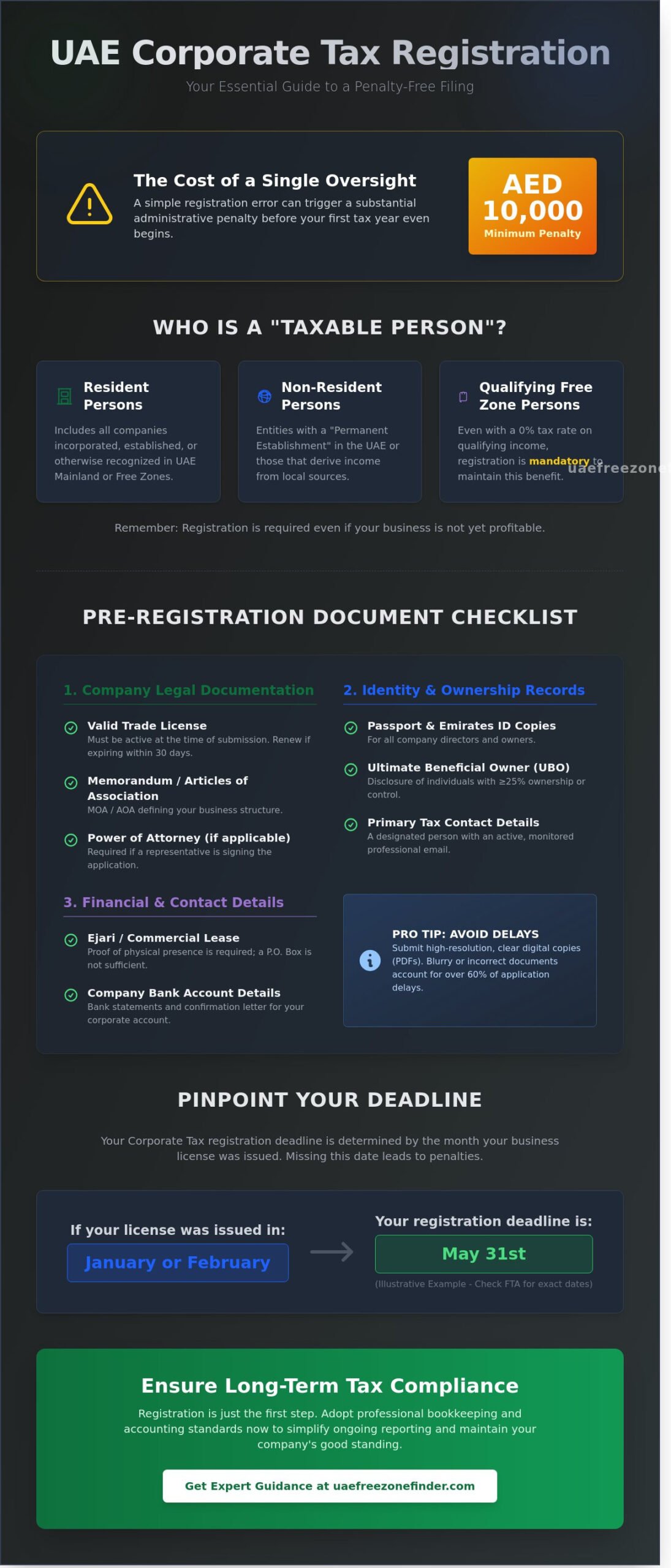
The law defines a “Taxable Person” as any entity or individual subject to tax. This includes Resident Persons, which covers companies incorporated in UAE Mainland or any of the various Free Zones. Non-Resident Persons are also included if they have a “Permanent Establishment” in the UAE or derive income from local sources. Branches of foreign companies are not exempt; they are typically treated as an extension of their parent company and must fulfill local tax obligations. Whether you’re a local LLC or a foreign branch, the requirement to register remains a top priority for your legal standing.
The Status of Free Zone Entities
Free Zones remain the backbone of international trade in the region. If your company meets specific criteria, you might qualify as a “Qualifying Free Zone Person” (QFZP). This status allows you to benefit from a 0% tax rate on qualifying income, which is a major draw for global investors. However, a 0% rate doesn’t mean zero responsibility. Every Free Zone entity must complete the corporate tax registration process regardless of whether they expect to pay tax or not. Corporate Tax Law No. 47 of 2022 serves as the foundation of this requirement. Failing to register, even as a QFZP, can result in the loss of your tax incentives and the imposition of fines starting from AED 10,000.
The Ultimate Pre-Registration Document Checklist
Preparing for your corporate tax registration isn’t just about ticking boxes; it’s about absolute precision. The Federal Tax Authority (FTA) is rigorous. If you submit blurry scans or expired licenses, you’ll likely face an immediate rejection. In fact, missing or incorrect documentation accounts for over 60% of application delays in the UAE. Before you log into the EmaraTax portal, ensure every file is a high-resolution digital copy. Clear, legible PDF uploads prevent the tedious back-and-forth that stalls your TRN issuance.
Company Legal Documentation
Check your Trade License first. It must be valid at the moment of submission. If it’s set to expire within the next 30 days, renew it before you begin the process. You’ll also need your Memorandum of Association (MOA) or Articles of Association (AOA). These documents define your business structure, whether you operate in a Free Zone or on the Mainland. If a representative is signing the application, a notarized Power of Attorney (POA) is mandatory. You can cross-reference these requirements with the Official UAE Government Tax Information to ensure you’re following the latest 2024 mandates.
Identity and Ownership Records
Transparency is a cornerstone of the UAE’s regulatory environment. You’ll need high-quality passport copies and Emirates IDs for all directors and owners. Under current Ultimate Beneficial Owner (UBO) regulations, you must disclose the individuals who hold at least 25% of the company’s shares or control. Don’t skip the contact details. You need a designated primary tax contact. This person handles all FTA communication, so use an active, professional email address that’s monitored daily.
Financial and Contact Details
The FTA requires proof of your physical presence. Have your Ejari or commercial lease agreement ready. A simple PO Box won’t suffice for corporate tax registration. On the financial front, you need your company’s bank account details, specifically the IBAN. This is essential for future tax dealings or potential refunds. Finally, verify your fiscal year-end date. While roughly 85% of UAE firms align with the 31st December, some follow a different cycle based on their MOA. If you’re feeling overwhelmed by the paperwork, it’s a good idea to seek expert matching to find the right consultant for your specific jurisdiction.
Navigating the EmaraTax Portal: A Step-by-Step Guide
The Federal Tax Authority (FTA) launched the EmaraTax platform on December 5, 2022, marking a major shift in how businesses handle their fiscal duties. This digital ecosystem replaced the older e-Services portal, unifying various tax types into one streamlined interface. It’s available 24/7, giving you the flexibility to manage your corporate tax registration whenever it fits your schedule. The portal is designed for efficiency, yet the technical requirements can be demanding. If the interface feels overwhelming, you can always rely on professional corporate tax registration services to handle the heavy lifting and ensure full compliance.
Creating and Verifying Your Account
To begin, you’ll need a valid email address and a UAE mobile number. The sign-up process is straightforward, but precision is key. If your business already pays VAT, you can link your existing profile to the new corporate tax section. This prevents you from having to enter the same data twice. Watch your inbox for a verification link; you won’t be able to proceed until you’ve clicked it to confirm your identity. For more context on the legal framework, the UAE Government Corporate Tax Information portal provides a detailed breakdown of how these digital systems integrate with national law.
Completing the Registration Form
Accuracy is vital when you reach the application stage. You’ll select your specific entity type, such as a Limited Liability Company (LLC), a Branch of a Foreign Company, or a Sole Establishment. You must input your trade license details exactly as they appear on the official document. Uploading the checklist items, like your Emirates ID and Articles of Association, is the next step. Before you hit submit, carefully review the declaration section. Even a small typo can lead to avoidable delays or a rejected application.
Post-Submission: Tracking Your Application
After you click submit, the system generates an Application Reference Number (ARN). Keep this number safe. It’s your primary tool for tracking the progress of your corporate tax registration. The FTA might reach out via email if they require “Additional Information” or clarification on your documents. Generally, you can expect to receive your Tax Registration Number (TRN) within 20 business days. This timeline can vary depending on the complexity of your corporate structure or the volume of applications the authority is processing.
Managing this process requires a steady hand. The EmaraTax portal is a powerful tool, but it rewards those who are prepared with the right documentation and a clear understanding of their legal obligations. Staying organized from day one is the best way to ensure your business remains in good standing with the FTA.
Managing Deadlines and Avoiding Non-Compliance Penalties
The biggest concern for business owners in the Emirates right now isn’t the tax rate itself; it’s the fear of missing the deadline. The Federal Tax Authority (FTA) has been very clear about the consequences of tardiness. If you miss your window, you’ll face an immediate administrative fine of AED 10,000. For an SME or a startup, this is a significant and unnecessary drain on capital that could be better spent on growth. Acting early is the only way to ensure you don’t get caught in a last-minute rush that leads to avoidable errors.
While the corporate tax registration process is relatively straightforward, the timing isn’t universal. The FTA uses a staggered approach, which means your specific deadline depends entirely on when your trade license was originally issued. Waiting until the final week of your window is a high-risk strategy. High portal traffic can lead to technical glitches, and if your documents are rejected for any reason, you won’t have time to resubmit before the penalty kicks in.
The 2026 Registration Timeline
The staggering logic is based on the month of your license issuance, regardless of the year. For instance, companies with licenses issued in January or February faced the earliest deadlines. If your license was issued later in the year, your window might still be open, but the clock is ticking. You can check your specific incorporation details by referring to our Free Zone Company Formation guide, which helps clarify how license dates impact your regulatory standing. Remember, even if you’re exempt from paying tax, you’re usually not exempt from the corporate tax registration requirement itself.
Common Pitfalls to Avoid
Many entrepreneurs stumble during the application because of small, technical oversights. Here are the most frequent errors we see in the field:
- Wrong Legal Category: Selecting “Individual” when you should be “Corporate” or vice versa will result in an immediate rejection.
- Poor Document Quality: The FTA portal uses automated scanning in many stages. Blurry mobile photos or expired trade licenses are the fastest ways to get your application flagged.
- Outdated Information: If you’ve changed your office address or your managing director recently, ensure your trade license reflects this before you start the tax process.
It’s also vital to understand that registration is a one-time event, but your profile must stay current. If your business undergoes a major change, such as a change in ownership or a shift in core activities, you’re required to update the FTA records. Keeping your data accurate is just as important as the initial filing. It’s about maintaining a transparent relationship with the authorities to prevent future audits from becoming a headache.
Beyond Registration: Ensuring Long-Term Tax Compliance
Successfully completing your corporate tax registration doesn’t mean your obligations are over. It’s actually the opposite. Obtaining your Tax Registration Number (TRN) is simply the first step in a long-term relationship with the Federal Tax Authority (FTA). You’re now part of a regulated system that demands accuracy and transparency. Think of registration as the foundation of a house; it’s essential, but you still need to maintain the structure to keep it standing. Registration is the prerequisite for your first tax return filing, and the quality of your data today determines the ease of your submission tomorrow.
Record Keeping Requirements
Under UAE law, specifically Article 52 of the Corporate Tax Law, businesses must maintain financial records for at least 7 years. This isn’t a suggestion. If the FTA conducts an audit, you’ll need to produce every invoice, bank statement, and ledger entry from that period. For Free Zone entities aiming for the 0% “Qualifying Income” rate, the stakes are higher. You’ll likely need audited financial statements to prove you meet all substance requirements. Using modern accounting software helps you track these details in real-time. It turns a massive year-end headache into a simple, automated process that protects your bottom line.
Professional Support and Consultation
The transition to a corporate tax regime is a significant shift for the UAE business community. Many firms now outsource their tax management to ensure they don’t miss deadlines or misinterpret complex rules. A dedicated PRO acts as a vital link between your company and the government. They handle the administrative heavy lifting so you can focus on scaling your operations across the Emirates. Having an expert eye on your books ensures you don’t fall victim to avoidable errors.
UAE Free Zone Finder stays by your side throughout your entire business lifecycle. We don’t just help you launch; we help you thrive within the legal framework. Compliance errors lead to hefty fines, such as the AED 10,000 penalty for late registration applications or even steeper costs for incorrect filings. Our team provides the steady hand you need in this complex environment. Don’t risk penalties; get expert assistance for your corporate tax registration and ensure your business remains in good standing from day one.
Master Your 2026 Compliance Strategy Today
Staying ahead of the UAE’s evolving tax landscape isn’t just about avoiding fines; it’s about building a sustainable foundation for your international business. You’ve seen the checklists and the portal steps, but remember that timing is everything. The Federal Tax Authority enforces strict deadlines, and missing your window for corporate tax registration can lead to administrative penalties starting from د.إ 10,000. Whether you’re operating in a Free Zone or on the Mainland, your documentation must be flawless to ensure a smooth approval process without unnecessary delays.
Since 2009, we’ve helped thousands of entrepreneurs navigate these complex regulatory waters. We don’t just provide information; we offer a steady hand to manage your residency and tax requirements without the stress. Our team ensures your business remains fully integrated with current regulations, giving you the freedom to focus on growth. We handle the technicalities so you can lead your company with total peace of mind.
Secure Your UAE Business Compliance Today
Your success in the Emirates is our priority, and we’re ready to help you thrive in this new era of transparency.
Frequently Asked Questions
Is corporate tax registration mandatory for all UAE businesses?
Yes, corporate tax registration is mandatory for nearly all legal entities in the Emirates, including mainland and free zone companies. Individuals who conduct business activities with an annual turnover exceeding AED 1 million must also register. Even if your business qualifies for a 0% tax rate or specific exemptions, you’re legally required to obtain a Tax Registration Number to remain compliant.
How much does it cost to register for corporate tax in the UAE?
It costs AED 0 to submit your application through the official EmaraTax portal. The Federal Tax Authority doesn’t charge a government fee for the registration process itself. If you decide to use a professional consultancy to handle the paperwork and ensure accuracy, you’ll only pay the service fees charged by that specific firm.
What is the deadline for corporate tax registration in 2026?
The deadline for corporate tax registration depends on the month your trade license was originally issued, with most existing businesses required to finish the process by late 2024 or 2025. By the time 2026 arrives, any newly incorporated company must complete its registration within three months of its date of formation. Missing these specific windows leads to immediate administrative penalties.
Can I register for corporate tax if I already have a VAT TRN?
You can and must register for corporate tax separately, even if you’re already registered for VAT. While you’ll use the same EmaraTax account to manage your profile, the two taxes are distinct legal obligations. You’ll need to submit a specific application for corporate tax to receive a unique Tax Registration Number that’s different from your VAT TRN.
What happens if I fail to register my company for corporate tax on time?
You’ll face a fixed administrative penalty of AED 10,000 if you fail to submit your corporate tax registration application within the timeframe set by the FTA. This fine was implemented under Cabinet Decision No. 75 of 2023 to encourage timely compliance. Delaying your registration can also lead to complications when you try to file your first tax return or claim specific reliefs.
Do Free Zone companies need to register for corporate tax?
Free Zone companies are strictly required to register for corporate tax regardless of their location or activity. To benefit from the 0% preferential tax rate available to Qualifying Free Zone Persons, you must first be registered with the FTA. Failing to register means you can’t access these tax incentives and might be subject to the standard 9% rate on all taxable income.
What documents are required for a branch of a foreign company?
A branch of a foreign company must provide its UAE trade license along with the parent company’s incorporation documents. You’ll also need the passport and Emirates ID of the authorized signatory, plus a formal Power of Attorney or Board Resolution. These documents verify the branch’s legal existence in the UAE and confirm who has the authority to sign tax declarations.
How long does the FTA take to process a tax registration application?
The FTA generally takes about 20 business days to review and process a corporate tax registration application. If your documents are complete and the information matches your trade license exactly, approval can happen much faster. You’ll receive a notification via email once your Tax Registration Number is active and your certificate is ready for download.
Disclaimer
The information provided in this article is intended for general informational purposes only and reflects conditions as understood at the time of publication. Free zone regulations, fees, and requirements in the UAE are subject to change. Readers are advised to verify details with the relevant free zone authority or regulatory body before making any business decisions. For personalised guidance, our business setup experts at UAE Free Zone Finder are available to assist — contact us at info@uaefreezonefinder.com or call +971-507864823.