Professional Company Liquidation Services in the UAE: A 2026 Strategic Guide
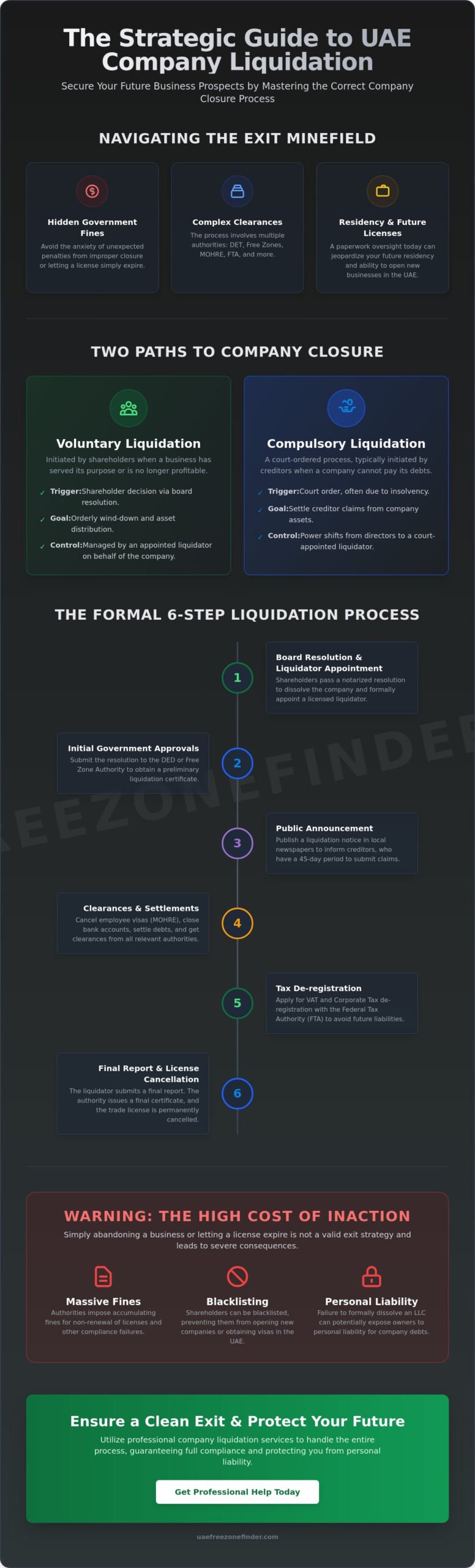
Closing a business in the UAE is actually the most critical step in launching your next one. You’ve likely spent months worrying about hidden government fines or the sheer complexity of obtaining clearances from the Department of Economy and Tourism and various free zone authorities. It’s frustrating to feel that your future residency or next trade license might be at risk because of a paperwork oversight today. We understand that the fear of VAT and Corporate Tax deregistration can make an exit feel like a minefield rather than a fresh start.
This strategic guide ensures you don’t fall into those traps by utilizing professional company liquidation services to secure a clean exit and full protection from personal liability. You’ll learn how to handle the 2026 regulatory landscape with the quiet confidence of an insider who knows exactly which pitfalls to avoid. We provide a step-by-step breakdown of the clearance process across multiple authorities, including the Federal Tax Authority, so your future UAE business licence eligibility is protected through properly documented clearances.
Key Takeaways
- Identify the critical differences between voluntary and compulsory paths to select the most efficient closure strategy for your specific entity.
- Understand how your jurisdiction—whether Mainland or Free Zone—and license type directly influence the legal requirements of the winding-up process.
- Learn how professional company liquidation services handle the heavy lifting of shareholder resolutions and visa cancellations to ensure you stay fully compliant.
- Recognize the severe financial and legal risks of letting a license expire, including the threat of massive fines and potential blacklisting by UAE authorities.
- Secure your future business prospects in the region by mastering the correct sequence for obtaining final government clearances and a clean exit.
Understanding Company Liquidation in the UAE
Liquidation is the formal process that brings a company’s legal existence to an end. It isn’t merely a matter of stopping trade or locking the office doors. In the UAE, it’s a rigorous legal procedure where a company’s assets are liquidated to settle outstanding debts and distribute any remaining surplus to shareholders. To understand the foundational concepts, it helps to look at What is Company Liquidation? and how it functions as a global standard for corporate dissolution. Within the Emirates, this process ensures that all local creditors, employees, and government entities receive their dues before the license is permanently struck off the register.
You’ll generally face two paths: voluntary or compulsory liquidation. Voluntary liquidation occurs when shareholders decide to close the business, usually because it has reached its natural end or is no longer profitable. Compulsory liquidation is a different matter entirely; it’s a court-ordered process often triggered by creditors when a company cannot meet its financial obligations. Even if your business has zero assets or liabilities, a formal “winding up” is mandatory. Leaving a company dormant without a legal closure leads to mounting fines, blacklisting by authorities, and potential legal hurdles for future ventures. Engaging professional company liquidation services helps you avoid these risks by managing the administrative burden from start to finish.
During this transition, the role of the liquidator is central. Once appointed, this individual or firm becomes the legal representative of the company. They take control of the assets, manage the “liquidation period” notice in local newspapers, and ensure all legal boxes are checked. It’s a position of high responsibility that shifts power away from the directors to ensure an unbiased closure.
The Legal Framework for Business Closure
The UAE Commercial Companies Law (Federal Decree-Law No. 32 of 2021) provides the primary legal basis for dissolving a legal entity. As we move through the 2026 regulatory environment, authorities have introduced more digitized and streamlined filing requirements to reduce the traditional 6 to 10-month timeline. The process begins with a formal board resolution. Shareholders must meet to pass this resolution, which then needs to be notarized by the Notary Public or the specific Free Zone Authority. This document is the official signal to the government that the business is entering its final phase.
Key Parties Involved in the Exit
Several government bodies oversee your exit to ensure compliance. You’ll first interact with the Department of Economic Development (DED) or your respective Free Zone Authority to obtain a preliminary liquidation certificate. Simultaneously, you must notify the Ministry of Human Resources and Emiratisation (MOHRE). It’s vital to cancel all employee visas and settle end-of-service benefits before the final closure can proceed. The licensed liquidator acts as the bridge between these departments, preparing the final report that confirms all liabilities are cleared. Using company liquidation services ensures that these interactions with the DED, MOHRE, and Customs are handled without delays, providing a clean break for the investor.
Choosing the Right Liquidation Path for Your Entity
Closing a business in the Emirates isn’t a one-size-fits-all procedure. The roadmap you follow depends entirely on where your license was issued and what activities you performed. The UAE’s commercial legal framework provides the necessary structure for these exits, ensuring that all stakeholders, from government bodies to private creditors, are treated fairly during the wind-down. You’ll find that a mainland LLC in Dubai follows a very different rhythm than a creative startup in a Northern Emirate free zone.
Your license type dictates the level of scrutiny you’ll face. Industrial licenses, for instance, often require extra clearances from environmental authorities or municipal waste management departments. Professional licenses, which are common for consultants, are usually faster to close because they rarely involve heavy machinery or large inventories. However, if you have a high employee count, the logistics of visa cancellations can become the most time-consuming part of the journey. Engaging professional company liquidation services early on helps you map out these dependencies so you don’t hit unexpected roadblocks in the final weeks.
Mainland Company Liquidation Requirements
Mainland entities operate under the direct oversight of the Department of Economy and Tourism (DET) or its equivalent in other Emirates. The process is highly transparent and public. You must start by coordinating with a notary public to legally appoint your liquidator. This triggers a mandatory 45-day notice period where you’re required to place advertisements in two local newspapers, one of which must be in Arabic. This gives creditors a fair window to raise claims. You won’t get your final cancellation certificate until you’ve secured clearances from customs, the municipality, and utility providers like DEWA or SEWA.
Free Zone Winding Up Procedures
Free zones offer a more centralized approach, but they’re equally rigorous. While some zones only require a 14-day or 15-day public notice, the internal checklists are detailed. For a Free Zone LLC or a branch office, you’ll need to provide a board resolution and a liquidator’s acceptance letter. A critical step that many founders overlook is the physical handover. You’ll need to return office keys, settle all outstanding service charges, and obtain a formal lease termination certificate from the zone’s authority. If you’re unsure which jurisdiction-specific rules apply to your setup, you can consult with an expert to verify the exact documents needed for your specific zone.
The complexity of your exit scales with your assets. If you’re liquidating an entity with significant physical stock or property, you’ll need a detailed valuation report. For smaller entities with zero assets and liabilities, some free zones offer a “summary winding up” which is much faster. It’s about finding the path that protects your reputation while minimizing the time spent on administrative tasks.
The Step-by-Step Process of Closing a UAE Entity
Winding down a business in the UAE isn’t as simple as turning off the lights. It’s a rigorous legal marathon that demands strict adherence to local regulations. If you don’t follow the sequence, you’ll face delays and mounting administrative fines. Most professional company liquidation services break this journey into five non-negotiable stages.
- Step 1: Shareholder Resolution and Liquidator Appointment. The process starts with a board meeting. Shareholders must pass a formal resolution to dissolve the company. For mainland entities, this document must be notarized by the Notary Public. You’ll also need to officially appoint a registered liquidator at this stage.
- Step 2: Cancellation of Visas and Labor Contracts. You can’t close a company while it still sponsors individuals. You must cancel all employee labor contracts and visas through the Ministry of Human Resources and Emiratisation (MoHRE) and the respective immigration authority.
- Step 3: Government and Utility Clearances. This is often the most time-consuming part. You need “No Objection Certificates” (NOCs) from the municipality, the electricity and water authority (like DEWA or ADDC), and the UAE Customs department if you hold an import/export code.
- Step 4: Public Notice and Claim Period. Once you receive the preliminary liquidation certificate, you must publish a notice in two local Arabic newspapers. This triggers a mandatory 45-day grace period where creditors can come forward with claims against the company.
- Step 5: Final Report and License Cancellation. After the 45 days pass without dispute, the liquidator submits a final report. You’ll then pay the final fees to the Department of Economy and Tourism (DET) or your specific Free Zone authority to receive the formal cancellation certificate.
Tax and Financial Deregistration
Tax compliance is the biggest hurdle for 2026 exits. You must apply for VAT deregistration within 20 business days of becoming eligible to avoid a AED 10,000 fine. It’s also vital to ensure all corporate tax registration obligations are finalized, as the Federal Tax Authority won’t clear an entity with pending filings. Finally, you’ll need to close the corporate bank account only after all payments are settled, ensuring you get a final closure statement for the liquidator’s records.
Employee and Visa Logistics
Managing your workforce is a sensitive legal priority. You’re required to settle all end-of-service gratuities according to UAE Labor Law No. 33 of 2021. Every employee must sign a settlement letter confirming they’ve received their full dues. For investors and partners, visa cancellation occurs after the company’s preliminary liquidation is approved. We’ve seen many founders struggle with this timing; it’s best to have a new sponsor or a transition plan ready to avoid overstay fines that can reach AED 50 per day. Utilizing expert company liquidation services ensures these transitions happen without legal friction.
The Hidden Risks of Improper Business Closure
Thinking you can just walk away from a failing venture is a dangerous gamble in the UAE’s 2026 regulatory environment. Many founders mistakenly believe that letting a license simply expire is a cost-free exit strategy. It isn’t. In reality, this triggers a cascade of automated penalties that don’t just disappear when you leave the country. For example, the Department of Economy and Tourism (DET) and various free zone authorities often levy monthly fines ranging from AED 200 to AED 2,000 for expired licenses. These debts accumulate indefinitely, often reaching six-figure sums before a shareholder even realizes they’re in trouble.
The Ministry of Interior and the Ministry of Human Resources and Emiratisation (MOHRE) maintain linked databases that track every business owner. If you abandon a company without formal closure, you’ll likely face an immediate “labor block.” This prevents you from hiring staff for any other entity or even renewing your own residency. Shareholders also face personal liability risks. If creditors prove that you neglected the legal wind-down process, UAE courts can pierce the corporate veil, making you personally responsible for the company’s debts. This administrative stain can even derail your eligibility for a Golden Visa or future 10-year residency permits.
Financial Penalties and Legal Hurdles
The Federal Tax Authority (FTA) is particularly vigilant about “silent” closures. If you stop filing VAT returns without formally deregistering, you’ll face a minimum penalty of AED 10,000 for late deregistration. Reopening a corporate bank account in the UAE after a messy exit is nearly impossible, as local banks share risk profiles through the Al Etihad Credit Bureau. Under UAE law, the statute of limitations for creditor claims generally extends to 15 years from the date the debt was incurred.
Reputational Damage in the UAE Market
A forced liquidation stays on your professional record for years. It complicates any future free zone company formation attempts, as compliance officers now conduct deeper background checks on serial entrepreneurs. You also risk losing your standing with utility giants like DEWA or telecom providers like Etisalat, who can block personal accounts due to linked corporate defaults. Engaging professional company liquidation services ensures every loose end is tied, protecting your future in the Emirates.
Don’t leave your professional future to chance; book a consultation with our liquidation experts today.
How Professional Liquidation Services Protect Your Future
Closing a business in the UAE involves much more than just locking the doors. It requires a meticulous unwinding of legal obligations that, if handled poorly, can haunt shareholders for years. Professional company liquidation services act as a buffer between your past liabilities and your future ventures. They ensure that every government clearance, from the Ministry of Human Resources and Emiratisation (MOHRE) to the Federal Tax Authority (FTA), is obtained in the precise order required by law.
Errors in the sequence of cancellations often lead to avoidable fines. For instance, canceling a trade license before de-registering for Corporate Tax can trigger penalties under Federal Decree-Law No. 47 of 2022. Expert liquidators manage this complex interplay, saving directors approximately 50 to 70 hours of administrative legwork. They handle the heavy lifting with government bodies and ensure the final liquidation report is legally robust. This document is your primary shield. It proves that all debts were settled and assets distributed according to the Commercial Companies Law, effectively protecting shareholders from personal liability.
Why Expertise Matters in the 2026 Regulatory Climate
By 2026, the UAE’s regulatory framework has become significantly more integrated. You can’t overlook the specific audit requirements that jurisdictions like DMCC or ADGM now enforce. A professional liquidator provides strategic advice on asset disposal, ensuring that debt settlement doesn’t violate anti-money laundering (AML) protocols. These experts understand the nuances of the 2026 tax landscape. They help you navigate final filings without attracting unnecessary scrutiny from the authorities. Utilizing specialized company liquidation services ensures that your VAT and Corporate Tax records are closed correctly, preventing the FTA from reopening files years down the line.
Next Steps for a Clean Exit
Starting the process early is the best way to avoid the stress of expiring visas or lease renewals. You should begin with a confidential consultation to assess your company’s current standing and potential hurdles. Before you reach out to a professional, gather these essential documents to speed up the timeline:
- Original Trade License and the Memorandum of Association (MOA)
- A formal Board Resolution stating the intent to dissolve the entity
- Power of Attorney for the appointed liquidator
- Final audited financial statements prepared by a UAE-registered auditor
- Evidence of canceled employee visas and work permits
Don’t leave your corporate legacy to chance. Contact UAE Free Zone Finder today for a tailored liquidation roadmap. We’ll match you with the right experts to ensure your exit is as calculated and professional as your market entry was. Our team provides step-by-step guidance to make the transition as clear and predictable as possible.
Secure Your Corporate Legacy and Move Forward with Confidence
Closing a UAE business is a significant legal undertaking that goes far beyond simple paperwork. You’ve got to secure clearances from multiple authorities like the Department of Economy and Tourism and the Federal Tax Authority to avoid lingering liabilities. A mistake in this phase can lead to substantial fines in AED or even travel bans for directors. It’s vital to treat your exit with the same strategic focus you gave your launch.
Utilizing professional company liquidation services ensures every regulatory box is checked. With practical UAE setup experience, UAE Free Zone Finder helps coordinate documentation, authority steps and post-setup requirements without promising official approvals. Our team takes over the end-to-end management of government clearances, protecting your future eligibility for visas and new trade licenses. We simplify the complex so you can focus on what comes next.
Get a Professional Liquidation Roadmap for Your Business
You’ve built something valuable, and you deserve an exit that reflects that success. Let’s work together to close this chapter correctly and open the door to your next big project.
Frequently Asked Questions
How long does it take to liquidate a company in the UAE?
It typically takes between 45 and 90 days to fully liquidate a company in the UAE. This timeline includes the mandatory 45 day public notice period required by the Department of Economy and Tourism or relevant Free Zone authorities. You’ll spend the first 14 days appointing a liquidator and the final weeks securing clearances from DEWA, Etisalat, and the Ministry of Human Resources and Emiratisation.
Can I close my company if I have outstanding debts or loans?
You can’t legally close your company until all outstanding debts and loans are settled or you’ve secured a formal No Objection Certificate from your creditors. During the 45 day notice period, creditors have the legal right to contest the liquidation. If the business is insolvent, you must follow the UAE Bankruptcy Law under Federal Decree-Law No. 51 of 2023 to manage liabilities without facing personal legal risks.
What happens to my residency visa when I liquidate my company?
Your residency visa must be cancelled before the final liquidation certificate is issued by the authorities. This requirement applies to all visas sponsored by the company, including those for employees and dependents. Once the cancellation is processed, you’ll have a 30 day grace period to either secure a new residency status, such as a Golden Visa, or exit the country to avoid overstay fines.
Is a professional audit report mandatory for every liquidation?
A professional audit report is mandatory for all Mainland companies and the majority of Free Zone entities during the closure process. This report, prepared by a UAE-registered auditor, confirms that the company has no remaining assets or liabilities. Our company liquidation services ensure your final financial statements comply with the 2025 Corporate Tax regulations to prevent any last-minute administrative penalties.
How much do company liquidation services cost in the UAE?
Government fees for the initial dissolution stage in Dubai start at approximately AED 2,000. You also need to account for newspaper advertisement costs, which usually range from AED 500 to AED 1,000, plus the professional fees of the appointed liquidator. Total costs for most small to medium enterprises generally fall between AED 6,000 and AED 15,000 depending on the specific jurisdiction and complexity of the file.
What is the difference between deregistration and liquidation?
Liquidation is the formal process of winding up a company’s affairs, which includes selling assets and paying off creditors. Deregistration is simply the final administrative step where the authority removes the company’s name from the commercial register. You can’t reach the deregistration stage until the liquidator submits the final report and the 45 day notice period expires without any legal claims.
Can I liquidate a company remotely if I am outside the UAE?
You can liquidate your company remotely by granting a Power of Attorney (POA) to a legal representative in the UAE. If you’re currently abroad, this POA must be attested by the UAE Embassy in your country and the Ministry of Foreign Affairs locally. Our company liquidation services allow us to act on your behalf to close bank accounts and cancel licenses so you don’t have to travel to Dubai.
Do I need to publish a notice in the newspaper for Free Zone closures?
Most major Free Zones, such as DMCC and JAFZA, require a public notice to be published in one Arabic and one English newspaper. This notice must run for a specific period, usually 45 days, to alert potential creditors of the company’s intent to close. Skipping this step is not an option, as the Free Zone authority won’t issue the final closure letter without proof of these publications.
Disclaimer
The information provided in this article is intended for general informational purposes only and reflects conditions as understood at the time of publication. Free zone regulations, fees, and requirements in the UAE are subject to change. Readers are advised to verify details with the relevant free zone authority or regulatory body before making any business decisions. For personalised guidance, our business setup experts at UAE Free Zone Finder are available to assist — contact us at info@uaefreezonefinder.com or call +971-507864823.