UAE Company Liquidation Process: A Complete 2026 Compliance Guide
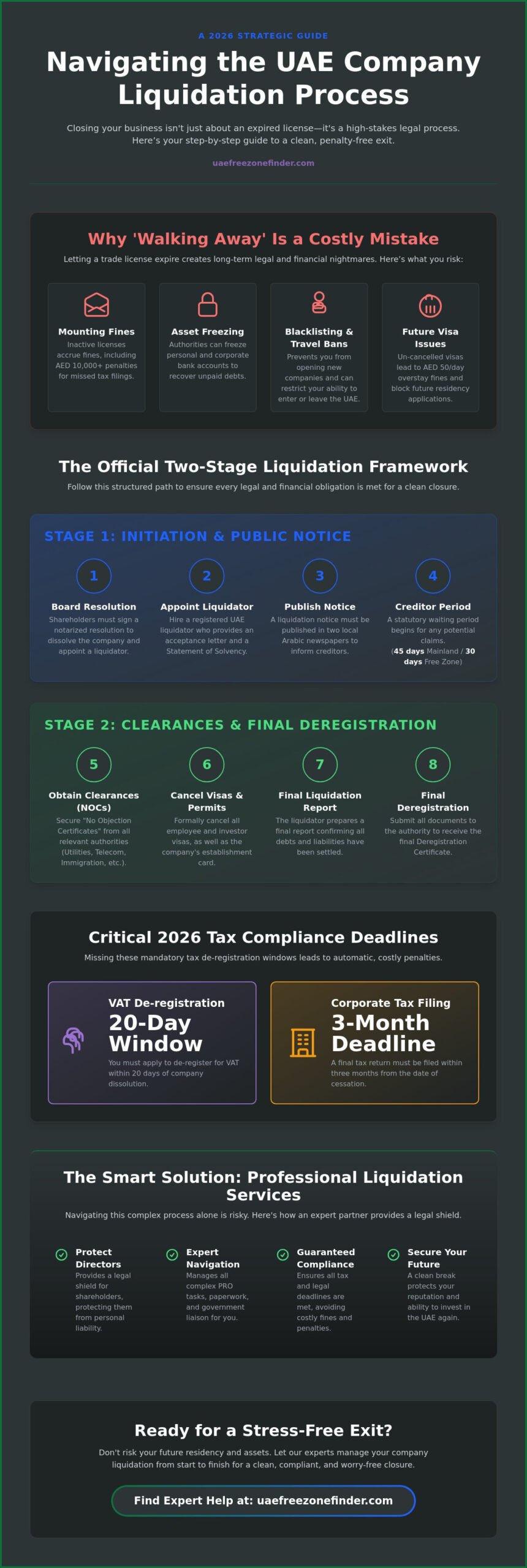
In 2026, closing a business in the UAE isn’t just about handing back a trade license; it’s a high-stakes tax audit in disguise. You’ve likely heard the warnings about founders facing AED 10,000 penalties for missing a single filing window. It’s natural to feel uneasy about the uae company liquidation process, especially when your future residency and investment rights are on the line. You want a clean exit that preserves your professional reputation and your ability to return to the local market whenever you choose.
We understand that the bureaucracy often feels like a confusing maze of visa cancellations and bank closures. This guide provides the strategic clarity you need to master the latest legal requirements without the stress of hidden fines. We’ll walk you through the mandatory 20-day VAT de-registration window, the three-month Corporate Tax filing deadline, and the step-by-step path to securing final clearance certificates from every relevant authority. By the end of this article, you’ll know exactly how to protect your assets and ensure your next global venture starts on perfectly solid ground.
Key Takeaways
- Understand why letting your trade license expire creates long-term legal risks and why a formal winding-up is the only way to protect your future re-entry rights.
- Master the two-stage framework of the uae company liquidation process, beginning with a notarized Board Resolution and ending with your final deregistration.
- Identify how your company’s jurisdiction—whether mainland or free zone—dictates your specific closure path and the required government clearances.
- Stay compliant with 2026 tax regulations by learning the mandatory timelines for Corporate Tax and VAT deregistration to avoid costly administrative fines.
- Discover how professional liquidation support provides a legal shield for directors while handling all necessary PRO tasks for a clean break.
Understanding UAE Company Liquidation: More Than Just Stopping Operations
Closing a business in the Emirates is a high-stakes legal transition. It isn’t as simple as stopping your operations or letting your trade license expire. Many entrepreneurs mistakenly believe that if they stop paying renewal fees, the company just disappears. In reality, an inactive license continues to accrue administrative fines, and the legal entity remains “live” in government databases. Formal liquidation is the only way to officially strike the company’s name from the register and relof shareholders from ongoing liabilities.
Think of this process as the legal “death” of your corporate entity. By following the uae company liquidation process, you ensure that all creditors are notified, employees are settled, and tax obligations are finalized. Understanding Company Liquidation as a global standard helps clarify why the UAE authorities are so meticulous; they want to ensure no “zombie” companies are left behind to complicate the financial ecosystem. Only a formal closure provides the “Clean Bill of Health” needed to move on to your next venture without baggage.
Voluntary vs. Compulsory Liquidation
Most business owners will undergo Voluntary Liquidation. This happens when shareholders decide the company has served its purpose or it’s time to restructure. It’s a proactive choice that requires a notarized Board Resolution to begin. On the other hand, Compulsory Liquidation is a court-ordered process, usually triggered by insolvency or a failure to meet legal obligations. While the courts lead the way for insolvent firms, this guide focuses on the standard voluntary path for active businesses. Choosing the voluntary route allows you to maintain control over the timeline and protect your professional reputation.
The Legal Consequences of Improper Closure
Walking away without a formal winding-up is a recipe for long-term disaster. The UAE has highly integrated regulatory systems in 2026. If you leave behind unpaid utility bills, office rent, or government fees, you risk being “blacklisted” by authorities. This doesn’t just stop you from opening a new company; it can lead to immediate travel bans and the freezing of personal assets.
The impact on your resident visa uae is equally severe. If visas aren’t cancelled through the proper channels during the uae company liquidation process, they remain active in the system. This creates overstay fines of AED 50 per day and can prevent you from obtaining a new visa in the future. A clean legal exit isn’t just about the business; it’s about safeguarding your right to live and work in the UAE for years to come.
The Step-by-Step UAE Company Liquidation Process in 2026
The uae company liquidation process follows a strict, two-stage framework to ensure every legal loose end is tied. It doesn’t start in a boardroom; it starts at the Notary Public. Shareholders must sign a Board Resolution to dissolve the company and appoint a liquidator. This document is the foundation of the entire procedure. Without that official notary stamp, the registry won’t even look at your application. It’s the first signal to the government that you’re initiating a controlled and transparent exit.
Stage 1: Appointment and Public Notice
Once you have your resolution, you must hire a registered UAE liquidator. They’ll provide an official acceptance letter. A vital piece of the puzzle that many miss is the “Liquidator Statement of Solvency.” This document is a formal declaration that the company has enough assets to cover its debts. It’s a protection for both the state and the creditors. Following the appointment, you’ll need to publish a liquidation notice in two local Arabic newspapers. This triggers a statutory waiting period, usually 45 days for mainland companies and 30 days for many free zones, allowing creditors to raise claims. If you’re feeling overwhelmed by the paperwork, our company liquidation services can manage these filings for you.
Stage 2: Clearances and Final Filing
The second stage is where most entrepreneurs hit a wall. You can’t just close the file; you need “No Objection Certificates” (NOCs) from several government departments. This includes Customs, the local utility provider, and telecommunications companies. You also need to prove to the Ministry of Human Resources and Emiratisation (MOHRE) that every employee has been paid and their work permits are cancelled. This phase is often the most time-consuming due to the manual coordination required between different bureaus.
After securing these clearances, the liquidator submits a “Final Liquidator Report.” This summarizes the asset distribution and confirms that the company is ready for its final exit. Following the official government process ensures that you don’t leave any lingering liabilities behind. Once the Licensing Authority reviews the final file, they issue the “Certificate of Dissolution.” This document is your ultimate legal shield, proving the entity no longer exists and you’re free from its corporate obligations.
Jurisdictional Differences: Mainland vs. Free Zone Liquidation
The core logic of the uae company liquidation process remains consistent across the Emirates, but the administrative “Authority” you answer to changes everything. If you’re on the mainland, you’re dealing with the Department of Economy and Tourism (DET) or the equivalent in your specific Emirate. If you’re in a free zone, your primary contact is the specific Free Zone Authority (FZA). This distinction dictates your timeline, your total costs, and even which liquidator you’re allowed to hire. Understanding these jurisdictional boundaries is the first step toward a predictable exit strategy.
Mainland Closure Nuances
For mainland Limited Liability Companies (LLCs), the Ministry of Economy plays a background role in ensuring compliance with the Commercial Companies Law. One strict requirement is that your chosen liquidator must be registered specifically with the mainland authorities; you can’t simply pick any auditor. You’ll also need to provide a lease cancellation certificate from your landlord. This document proves you’ve officially vacated the physical office space required for mainland licenses. The statutory notice period for mainland entities is a non-negotiable 45 days, which provides creditors a longer window to come forward compared to most free zones.
Free Zone Specific Requirements
Entrepreneurs who initially chose free zone company formation often enjoy a faster closure path. Many jurisdictions, such as DMCC or IFZA, have streamlined digital portals that allow for faster document submission. Some zones even offer “Summary De-registration” for companies that have no assets or liabilities, which can significantly cut down on processing time. However, don’t expect a total shortcut. You’ll still need to return original share certificates and the physical trade license to the authority. The notice period in these zones is typically shorter, often only 30 days, which helps speed up the final dissolution.
Offshore entities follow the simplest path of all. These companies often only require a shareholder resolution and a final audit report without the extensive public notice requirements of their mainland counterparts. It’s also vital to account for varying de-registration fees. While mainland fees are relatively standardized across the DET, free zone costs can vary by thousands of Dirhams depending on the specific jurisdiction’s tariff. Getting these details right early on prevents budget surprises during what is already a complex transition. Whether you’re navigating a mainland exit or a free zone winding-up, the key is matching your steps to the specific regulations of your registry.
Managing Compliance: Visas, VAT, and the 2026 Corporate Tax Impact
Compliance is the stage where most founders feel the most pressure. It’s the most sensitive part of the uae company liquidation process because it directly impacts your personal residency and your financial standing with the state. In 2026, the Federal Tax Authority (FTA) and immigration departments are more integrated than ever. You can’t simply walk away from a business; you must systematically untangle your tax and residency ties to avoid being flagged in government systems. Failing to do so doesn’t just end the business; it can prevent you from ever opening another one.
Visa Cancellation and Transition
A primary concern for many entrepreneurs is their legal status. You must cancel all employee and investor visas before the trade license is officially revoked. There’s a strict order of operations here. If you’ve sponsored family members, you have to cancel their visas first. It’s a common mistake to try and cancel the sponsor’s visa while dependents are still active, which leads to immediate rejections. Once the cancellation is processed, you’ll typically enter a grace period. While this period is usually between 10 and 30 days depending on the specific Emirate, you shouldn’t treat it as a vacation. Overstay fines now sit at AED 50 per day, and these accumulate quickly if your transition to a new visa or a Golden Visa isn’t handled with precision.
Banking and VAT Deregistration
Closing your business involves essentially reversing the work done during corporate bank account opening assistance. You’ll need to settle every outstanding debt to obtain a “No Liability” letter from your bank. This document is a mandatory requirement for the liquidator’s final report. Keep in mind that you should only close the account after you’ve received your final utility clearances, as you’ll need a way to pay those last bills.
Tax compliance is the area with the highest risk of “hidden” penalties. You’re required to file for VAT deregistration within 20 business days of stopping your taxable activity. For Corporate Tax, the 2026 regulations require you to deregister within 3 months of the company’s cessation. If you miss these windows, the FTA can levy an automatic AED 10,000 penalty. You’ll also need to prepare for a potential “Final Return” audit. The FTA wants to ensure all assets sold during the uae company liquidation process were taxed correctly. Only after these filings are accepted will you receive a Tax Clearance Certificate, which is the final green light for license cancellation.
If you’re concerned about navigating these tight filing windows, our expert team can manage your Company Liquidation Services to ensure a smooth, penalty-free exit.
Why Professional Liquidation Services Are Essential for Your Future
Attempting to DIY the uae company liquidation process is a gamble that rarely pays off for international investors. The regulatory shifts of 2026 have turned what was once a standard administrative task into a complex legal and tax maneuver. Without a professional at the helm, you’re not just closing a business; you’re leaving your personal reputation and future residency rights exposed to bureaucratic errors. Engaging a local expert provides the quiet confidence that every box is ticked and every liability is extinguished.
A professional liquidator acts as a vital bridge between your company and the UAE’s regulatory bodies. They don’t just file paperwork; they provide strategic direction that ensures your exit is as efficient as your entry was. By handling the heavy lifting of government liaison through dedicated PRO services, they allow you to focus on your next global expansion rather than getting bogged down in utility clearances and labor settlements.
Mitigating Personal Liability
The most significant benefit of hiring a professional is the legal shield it provides for directors and shareholders. The liquidator’s primary output is the “Liquidator’s Report,” a formal document that validates you’ve acted in good faith. This report is your primary defense against future claims from creditors or former employees. If someone attempts to raise a financial dispute years down the line, this certified report proves that the uae company liquidation process was conducted transparently and all assets were distributed legally. It effectively closes the door on personal liability, ensuring the company’s debts don’t follow you into your personal life.
Ensuring a Seamless Exit
Time is a critical factor when you’re managing a corporate wind-up. Professional Company Liquidation Services prevent the standard 45-day notice period from stretching into a six-month ordeal due to minor clerical mistakes. Having a single point of contact for all government clearances—from Customs to the Federal Tax Authority—removes the stress of navigating multiple portals and physical offices. Expert guidance is also essential for the final tax filings. One error in your Corporate Tax deregistration can trigger substantial penalties that persist even after the license is gone.
A clean exit today is the foundation for your next UAE venture tomorrow. The Emirates remains a land of massive opportunity, and you don’t want a “zombie” company or an unresolved tax fine to block your re-entry. By investing in professional support now, you’re protecting your right to return to this market whenever the next big idea strikes. It’s about finishing well so you can start again with total peace of mind.
Secure Your Professional Legacy in the UAE
Closing your business is just as strategic as opening one. You’ve seen how a formal exit is the only way to safeguard your future and avoid the heavy penalties linked to 2026 tax regulations. Whether you’re navigating the 45-day notice period on the mainland or a streamlined free zone closure, precision is your best defense against blacklisting or travel bans. It’s about ensuring that your corporate history doesn’t become a personal liability.
Mastering the uae company liquidation process requires a deep understanding of the current regulatory shift. You don’t have to manage the complex coordination of visa cancellations, bank closures, and FTA filings alone. Our team provides access to an authorized UAE liquidator network and expert corporate tax and VAT compliance support to ensure your exit is handled with total accuracy. We manage the full visa and bank account closure details so you can walk away with a clean legal record.
Get expert assistance with your UAE company liquidation today and ensure your next venture starts on a foundation of perfect compliance. Your journey in the Emirates is far from over; let’s make sure this chapter ends on your terms.
Frequently Asked Questions
How long does the company liquidation process take in the UAE?
The company liquidation process in the UAE generally takes between 3 to 12 months to complete. This timeline depends heavily on how quickly you secure clearances from utility providers and the Federal Tax Authority. Mainland companies usually face a longer path due to the mandatory 45-day newspaper notice period, while some free zones can process the final de-registration faster if all documents are in order.
Can I liquidate my UAE company if I have outstanding debts?
You cannot finalize a voluntary liquidation if the company has outstanding debts that haven’t been settled. The liquidator must issue a statement of solvency or confirm that all creditors have been paid in full. If the company is insolvent and cannot pay its debts, you’ll need to follow a court-led compulsory uae company liquidation process rather than the standard voluntary path discussed in this guide.
Do I need to be physically present in the UAE to liquidate my company?
You don’t necessarily need to be physically present in the UAE to liquidate your company if you’ve appointed a legal representative. By granting a Power of Attorney (POA) to a professional service provider, they can handle the notarization of resolutions and the submission of documents to the registry. However, some banks may still require the authorized signatory to be present for the final account closure.
What is the penalty for not de-registering for Corporate Tax in 2026?
The penalty for failing to deregister for Corporate Tax within the mandatory three-month window is AED 10,000. In 2026, the Federal Tax Authority enforces this strictly to ensure the tax registry remains accurate. It’s vital to file your final tax return and apply for de-registration as soon as the liquidator is appointed to avoid this automatic administrative fine and ensure a clean legal exit.
Can I keep my UAE residency visa after my company is liquidated?
You cannot keep a residency visa that’s sponsored by a company being liquidated. All investor and employee visas must be cancelled before the trade license is officially revoked. Once the cancellation is complete, you’ll have a grace period to either exit the country or transition to a new visa status, such as a Golden Visa or a residency visa under a new corporate entity.
What happens to the company bank account during the liquidation process?
The company bank account must remain active until you’ve settled all final utility bills and government fees. Once you’ve obtained your “No Liability” letters and final clearances, the liquidator will oversee the closure of the account. Any remaining funds are then distributed to the shareholders according to the final liquidator’s report before the license is officially struck from the register.
Is a public newspaper notice mandatory for all Free Zone liquidations?
A public newspaper notice is mandatory for all mainland companies, but requirements vary among free zones. While many free zones still require a 30-day notice in local Arabic newspapers, some modern jurisdictions have replaced this with a digital notice on their official portal. You should check the specific regulations of your free zone to see if a physical advertisement is still a requirement for closure.
What documents are required to start the liquidation process?
To start the uae company liquidation process, you’ll need a notarized Board Resolution signed by all shareholders. You also need an official appointment letter from a registered UAE liquidator and original copies of your trade license and share certificates. As the process moves forward, you’ll be required to submit “No Objection Certificates” from various government departments and a final liquidator’s report summarizing the asset distribution.
Disclaimer
The information provided in this article is intended for general informational purposes only and reflects conditions as understood at the time of publication. Free zone regulations, fees, and requirements in the UAE are subject to change. Readers are advised to verify details with the relevant free zone authority or regulatory body before making any business decisions. For personalised guidance, our business setup experts at UAE Free Zone Finder are available to assist — contact us at info@uaefreezonefinder.com or call +971-507864823.