Dubai Mainland Business Setup (DET): The 2026 Strategic Investor Guide
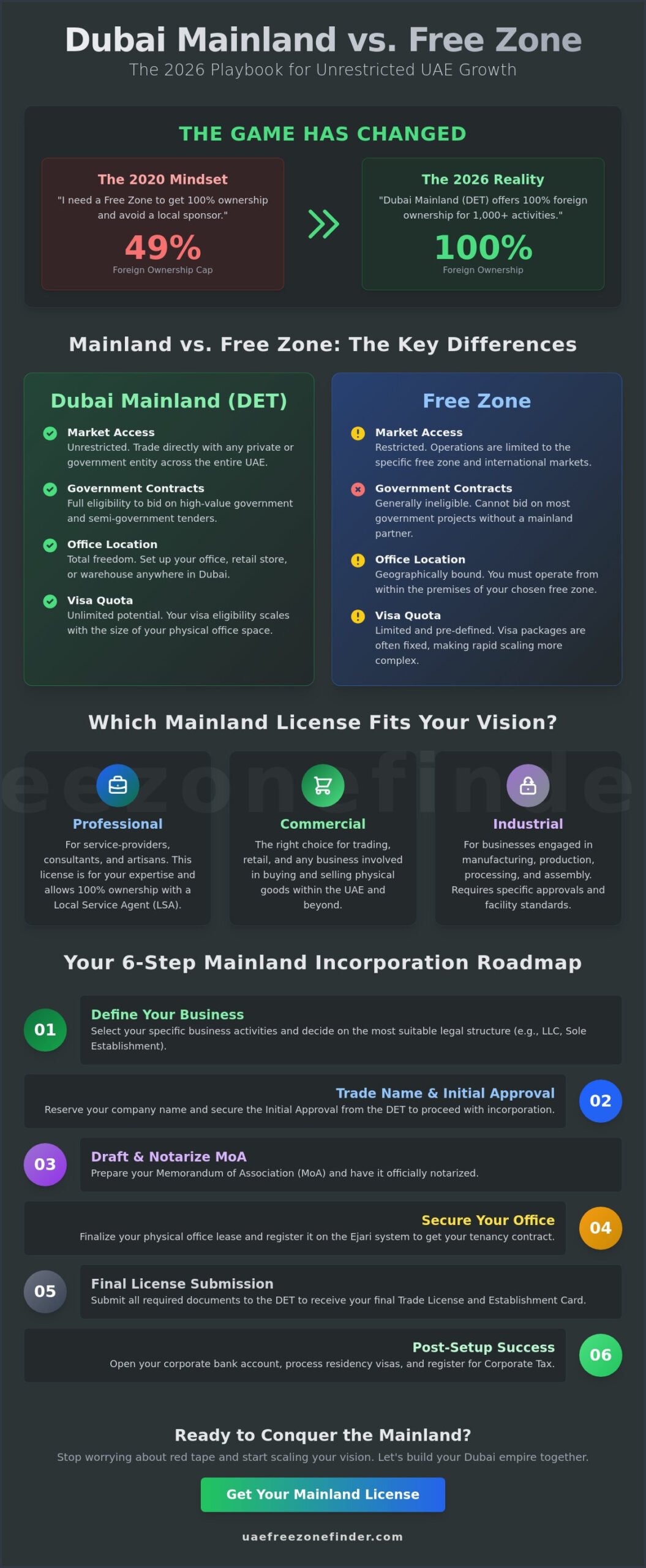
Choosing a free zone because you’re afraid of losing control of your company is a 2020 mindset that could be costing you massive government contracts and local trade opportunities today. The reality in 2026 is that a Dubai Mainland Business Setup (DET) now offers 100% foreign ownership for most activities, making the old local sponsor requirement a thing of the past for the vast majority of entrepreneurs. It’s understandable if you feel a bit overwhelmed by the shifting rules. Between finding the right office space to satisfy DET inspectors and the anxiety of trying to open a corporate bank account in a high-compliance environment, the process can feel like a mountain to climb.
I’m here to tell you that it doesn’t have to be a struggle. This guide will help you master the complexities of mainland licensing and position your business for unrestricted growth across the entire UAE. You’ll learn how to handle the 9% corporate tax threshold, secure your physical premises without overspending, and move through the incorporation process with the confidence of a local insider. We’re going to break down every step, from trade name reservation to residency visas, so you can stop worrying about red tape and start scaling your vision.
Key Takeaways
- Understand how the shift to 100% foreign ownership makes a Dubai Mainland Business Setup (DET) the most strategic choice for international investors in 2026.
- Learn to distinguish between professional, commercial, and industrial licenses so your business activities are perfectly aligned with local regulations.
- Master the incorporation journey, including how to handle trade name reservations and the notarization of your Memorandum of Association.
- Get a clear roadmap for post-setup success, covering everything from corporate bank account opening to managing your new tax obligations.
What Is Dubai Mainland Business Setup (DET)?
A mainland company is an onshore business entity that’s registered directly with the Department of Economy and Tourism (DET). Unlike free zone companies that are restricted to specific geographical enclaves, a mainland license allows you to trade anywhere in the UAE and across international borders. It’s the gold standard for entrepreneurs who want zero geographical boundaries for their operations. The most significant shift in this landscape occurred in June 2021. This was a landmark moment for Dubai’s economic diversification, as the government officially allowed 100% foreign ownership for more than 1,000 commercial and industrial activities. This effectively ended the requirement for a local Emirati partner to hold a 51% stake in the majority of business types.
When you opt for a Dubai Mainland Business Setup (DET), you’re choosing a structure built for the local market. If your business model involves retail shops, construction projects, or bidding on government contracts, the mainland is your only real path forward. The DET acts as your primary regulator, managing everything from your initial trade name reservation to the final issuance of your license. They’ve streamlined the process through the “Invest in Dubai” portal, making the bureaucratic side of things much faster than it was just a few years ago. It’s a transparent system designed to foster growth and attract global talent.
The Core Advantages of Going Mainland
The biggest draw of the mainland is the ability to trade with any private or government entity in the UAE without a middleman. You aren’t restricted to a specific zone; you can set up your office anywhere in Dubai that suits your brand. You can also bid for high value government tenders, which is a massive revenue stream for many industrial and service firms. Additionally, your license allows you to apply for an unlimited number of residency visas, provided your office space is large enough to accommodate the headcount. This flexibility is vital for businesses planning to scale their workforce rapidly.
Mainland vs. Free Zone: Making the Choice
The choice usually comes down to where your customers are located. If you’re a logistics firm focused on tax-free import and export, a free zone might be your best bet. However, if you’re a service provider or consultant targeting clients in the heart of the city, the mainland is better. You won’t face the “fences” that sometimes limit free zone entities when they try to operate on the “outside.” You can check out our free zone company formation guide for a side by side comparison to see which jurisdiction fits your 2026 strategy.
Selecting Your License Type and Activity
Don’t treat your business activity selection as a mere administrative formality. It’s the most critical decision in your Dubai Mainland Business Setup (DET) journey. If you get this wrong, you might find yourself blocked from specific contracts or facing unexpected hurdles when trying to open your bank account. The DET offers a massive catalog of over 2,000 activities. While the choice is broad, your selection dictates your legal structure and whether you need additional permissions from government bodies. It’s about finding the perfect fit between what you do today and where you want to be in five years.
One of the most significant upgrades for 2026 investors is the Dubai Unified License (DUL). This digital initiative assigns a unique QR code to your business, acting as a single point of truth for all government departments. It eliminates the need to carry stacks of paper for every interaction. According to the UAE official business setup guidance, these digital advancements have placed the UAE among the top global leaders for business setup efficiency. The DUL makes your compliance status transparent and instantly verifiable, which is a massive win for efficiency.
Professional vs. Commercial Licenses
Professional licenses are designed for service providers, consultants, and artisans. Think of it as a license for your expertise. In this setup, you retain 100% ownership, though you’ll typically appoint a Local Service Agent (LSA) to handle administrative liaisons. Commercial licenses, on the other hand, cover trading and retail activities. This is the path for those moving physical goods. If you’re looking at large-scale manufacturing, an Industrial license is required. Each of these carries different requirements for office space and physical inspections, so clarity is key.
The Role of External Approvals
Not all licenses are issued by the DET alone. If you’re starting a school, you’ll need the KHDA’s blessing. A medical clinic requires DHA approval, and a logistics firm will spend time with the RTA. These external approvals can add weeks to your launch timeline if you don’t plan for them. It’s also common for entrepreneurs to accidentally pick conflicting activities, like trying to combine heavy manufacturing with high-end consulting on the same license. This is where getting expert help for your mainland company formation pays off, as it ensures your activity list is clean and compliant from day one.
Legal Structures and the 100% Ownership Rule
The headline news for 2026 remains the same. You don’t need a local partner to hold the majority of your shares anymore. While we touched on this earlier, it’s vital to understand how this rule interacts with your chosen legal structure. For over 1,000 commercial and industrial activities, the 100% ownership rule is the standard for any Dubai Mainland Business Setup (DET). However, choosing the right legal “container” for those shares is what determines your personal liability and your ability to scale. Whether you’re a solo consultant or a growing trading firm, your legal structure is your first line of defense in a foreign market.
Most investors find themselves choosing between a Limited Liability Company (LLC), a Sole Establishment, or a Civil Company. If you’re a professional, such as a doctor, lawyer, or engineer, a Sole Establishment or Civil Company might feel like a natural fit. These structures allow you to practice your craft under your own name or with partners. But for those moving products or managing larger teams, the LLC is almost always the superior choice. It provides a clear separation between your business obligations and your personal wealth, which is a non-negotiable for most sophisticated investors.
The Limited Liability Company (LLC) Breakdown
The LLC is the powerhouse of the Dubai economy. It’s flexible, allowing for a minimum of one shareholder and a maximum of 50. This means you can start as a solo founder and bring on partners as you grow. The primary draw is liability protection. Your personal assets are shielded from business debts, meaning your risk is limited to the capital you’ve invested in the company. In 2026, 100% of the profits and 100% of the management control stay with you, the foreign investor. It’s a clean, modern structure that banks and government entities recognize and trust.
Understanding the Local Service Agent (LSA)
If you’re opting for a professional license, you’ll still need to appoint a Local Service Agent (LSA). It’s a point of confusion for many, but here’s the reality: the LSA has zero ownership in your company. Their role is strictly an administrative liaison. They help with government departments, labor permits, and visa applications. They don’t take a cut of your profits or have a say in your board meetings. We help you find a reliable LSA and draft a robust agreement to ensure your management rights are fully protected. Our mainland company formation services focus on making this relationship transparent and hassle-free, so you can focus on your business while we handle the bureaucratic heavy lifting.
The Step-by-Step Mainland Incorporation Process
Getting your business off the ground isn’t just about obtaining a piece of paper; it’s about building a legal foundation that stands up to scrutiny. The Dubai Mainland Business Setup (DET) process has become significantly more digital and efficient, but it still requires a methodical approach to ensure you don’t hit expensive roadblocks. You aren’t just registering a name; you’re entering a regulated ecosystem that rewards precision and compliance. From the moment you pick your trade name to the day you hold your physical license, each step must be handled with the quiet confidence of someone who knows the system inside out.
Trade Name Reservation and Initial Approval
Your first move is to reserve a trade name that reflects your brand while staying within DET guidelines. You’ll need to avoid terms that reference religions, political groups, or sensitive global organizations. Names shouldn’t be similar to existing brands to avoid trademark conflicts. Once the DET approves your name, you’ll receive your Initial Approval. Initial approval allows you to start your office search. This document is essentially a green light from the government, signaling that they’ve reviewed your business activity and found no immediate issues with your proposal. It’s a vital milestone that moves you from the planning phase into the execution phase.
The Physical Office Requirement
Unlike some free zones that offer virtual desk options, a mainland license requires a physical footprint. You’ll need a tenancy contract registered through Ejari, which is the government’s mandatory online portal for rental agreements. This isn’t a step you can skip. The size of your office is particularly important because it directly dictates your total visa quota. Typically, the authorities look for a specific amount of square footage per employee. If you plan to scale your team quickly, you’ll need to secure a space that can accommodate that growth from the start. While we don’t lease office space directly, we guide you through the compliance requirements to ensure your chosen premises meet DET standards.
After your office is secured and your Ejari is in hand, you’ll move to drafting and notarizing your Memorandum of Association (MOA). This legal document defines the shareholding structure and operational rules of your company. In 2026, this is mostly handled through digital notarization, which means you don’t have to spend hours waiting at a notary public’s office. Once the MOA is signed, you’ll submit the final application, pay the license fees, and collect your corporate documents. If you want to bypass the administrative stress, our team is ready to manage your mainland company formation from start to finish, ensuring every document is perfect before it hits the regulator’s desk.
Post-Setup Success: Banking, Visas, and Taxes
Getting your trade license is a major win, but it’s not the finish line. To truly operationalize your Dubai Mainland Business Setup (DET), you need to clear the hurdles of banking, residency, and tax compliance. This is where many investors stumble because they underestimate the complexity of local regulations. It’s about moving from a legal entity on paper to a functional business with a heartbeat. You’ve built the foundation; now you have to make sure the walls are solid and the doors are open for trade.
Corporate Banking Mastery
Opening a corporate bank account is often cited as the most challenging part of the setup journey. UAE banks have strict “Know Your Customer” (KYC) protocols and are highly selective about the businesses they onboard. To succeed, you need a comprehensive “Business Profile” that outlines your professional experience, expected turnover, and key suppliers. Rejections often happen because of a lack of a clear physical presence or a vague business model that triggers high-risk alerts. If you’re feeling stuck, our corporate bank account opening assistance can help you navigate these high-compliance waters with much better odds. We know what the compliance officers are looking for and how to present your case effectively.
Residency Visas and Compliance
Once your license is active, you can begin processing visas through the DET portal. This involves three main steps: obtaining an entry permit, completing a medical fitness test, and finally, getting your Emirates ID. It’s a methodical process that requires precision in documentation. For a deeper dive into the specifics of the resident visa uae, check out our dedicated guide. Beyond visas, don’t forget your mandatory Anti-Money Laundering (AML) and Economic Substance Regulation (ESR) filings. Missing these deadlines can lead to heavy fines that eat into your initial capital. These aren’t optional; they’re the price of doing business in a globally respected jurisdiction.
Compliance in 2026 also means staying on top of your tax game. You must register for the 9% corporate tax if your taxable income exceeds AED 375,000. Additionally, if your taxable supplies and imports go over the AED 375,000 threshold, VAT registration becomes mandatory. Managing these ongoing government relations is exactly what our PRO services are for. We act as your steady hand, ensuring you never miss a renewal or a filing deadline. Your focus should be on growth; let us handle the bureaucracy. Whether it’s bookkeeping or company liquidation services, we provide the full spectrum of support your mainland firm needs to thrive.
Launch Your Dubai Mainland Venture Today
The 2026 business landscape in the UAE is defined by openness and digital efficiency. By choosing a Dubai Mainland Business Setup (DET), you aren’t just getting a trade license; you’re gaining the freedom to trade across the entire country and bid for high value government contracts. You’ve seen how 100% foreign ownership has changed the game and why securing a physical office is the key to unlocking your visa quota. However, the real work begins with managing the banking and tax requirements that keep your firm in good standing.
You don’t have to tackle these bureaucratic hurdles alone. As part of the UAE Free Zone Finder Group, we’ve helped establish over 20,000 companies since 2009. We provide the end-to-end PRO and banking support you need to move from incorporation to operation without the usual stress. Our experts ensure your legal structure is optimized for growth and your compliance is bulletproof from day one. We take the guesswork out of the process, acting as your steady hand in a complex regulatory environment.
Ready to take the next step? Book your free consultation with our mainland experts today! It’s time to turn your strategic vision into a thriving reality in one of the world’s most dynamic markets.
Frequently Asked Questions
Can I own 100% of my Dubai mainland company in 2026?
Yes, 100% foreign ownership is the standard for the vast majority of commercial and professional activities on the mainland. While certain strategic sectors like oil and gas or defense still have specific ownership requirements, most entrepreneurs in retail, consulting, and technology can now retain full control of their shares. This change has effectively removed the need for a local partner to hold a majority stake in most business types.
What is the difference between a mainland and a free zone license?
The primary difference is your ability to trade locally and the regulatory body overseeing your firm. A mainland license allows you to trade with any private or government entity across the entire UAE without restrictions. Free zone companies are generally limited to trading within their specific geographical zone or internationally, unless they work through a local agent or distributor to reach the mainland market.
How much does a Dubai mainland business license cost?
Costs for a mainland license vary based on your business activity, legal structure, and the specific approvals you need. You’ll need to account for trade name reservation, initial approval, and the mandatory license fees from the DET. Since a physical office is required, you must also factor in the cost of your lease and the associated Ejari registration fees when planning your startup budget.
Do I need a physical office to get a DET mainland license?
A physical office with a registered Ejari contract is a mandatory requirement for a Dubai Mainland Business Setup (DET). Virtual offices aren’t typically accepted for mainland licenses because the size of your office directly dictates your employee visa quota. You’ll need to secure a space that meets the government’s square footage requirements per staff member before your final trade license can be issued.
What is a Local Service Agent (LSA) and do I need one?
An LSA is a UAE national who acts as an administrative representative for professional or civil companies but holds zero ownership in your firm. You’ll need one if you’re setting up a service-based business under a professional license. Their role is strictly to facilitate government interactions, such as visa processing and labor permits, and they don’t have any say in your company’s management or profits.
How long does it take to set up a mainland company in Dubai?
Completing a Dubai Mainland Business Setup (DET) can take anywhere from a few days to several weeks. If your business activity is straightforward and doesn’t require external government approvals, the process is very fast. However, if you need sign-offs from bodies like the RTA or DHA, or if there are delays in securing your office space, your timeline will naturally extend to accommodate those steps.
Can a mainland company trade in a free zone?
Yes, a mainland company has the unique advantage of being able to trade freely within any free zone and across the entire UAE. This geographical flexibility is a major draw for investors who don’t want to be limited to a specific area. You can bid on government contracts and work with private clients anywhere in the country without needing a secondary license or a local distributor.
Is it easy to open a bank account with a mainland license?
Opening a corporate bank account is a high-compliance process that requires a solid business profile and a physical office presence. While a mainland license is generally viewed favorably by local banks, it doesn’t guarantee an automatic approval. You’ll need to provide clear documentation regarding your sources of funds, expected turnover, and residency status to satisfy the bank’s strict “Know Your Customer” protocols.
Disclaimer
The information provided in this article is intended for general informational purposes only and reflects conditions as understood at the time of publication. Free zone regulations, fees, and requirements in the UAE are subject to change. Readers are advised to verify details with the relevant free zone authority or regulatory body before making any business decisions. For personalised guidance, our business setup experts at UAE Free Zone Finder are available to assist — contact us at info@uaefreezonefinder.com or call +971-507864823.