
Dubai Bank Trade Center Freezone (DWTC): Your 2026 Business Setup Guide
What if your company’s physical address did more than just sit on a business card, but actually acted as a high-octane engine for global networking? Most entrepreneurs recognize that being at the heart of the action is vital for growth, yet they often worry that the prestige of the Dubai Bank Trade Center Freezone (DWTC) comes with impossible regulatory hurdles or hidden tax traps. It’s a common concern, especially as 2026 brings stricter compliance rules for maintaining that coveted 0% tax rate on qualifying income.
This guide simplifies the entire journey, showing you exactly how to secure your spot in this elite ecosystem while staying fully aligned with the latest corporate tax landscape. You’ll learn how to establish a prestigious corporate presence and secure residency visas for your team without the usual administrative headaches. We’ll break down the specific costs, visa requirements, and the unique dual-licensing advantages that make this jurisdiction a standout choice for international trade. From managing your first VAT registration to choosing the right office space for your visa needs, we’ve got the expert insights you need to launch with confidence.
- Learn why the Dubai Bank Trade Center Freezone (DWTC) is the most strategic hub for companies targeting global trade and high-level networking.
- Discover the specific license categories that allow your business to operate within the DWTC’s unique technology and trade ecosystem.
- Follow a clear roadmap for company formation that simplifies legal entity selection and documentation for your new venture.
- Secure residency visas for your team while ensuring your business meets the latest 2026 corporate tax and VAT registration standards.
- Access expert support for essential operational milestones, including the critical process of corporate bank account opening.
What is the Dubai Bank Trade Center Freezone (DWTC)?
Think of the Dubai Bank Trade Center and you probably picture massive exhibition halls and global summits like GITEX or Gulfood. While that’s accurate, the Dubai Bank Trade Centre (DWTC) has evolved into something much more significant for the modern entrepreneur. It’s now a specialized ecosystem designed specifically for global trade, technology, and finance. By choosing the Dubai Bank Trade Center Freezone (DWTC), you aren’t just renting an office; you’re positioning your business in the most connected district of the city.
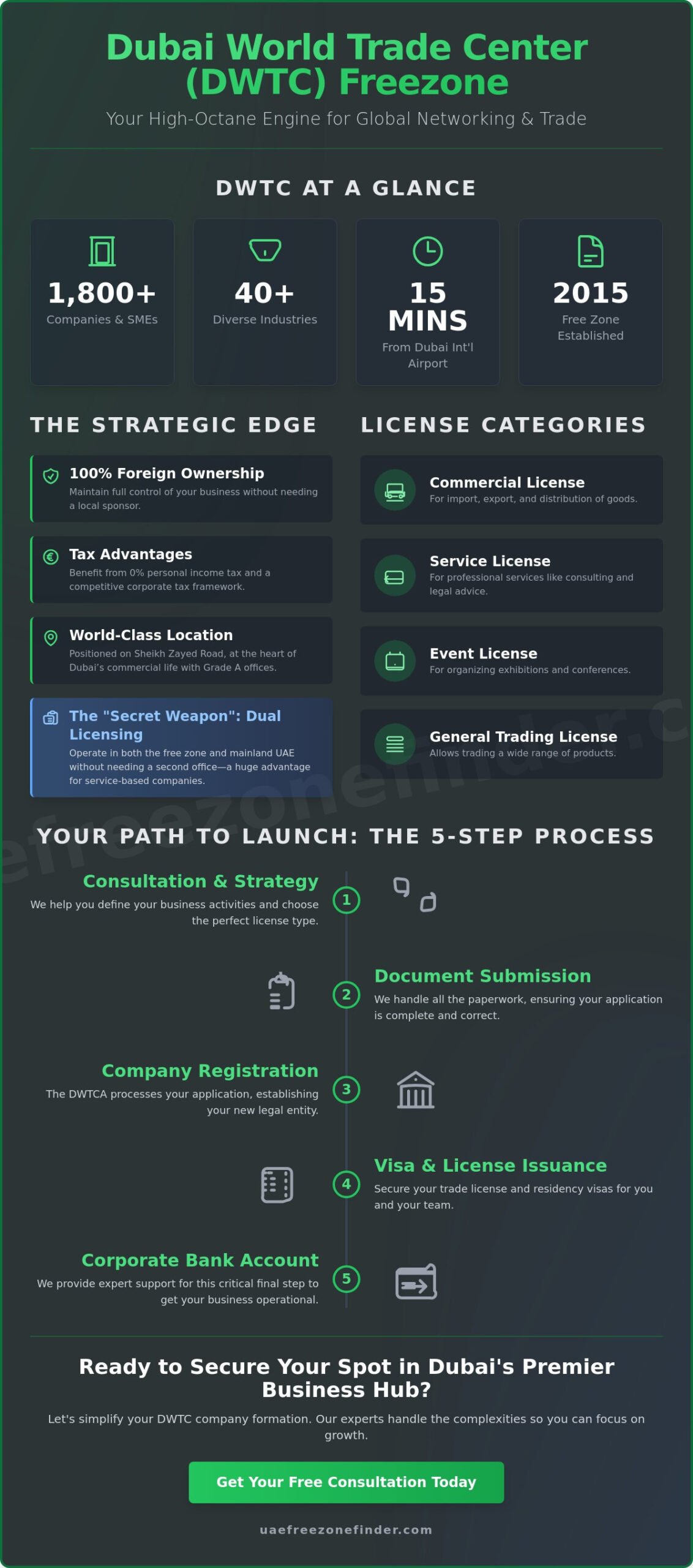
This jurisdiction offers a unique “onshore” free zone experience. It provides 100% foreign ownership and ensures you don’t pay any personal income tax. It’s an ideal landing spot for international firms wanting a prestigious footprint in the Middle East without the typical complexities of local sponsorship. Currently, it’s home to over 1,800 small and medium-sized businesses across 40 different industries, proving its versatility as a corporate hub.
The Evolution of the DWTC Authority
The Dubai Bank Trade Centre Authority (DWTCA) was established as a free zone in 2015. This was a strategic game-changer. It shifted the area from a seasonal event venue to a year-round corporate powerhouse. The zone plays a vital role in the Dubai Economic Agenda (D33). This is a government initiative that aims to double the size of Dubai’s economy by 2033 through innovation and foreign investment. The DWTCA acts as a single-window regulator. They handle everything from company formation to your annual trade license renewal. This streamlined approach means you spend less time on paperwork and more time on growth.
Key Infrastructure: One Central and Beyond
The physical heart of the free zone is the One Central development. This area offers some of the highest-quality Grade A office spaces in the region, designed to meet international standards. There’s a unique synergy here that you won’t find elsewhere in the city. One day you’re in a board meeting in your private office; the next, you’re walking across the plaza to meet a global partner at a major exhibition.
Connectivity is the biggest draw for international business travelers. Located in Dubai’s central exhibition district, the zone has its own dedicated Metro station. You’re only a 15-minute drive from Dubai International Airport. This accessibility makes it easy for staff and clients to reach you. It’s a workspace built for people who value efficiency and want to be at the center of Dubai’s commercial life.
License Types and Permitted Business Activities
Selecting the right legal framework for your business isn’t just a formality; it’s a strategic decision that dictates your operational reach. The Dubai Bank Trade Center Freezone (DWTC) provides an incredibly diverse menu of over 1,200 licensed activities. This variety ensures that whether you’re a niche consultant or a global commodity trader, there’s a specific category that fits your model. You can generally bundle up to 10 related activities under a single license, which offers significant cost efficiency for multi-faceted businesses. If you’re unsure which category fits your vision, our team at UAE Free Zone Finder can help you map your business plan to the most advantageous license type.
The primary license categories include:
- Commercial License: Designed for companies engaged in the import, export, and distribution of specific goods.
- Service License: Ideal for professionals providing consulting, accounting, or legal services.
- Event License: A specialized permit for organizers holding exhibitions or conferences within the DWTC Authority Free Zone venue.
- General Trading License: This allows for the trading of a wide range of products under one umbrella, though it comes with a higher fee structure.
For individual professionals, the zone also offers Freelance Permits. These are excellent for solo entrepreneurs in the media or tech sectors who don’t yet require a full corporate structure but need a legal residency visa to operate in Dubai.
The Advantage of Dual Licensing
The most significant “secret weapon” of this jurisdiction is the dual-licensing agreement with the Department of Economy and Tourism (DET). This allows a company registered in the free zone to obtain a mainland license without leasing a second office. It’s a massive benefit for service-based businesses. You get the 100% ownership benefits of a free zone while gaining the legal right to bid for government contracts and serve clients directly in the UAE mainland market. It’s the ultimate bridge between two distinct regulatory worlds.
Specialized Tech and Crypto Regulations
If you’re in the blockchain or fintech space, this zone is particularly welcoming. DWTC has established itself as a supportive environment for virtual assets by aligning its regulations with the Virtual Assets Regulatory Authority (VARA). This clear legal framework is why tech startups are flocking here. They don’t just get a desk; they get a seat in a jurisdiction that understands the nuances of decentralized finance and emerging tech, making it much easier to attract venture capital and international talent.
The Strategic Edge: Why Choose DWTC in 2026?
Choosing where to base your headquarters is about more than just a physical office; it’s about buying into a brand that carries immediate weight with global partners. While some entrepreneurs look at the initial setup costs and hesitate, the long-term ROI of a Dubai Bank Trade Center Freezone (DWTC) address is found in the doors it opens. Having your trade license issued by an entity that sits at the very heart of Dubai’s commercial history signals stability and high-level government alignment. It’s a badge of credibility that helps when negotiating international contracts or attracting top-tier talent.
Efficiency is another major draw for the time-poor executive. The “One-Stop-Shop” approach means the authority handles your residency visas, license renewals, and various government approvals under a single roof. You won’t find yourself bouncing between different departments across the city to get a simple permit. This level of administrative clarity is highlighted in the UAE Ministry of Economy & Tourism overview of DWTC, which notes its strategic role in fostering a competitive environment for international businesses and startups alike.
DWTC vs. Other Dubai Free Zones
Selecting the right jurisdiction depends on your core activity. If you’re a high-frequency trading firm or a retail bank, the DIFC is your natural home. If you deal primarily in physical gold or soft commodities, the DMCC is a world leader. However, for companies that thrive on general trade, technology, and face-to-face client interaction, the Dubai Bank Trade Center Freezone (DWTC) is hard to beat. Unlike the northern emirates, which offer lower costs but require long commutes for international clients, this zone keeps you in the heart of the central business district. You’re minutes away from the city’s top financial law firms and five-star hospitality hubs.
Ecosystem Benefits for Event-Driven Businesses
If your business model relies on exhibitions, professional networking, or tech launches, the benefits here are even more pronounced. You’re physically located where millions of international visitors land every year for major trade shows. Tenants often enjoy smoother logistics when exhibiting, as they’re already part of the internal ecosystem. The exclusive “Business Club” within the zone provides a sophisticated setting for high-level meetings that would otherwise require a trip to a busy hotel lobby. It’s an environment built for closing deals, not just doing desk work.
Step-by-Step: The DWTC Company Formation Process
Launching your business within the Dubai Bank Trade Center Freezone (DWTC) is a structured and logical process, but don’t let the word “simple” lead you into a false sense of security. The authority maintains high standards for corporate governance and compliance. Precision in your initial application is the primary factor that determines whether you’ll be operational in weeks or stuck in a cycle of document revisions. While the digital eServices platform has streamlined many steps, the nuances of legal drafting still require a steady hand.
One of your first major decisions involves selecting the correct legal structure. Most entrepreneurs find that a Free Zone Company (FZCO) is the most common choice for new setups because it allows for multiple shareholders and provides a distinct legal personality. If you’re representing an existing international firm, you might opt for a Branch office instead. This allows you to maintain your global brand identity while establishing a local footprint without the need for a separate share capital injection.
The Incorporation Timeline
The journey from concept to trade license typically follows three distinct phases. First, you must finalize your legal structure and select your business activities from the approved list of over 1,200 options. Second, you’ll submit your application for initial approval, often called pre-approval. This is where the DWTCA reviews your background and the viability of your business plan. Finally, once approved, you’ll move to the physical stage. This involves signing the Articles of Association and your lease agreement. It’s vital to remember that physical office space is a mandatory requirement for all license types in this jurisdiction. Even if you only require a flexi-desk, you must have a registered address within the zone to finalize your incorporation.
Essential Documentation Checklist
To keep your application moving at a fast pace, you’ll need to have your dossier ready before you begin. The authority typically requires:
- Clear passport copies and professional CVs for all shareholders and appointed managers.
- A detailed business plan, especially if you’re applying for specialized tech or consultancy licenses.
- Notarized board resolutions if the new company is being owned by another corporate entity.
- Proof of address and bank reference letters in some specific cases.
Errors in these documents are the leading cause of application rejection. Engaging a specialist for Free Zone Company Formation ensures that every signature and attestation is exactly where it needs to be. Our PRO services team acts as your bridge to the authority, handling the technical heavy lifting so you can focus on your 2026 growth strategy.
Managing Your DWTC Business: Visas, Banking, and Tax
Once your trade license is issued, your focus shifts from incorporation to operational management. Holding a license within the Dubai Bank Trade Center Freezone (DWTC) is a significant milestone, but the long-term success of your venture depends on how you handle the three pillars of UAE residency: visas, corporate banking, and tax compliance. In the 2026 regulatory environment, these aren’t just administrative tasks; they’re ongoing obligations that require precision to maintain your company’s standing and your personal residency status.
The most immediate hurdle for many new arrivals is financial integration. Opening a business account in the UAE has become increasingly complex due to stringent global KYC (Know Your Customer) and AML (Anti-Money Laundering) standards. Banks now require extensive documentation regarding your business model and source of funds. Utilizing professional corporate bank account opening assistance can save you months of back-and-forth communication with compliance departments. We help you prepare a “bank-ready” dossier that addresses a banker’s specific concerns before you even walk through the door.
Securing Your UAE Residency Visa
Your Dubai Bank Trade Center Freezone (DWTC) license grants you the right to apply for residency visas for yourself, your employees, and eventually, your family. For 2026, the costs are clearly defined. An investor or employee visa costs AED 2,000 if you’re currently outside the UAE, or AED 3,200 if you’re already in the country. You’ll also need to budget AED 755 for the mandatory medical checkup and AED 390 for your Emirates ID. All visas in this jurisdiction are valid for two years.
Once your own visa is stamped, you can begin the process of sponsoring family members or domestic staff. This is a reassuring benefit for international entrepreneurs looking to relocate their entire lives to Dubai. For a deeper look at the medical insurance requirements and timelines, check out our comprehensive resident visa uae guide.
Corporate Tax and VAT Compliance in 2026
The tax landscape has changed significantly. Since June 2023, a standard 9% corporate tax rate applies to taxable income exceeding AED 375,000. While free zone entities can still access a 0% rate on “qualifying income,” the requirements to be a Qualifying Free Zone Person (QFZP) are strict. You must maintain adequate substance in the UAE and ensure your non-qualifying income doesn’t exceed the de minimis threshold. Failure to meet these conditions results in disqualification from the 0% rate for five years. Furthermore, all DWTC companies must register for corporate tax and file an annual return, regardless of their profit levels.
VAT compliance is equally vital. If your taxable supplies and imports exceed AED 375,000 per year, registration is mandatory. Even if you’re below this, voluntary registration at AED 187,500 is often a smart move to reclaim VAT on your setup expenses. Our team manages your ongoing bookkeeping and tax liaison needs so you don’t fall foul of the Federal Tax Authority’s audit requirements.
Next Steps for Your Business
Don’t let the complexity of 2026 regulations slow your momentum. The best way to begin is with a clear feasibility consultation to ensure the DWTC ecosystem aligns with your specific trade goals. If you’re ready to take the first step toward your Dubai future, explore our pillar page on free zone company formation to compare your options and start the application process today.
Securing Your Place in Dubai’s Commercial Future
The path to 2026 success in the UAE requires more than just a trade license; it demands a location that provides immediate credibility and a regulatory strategy that protects your bottom line. We’ve explored how the dual-licensing model and the specialized tech ecosystem within the Dubai Bank Trade Center Freezone (DWTC) offer a unique bridge to both local and global markets. By aligning your business with this prestigious jurisdiction, you’re positioning yourself at the very center of the region’s economic growth.
Navigating the nuances of corporate tax registration and bank account opening doesn’t have to be a solo journey. As a strategic partner of UAE Free Zone Finder with expertise across 40+ UAE Free Zones, we provide the dedicated PRO and tax compliance support you need to stay ahead of shifting regulations. Launch your DWTC business today with expert guidance from UAE Free Zone Finder and turn your vision into a compliant, thriving reality. The future of global trade is happening right here, and it’s time you claimed your seat at the table.
Frequently Asked Questions
Can I own 100% of my company in the Dubai Bank Trade Center Freezone?
Yes, you can own 100% of your company in the Dubai Bank Trade Center Freezone (DWTC). This jurisdiction allows for full foreign ownership without the need for a local Emirati partner or sponsor. It’s a significant advantage for international investors who want to maintain complete control over their business operations and capital while operating in a globally recognized business hub.
How much does it cost to set up a business in DWTC?
Initial government fees for a business license and registration start at approximately USD $5,500. This base cost usually includes the license, registration, and a flexi-desk space. Total costs will vary depending on your specific business activity, the number of visas you require, and the type of office space you choose to lease. It’s best to get a tailored quote for your exact needs.
Do I need a physical office to get a DWTC license?
Yes, a registered physical address within the free zone is a mandatory requirement for all license types. Most startups begin with a flexi-desk, which provides the legal address needed for the license and allows for up to two residency visas. If your team grows, you’ll need to upgrade to a physical executive office, as the size of your office directly dictates your visa allocation.
What is the difference between a DWTC license and a Dubai mainland license?
A DWTC license allows for 100% foreign ownership and operates under free zone regulations, whereas a mainland license traditionally involves different regulatory requirements from the Department of Economy and Tourism. However, the Dubai Bank Trade Center Freezone (DWTC) is unique because it offers a dual-licensing option. This allows your company to operate in the free zone and the mainland under one umbrella without needing separate office spaces.
Can I live in Dubai if I open a company in the DWTC Freezone?
Yes, opening a company in the free zone entitles you to apply for a UAE residency visa. As an investor or employee, you’ll receive a visa valid for two years, which you can renew indefinitely as long as your company remains active. This residency status also allows you to sponsor your family members and domestic staff to live with you in Dubai.
Is DWTC a good choice for a tech startup or blockchain company?
DWTC is one of the premier hubs for tech startups and blockchain ventures in the region. The authority has established a clear regulatory framework that aligns with the Virtual Assets Regulatory Authority (VARA). This makes it much easier for crypto-related businesses to obtain licenses and navigate the compliance requirements necessary for opening corporate bank accounts compared to many other jurisdictions.
How long does the company formation process take in DWTC?
The company formation process usually takes between 10 and 15 working days once all your documents are submitted and verified. This timeline includes the initial approval, signing the lease, and the issuance of the trade license. Visa processing for shareholders and staff begins immediately after the license is issued and typically takes an additional two weeks to complete.
What are the corporate tax implications for a DWTC company in 2026?
All companies must register for corporate tax and file an annual return, even if they qualify for a 0% rate. A 9% tax rate applies to taxable income exceeding AED 375,000. However, your business may qualify for a 0% rate on “qualifying income” if you meet the specific criteria of a Qualifying Free Zone Person, which includes maintaining audited financial statements and meeting substance requirements.
Disclaimer
The information provided in this article is intended for general informational purposes only and reflects conditions as understood at the time of publication. Free zone regulations, fees, and requirements in the UAE are subject to change. Readers are advised to verify details with the relevant free zone authority or regulatory body before making any business decisions. For personalised guidance, our business setup experts at UAE Free Zone Finder are available to assist — contact us at info@uaefreezonefinder.com or call +971-507864823.
Keep Reading
Related UAE free zone guides
Cost Comparison of Major UAE Free Zones: Fees, Licenses, and Hidden Expenses
Quick Answer: A detailed side‑by‑side analysis of setup costs across Dubai, Abu Dhabi, Sharjah and Ras Al Khaimah free zones to help entrepreneurs choose the most…

Step‑by‑Step Guide to Obtaining a Free Zone Visa for Employees
Quick Answer: Detail the visa application process for hiring staff in UAE free zones, a topic often overlooked by competitors. Securing a UAE free zone employee…

Comparative Tax Benefits: Free Zone vs. Mainland Companies for E‑Commerce Start‑ups
Quick Answer: An analysis of tax implications for e-commerce businesses choosing between free zone and mainland structures. While UAE free zones can offer a 0% corporate…