

The cheapest e-commerce license in Dubai often ends up being the most expensive mistake an international founder can make. While a low entry price looks attractive on a marketing brochure, the hidden reality often involves unexpected fees for visa processing, office flexi-desks, and mandatory health insurance that can quickly double your initial investment. You’ve likely felt the frustration of comparing 40 different free zones, each claiming to be the best, while wondering why the dubai e-commerce license cost remains so elusive. It’s difficult to plan a global expansion when you’re worried about being blindsided by administrative charges three months after your launch.
We’re changing that right now. This guide provides a crystal-clear breakdown of every dirham you’ll spend to launch and sustain your online business in the UAE through 2026. We’ll move past the vague estimates to give you a transparent year-one budget, a professional recommendation for the most cost-effective jurisdiction for your specific needs, and a reliable path to securing your corporate bank account. You’re about to get the insider knowledge required to build your business on a foundation of total financial certainty.
Key Takeaways
- Understand why a legal license is the non-negotiable foundation for any digital business operating in the UAE’s 2026 economy.
- We strip away the “starting price” marketing to give you the real dubai e-commerce license cost, covering everything from initial fees to first-year visa expenses in AED.
- Identify the critical differences between Free Zone and Mainland setups so you don’t waste your budget on a jurisdiction that doesn’t fit your target market.
- Get a clear, five-step roadmap that simplifies activity selection and helps you handle government requirements without the usual stress.
What Is a Dubai E-commerce License and Why Do You Need It?
An e-commerce license is the legal authorization required to sell products or services through digital channels in the UAE. By 2026, the distinction between “online business” and “business” has almost vanished; digital-first is the standard model for growth. This license allows you to operate legally across websites, social media platforms, and mobile apps. Without it, you risk heavy fines and the immediate closure of your digital storefront. Understanding the dubai e-commerce license cost is your first step toward building a compliant, scalable presence in the region.
Investors often ask why a standard trade license isn’t sufficient. The answer lies in infrastructure and trust. Modern payment gateways and marketplaces like Amazon or Noon require specific e-commerce activity codes before they’ll approve your merchant account. While the dubai e-commerce license cost varies based on the jurisdiction you choose, the benefits remain consistent. You’ll enjoy 100% foreign ownership, zero personal income tax, and the ability to repatriate all profits. This regulatory clarity is a cornerstone of the Economy of the United Arab Emirates, which continues to attract global tech talent through its pro-business stance.
The Legal Framework for Online Trading
Digital trade is governed by Federal Decree-Law No. 14/2023, which focuses on trade through modern technology. This law isn’t just about paperwork; it sets high standards for secure technology infrastructure and consumer rights. The Department of Economy and Tourism (DET) regulates these activities to ensure transparency. You’re required to provide clear refund policies and secure payment environments, which builds immediate credibility with your customers. It’s a system designed to protect both the founder and the consumer in a fast-moving digital market.
E-commerce vs. E-Trader Licenses
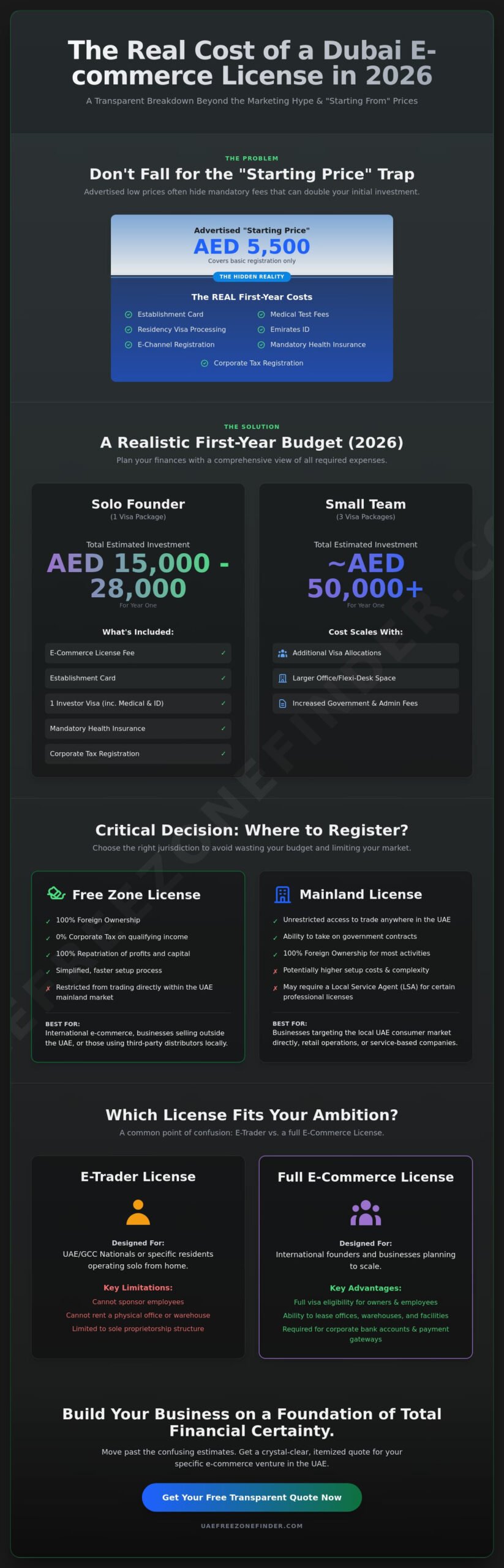
It’s easy to confuse the E-Trader permit with a full E-commerce license, but they serve different purposes. The E-Trader license is designed for UAE and GCC nationals or specific residents operating solo from home. It’s a low-cost entry point but comes with strict limitations; you can’t sponsor employees or rent a physical office. For international founders looking to scale, a full E-commerce Trade License is the only viable path. It provides the necessary framework for visas, corporate bank accounts, and warehouse space, ensuring your business has the room it needs to expand without hitting regulatory ceilings.
Breaking Down the 2026 E-commerce License Costs
Don’t fall for the “starting price” trap. You’ll often see advertisements promising a license for AED 5,500 or AED 6,000. While that might cover the basic registration of a trade name and the initial approval, it rarely represents the total dubai e-commerce license cost you’ll actually pay. By 2026, regulatory updates have shifted the focus toward comprehensive packages that include digital infrastructure and compliance readiness from the moment of incorporation.
For a solo founder, a realistic first-year investment sits between AED 15,000 and AED 28,000. This range accounts for the license, a single residency visa, and mandatory registrations. If you’re launching with a small team of three, expect that figure to climb toward AED 50,000. You’ve got to plan for these expenses early. Many founders forget that renewals happen annually; if you don’t set aside funds for year two, you risk business suspension and heavy fines. The 2026 fee structures are more transparent than in previous years, but they require a higher upfront commitment to ensure long-term stability.
License, Visas, and Government Fees
Your primary expense is the license issuance fee, which varies depending on whether you choose a Free Zone or a Mainland setup. In 2026, most Free Zones have bundled their fees to include “e-office” or “flexi-desk” spaces. Beyond the paper license, you’ll pay for your Establishment Card and E-channel registration for visa processing. Investor visas involve medical tests, Emirates ID fees, and mandatory health insurance, adding roughly AED 4,500 to AED 7,000 per person. All these requirements are governed by the UAE’s eCommerce law, which ensures every digital business operates within a clear legal framework.
Mandatory Compliance and Corporate Support
The financial landscape changed significantly with the full implementation of Corporate Tax. Registering for Corporate Tax is now a mandatory step for every new license holder in 2026, regardless of your initial turnover. You’ll also need to monitor your revenue for VAT registration. Once you hit the AED 375,000 threshold, it’s a legal requirement. Because the rules are more stringent now, many founders find they need professional accounting and taxation advice to avoid penalties. Staying compliant isn’t just about following rules; it’s about protecting your investment from avoidable administrative costs.
Understanding these variables helps you build a resilient business from day one. If you want to see which jurisdiction offers the best value for your specific model, you can compare the latest packages here to find your ideal fit.
Free Zone vs. Mainland: Deciding Where Your Dirhams Go
Choosing between a Free Zone and a Mainland setup is the most critical financial decision you’ll make. This choice doesn’t just affect your initial dubai e-commerce license cost; it dictates your entire operational budget for years to come. Free Zones are designed for efficiency, offering a streamlined entry point that often appeals to lean startups. Mainland setups, while sometimes more expensive upfront, offer unfettered access to the local UAE market without the need for a third-party distributor. You need to weigh the immediate savings of a Free Zone against the long-term revenue potential of direct local sales.
Your target market is the primary factor here. If your business model focuses on international shipping or transshipment, a Free Zone is almost always the more cost-effective route. Data from eCommerce in the UAE shows a massive surge in cross-border trade, and Free Zones are built to facilitate this. However, if you plan to deliver groceries or electronics directly to a customer’s doorstep in Downtown Dubai, a Mainland license removes the middleman, potentially saving you more in commissions than you’d pay in licensing fees.
Free Zone Advantages for Online Sellers
Free Zones remain the top choice for e-commerce entrepreneurs because they minimize overhead. Most zones offer “package” deals that include the license, a few business activities, and a flexi-desk for a flat annual fee, often starting as low as AED 5,700 in northern Emirates or AED 12,000 in Dubai-based zones. You won’t need to rent a physical office, which saves you roughly AED 30,000 to AED 50,000 in annual rent. Additionally, these ecosystems provide specialized corporate bank account opening assistance, which is vital since banking remains a significant hurdle for new digital businesses. You also benefit from 100% import and export tax exemptions within the bonded zones.
When Mainland Makes Financial Sense
Mainland setups are the gold standard for businesses targeting local government contracts or high-volume B2C sales within the UAE. While the dubai e-commerce license cost on the mainland includes a 2.5% market fee based on your office rent, the flexibility is unmatched. You can bid on lucrative government tenders that are strictly off-limits to Free Zone entities. For those worried about physical costs, the “Virtual Office” or Estidama option allows you to secure a license without a massive warehouse, provided your stock is managed by a third-party logistics provider. This hybrid approach gives you Mainland benefits while keeping your fixed costs manageable, usually around AED 15,000 to AED 25,000 for the total first-year setup.
Your 5-Step Action Plan to Getting Licensed
Turning your digital vision into a legal entity requires a methodical approach. You don’t want to rush the process and end up paying for amendments later. Following these five steps ensures you keep your dubai e-commerce license cost within your initial budget while meeting all 2026 regulatory standards.
- Step 1: Define your specific activity. Decide if you’ll focus on a single niche, like specialized tech gadgets, or if you need a General Trading license. Niche retail activities are usually more affordable; general trading offers more flexibility but carries higher annual renewal fees.
- Step 2: Select your jurisdiction. Compare Free Zones against Mainland options based on your 2026 growth plans. If you’re targeting international markets and need a fast visa process, Free Zones like Meydan or SHAMS often provide the most competitive packages for startups.
- Step 3: Prepare your dossier. You’ll need high-resolution passport copies, digital photos with a white background, and at least three unique trade name options. Having these ready prevents back-and-forth delays with the registration authorities.
- Step 4: Submit for initial approval. Once the authority reviews your documents, they’ll issue an initial approval. This is your green light to settle the license fees and secure your legal right to trade.
- Step 5: Finalize visas and banking. After your license is issued, you’ll apply for your establishment card and Emirates ID. You can’t open a corporate bank account in the UAE without a valid residency visa and a physical presence of some kind.
Avoiding Common Application Pitfalls
Trade name rejections are a frequent headache for new founders. If your proposed name includes restricted words or too closely resembles an existing brand, the authority will reject it. This often leads to extra administrative fees and delays. Choosing the wrong activity code is even riskier. Activity Code is the specific identifier for your business operations. If this code doesn’t match the requirements of your chosen payment gateway, like Stripe or Telr, you won’t be able to process customer payments, forcing a costly license amendment.
Setting Up for Success After Licensing
The work doesn’t stop once the license is in your hand. You must register for Corporate Tax with the Federal Tax Authority (FTA) immediately after issuance. Since the UAE introduced the 9% tax on profits exceeding 375,000 AED, compliance is a top priority for the government. You’ll also need a dedicated UAE business phone number and a registered address to satisfy bank KYC requirements. Many successful founders use PRO services to handle these government interactions. It’s a strategic investment that saves roughly 40 hours of manual labor in government queues. To find the right setup for your specific budget, compare the latest free zone packages today.
Why Smart Founders Partner with UAE Free Zone Finder
Starting a business in a new country often feels like a high-stakes puzzle. We provide the missing pieces. Our team relies on real-time 2026 data to ensure your dubai e-commerce license cost stays within your initial projections. We don’t just list generic prices; we analyze which free zones offer the most aggressive incentives for your specific e-commerce niche this year. This data-driven approach prevents you from overpaying for features your startup doesn’t yet require.
Paperwork often stalls progress for international investors. We take over the legal documentation and government liaison entirely. This means you avoid the repetitive back-and-forth with authorities that typically adds weeks to the timeline. We know the current specific requirements for every jurisdiction, from Shams to CommerCity, ensuring your application moves through the system without common clerical rejections. We handle the heavy lifting so you can focus on your inventory and marketing strategy.
Opening a corporate bank account is the biggest hurdle for e-commerce founders today. It’s a complex process where a single mistake can lead to months of delay. We maintain the “Expert Guide” advantage by tracking which zones currently have the highest success rates for bank approvals. We know which banks are currently “e-commerce friendly” and which jurisdictions they prefer. This insider knowledge is the difference between being operational in weeks or being stuck in administrative limbo.
Transparency is our core value. We don’t believe in hidden fees or “surprise” administrative charges that appear at the final stage of incorporation. We provide a straightforward breakdown of every dirham spent. Our goal is to build a long-term partnership based on trust, not a one-off transaction.
Comprehensive Support Beyond the License
Our relationship doesn’t end when you receive your digital certificate. We provide a full suite of services to ensure your business thrives in the UAE market:
- License Management: We handle your annual trade license renewals and coordination to ensure you stay compliant.
- Residency Services: We provide end-to-end assistance with residency permits and Golden Visa applications for you, your family, and your employees.
- Financial Compliance: Our team offers dedicated accounting and VAT support to keep your online business audit-ready and aligned with UAE Federal Tax Authority standards.
Get Your Personalized Cost Estimate Today
A generic price tag rarely reflects the reality of a professional business setup. Your total dubai e-commerce license cost depends on your visa requirements, office space needs, and specific activity list. A one-size-fits-all approach often leads to unexpected expenses later in the year. We offer a free consultation to map out your specific year-one budget with total precision. You’ll see every fee upfront, allowing you to allocate your capital where it matters most.
Take the Next Step Toward Your Digital Empire
Navigating the 2026 regulatory landscape requires more than just an initial budget; it demands a clear understanding of how your choice between Free Zone and Mainland jurisdictions affects your long-term scalability. You’ve seen that the dubai e-commerce license cost is influenced by specific activity choices and visa requirements. Success in this market isn’t just about the launch. It’s about ensuring your structure remains compliant with evolving Corporate Tax and VAT laws from day one.
We’ve helped thousands of entrepreneurs establish their roots here since 2009 as part of the Virtuzone Group. Our team provides expert matching across 40+ Free Zones to find the exact fit for your business model. You don’t have to guess which jurisdiction offers the best value for your dirhams. We provide the strategic direction and dedicated corporate tax support needed to turn administrative hurdles into a competitive advantage.
Ready to build? Start your Dubai e-commerce journey with UAE Free Zone Finder today. Your global expansion starts with a single, well-informed decision.
Frequently Asked Questions
Can I start an e-commerce business in Dubai without a physical office?
Yes, you can start your business without a traditional physical office by opting for a flexi-desk or virtual office package. Most free zones, including IFZA and Meydan, allow you to register your company using these shared spaces to fulfill legal residency requirements. This setup is perfect for digital nomads and startups looking to minimize overhead while maintaining a professional presence in the UAE market.
How much does a residency visa cost for an e-commerce business owner?
A residency visa for an e-commerce business owner generally costs between AED 3,000 and AED 5,000 for the permit itself. You’ll need to budget an additional AED 2,500 for medical tests, Emirates ID processing, and mandatory health insurance. These costs are separate from your license fees and are typically renewed every two or three years depending on the jurisdiction you choose.
Do I need to pay Corporate Tax on my online sales in 2026?
You’ll pay a 9% corporate tax if your annual taxable net profit exceeds AED 375,000. This regulation, which took effect on June 1, 2023, applies to all businesses operating within the UAE. While some free zone entities might qualify for a 0% rate on specific qualifying income, every business must register with the Federal Tax Authority and file annual returns regardless of their profit levels.
How long does it take to get an e-commerce license in the UAE?
You can secure your license in as little as 24 to 48 hours when applying through efficient free zones. Mainland registrations usually take between 3 and 5 working days due to additional government approvals. While the dubai e-commerce license cost is a major factor, your total timeline depends on the speed of your document submission and the specific business activities you’ve selected for your online store.
What is the cheapest free zone for an e-commerce license in 2026?
SHAMS (Sharjah Media City) and Meydan Free Zone are currently the most affordable jurisdictions for digital entrepreneurs. While the dubai e-commerce license cost changes based on visa quotas, these zones offer packages starting around AED 6,000 for licenses without visa eligibility. Choosing a hub like SHAMS can reduce your initial setup expenses by up to 25% compared to premium mainland locations.
Can I use a personal bank account for my Dubai e-commerce business?
No, you can’t use a personal bank account for your commercial transactions in Dubai. UAE regulations require a distinct separation between personal and business funds to ensure transparency and compliance with anti-money laundering laws. You’ll need to apply for a corporate bank account; digital-first banks like Wio or Mashreq Neo Biz are excellent options for getting your business account active quickly.
What documents are required to apply for a Dubai e-commerce license?
You only need a few basic documents to start, including a clear passport copy, a digital passport-sized photo, and a proposed business name. Some free zones might ask for a utility bill as proof of address or a brief resume. You don’t need a physical office lease or a complex business plan for the initial application, making the process straightforward for international investors.
Do I need a local partner to own an e-commerce company in the UAE?
You don’t need a local partner to own your e-commerce company, as UAE laws now allow 100% foreign ownership for most commercial activities. This rule applies to both free zone and mainland setups following the 2021 amendments to the Commercial Companies Law. You retain full control over your business decisions and can repatriate 100% of your profits back to your home country without any restrictions.
Disclaimer
The information provided in this article is intended for general informational purposes only and reflects conditions as understood at the time of publication. Free zone regulations, fees, and requirements in the UAE are subject to change. Readers are advised to verify details with the relevant free zone authority or regulatory body before making any business decisions. For personalised guidance, our business setup experts at UAE Free Zone Finder are available to assist — contact us at info@uaefreezonefinder.com or call +971-507864823.