Post-Regional Recovery: How UAE Free Zones Are Powering Global Trade Confidence
Setting up in the most famous free zone isn’t always the smartest move for your bottom line in 2026. You’ve likely felt the weight of choosing between more than 20 different free zones in dubai, each promising the world while hiding renewal fees in the fine print. It’s stressful to weigh the 9% Corporate Tax regulations against your growth plans, especially when you’re just trying to secure a corporate bank account without a six-month wait.
We understand that you want clarity, not more confusion. That’s why we’re going to help you identify the exact jurisdiction that aligns with your specific 2026 goals and show you how to secure your residency visa without the typical bureaucratic headaches. You’ll gain a clear comparison of the top-tier zones and a predictable setup timeline that respects your schedule. This guide also reveals the hidden costs you need to avoid to keep your capital safe, ensuring your transition into the UAE market is as efficient as possible.
Key Takeaways
- Understand how 100% foreign ownership and independent regulations protect your business interests within specialized economic jurisdictions.
- Navigate the 2026 tax landscape by identifying if your entity meets the “Qualifying Free Zone Person” criteria for a 0% corporate tax rate.
- Determine which free zones in dubai align with your specific industry by comparing setup costs in AED and available infrastructure.
- Follow a proven 5-step roadmap to select the right legal structure and prepare your documentation with total precision.
- Discover how expert PRO services take the weight off your shoulders by managing complex government liaison and bureaucratic requirements.
What are Free Zones in Dubai and Why Do They Matter in 2026?
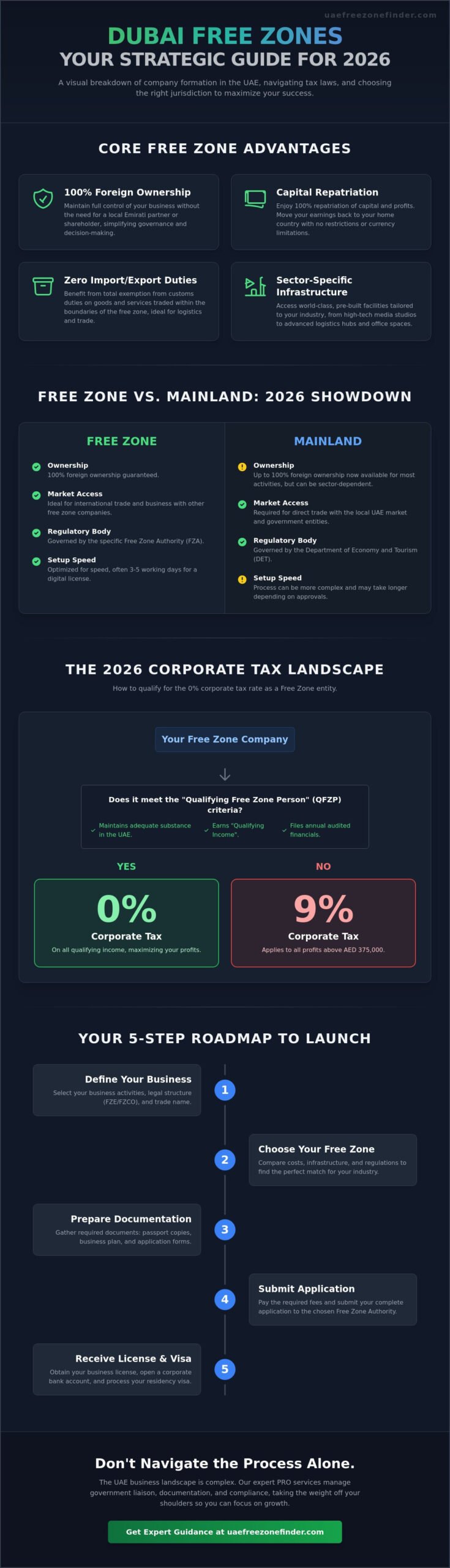
Free zones in dubai are specialized economic jurisdictions designed to attract foreign investment by offering 100% ownership and a tax-friendly environment. These aren’t just standard business parks; they’re “ring-fenced” areas. Each zone operates under its own regulatory framework, which functions independently from the UAE’s federal civil laws in most commercial matters. This legal independence allows for a business-friendly ecosystem tailored to specific sectors like financial services, commodities trading, or digital media.
As we move through 2026, these zones sit at the heart of the Dubai Economic Agenda (D33). This ambitious plan aims to double Dubai’s economy by 2033, and free zones are the primary vehicle for hitting that target. For an investor, this translates to better digital infrastructure and faster licensing than ever before. You get to keep every dirham you earn because there’s zero personal income tax and 100% repatriation of capital and profits. It’s a setup built for maximum capital efficiency.
The Core Benefits of Setting Up in a Free Zone
The most significant draw remains the ability to own 100% of your company. You won’t need a local Emirati partner to hold a majority stake, which simplifies your corporate governance. Additionally, you’ll benefit from a total exemption from import and export duties within the zone’s boundaries. Most jurisdictions also provide pre-built infrastructure tailored to your industry. For example, you can find specialized labs in Dubai Science Park or high-tech production studios in Dubai Media City. This saves you the trouble of building specialized facilities from scratch.
- Total Ownership: Full control without requiring a local shareholder.
- Duty Exemptions: No customs duties on goods moving within the zone.
- Sector Specificity: Infrastructure designed for your specific business niche.
- Financial Freedom: No restrictions on moving your profits back to your home country.
Free Zone vs. Mainland: A Quick 2026 Overview
Choosing between a free zone and the mainland depends on where your customers are located. Free zone companies usually trade internationally or with other businesses within the zones. If you want to sell goods or services directly to consumers in the local Dubai market, you’ll likely need a Mainland license through the Department of Economy and Tourism (DET).
The regulatory oversight differs as well. Free zones are governed by their own specific Free Zone Authority (FZA), while mainland firms fall under the DET. For remote investors, free zones are often the better choice. The setup process is optimized for speed, often taking as little as 3 to 5 working days for a digital license. You don’t need to be physically present in the UAE for many of these administrative steps, making it a highly efficient entry point into the Middle East market.
Navigating the 2026 Financial Landscape: Taxes and Incentives
The UAE’s fiscal environment underwent its most significant transformation on June 1, 2023, with the introduction of a 9% federal corporate tax. While this change marked a new era for the country, free zones in dubai continue to offer a sanctuary for strategic tax planning. The 0% personal income tax remains a cornerstone of the Dubai appeal, ensuring that global talent keeps every dirham they earn. For businesses, the focus has shifted from automatic exemption to demonstrated compliance. You can’t just set up a shell company and expect to bypass the taxman anymore. You need a clear strategy that aligns with the latest Ministry of Finance cabinet decisions.
Qualifying for the 0% Corporate Tax Rate
To benefit from the 0% rate, your business must meet the criteria of a Qualifying Free Zone Person (QFZP). This isn’t just about having a license. You need to earn “Qualifying Income,” which generally includes income from transactions with other free zone entities or specific “Qualifying Activities” such as manufacturing or fund management. Maintaining adequate substance is equally critical. You must show that your core income-generating activities happen within the zone, supported by physical assets and qualified employees. Since the 2023 regulations, annual audits and meticulous bookkeeping are mandatory. Neglecting these can trigger the standard 9% rate on all profits over AED 375,000. Our accounting and taxation advice provides the roadmap you need to stay compliant while protecting your bottom line.
Customs and Duty Exemptions
Logistics and trading companies still find immense value in the “Designated Zone” status. These specific areas are treated as being outside the UAE for VAT purposes regarding certain goods. When you move products from international markets into a Designated Zone, you don’t pay the 5% VAT or customs duties, provided the goods don’t enter the mainland. For a trading firm moving AED 2,000,000 worth of inventory monthly, this creates a massive cash flow advantage. You’re effectively operating in a duty-free corridor that connects global supply chains without the typical bureaucratic friction. If you’re unsure which jurisdiction offers these specific perks, finding the right match is the first step toward optimizing your overheads.
By 2026, the distinction between a compliant and non-compliant entity will define who thrives in free zones in dubai. The authorities now use sophisticated digital systems to track transactions, making transparency your best friend. While the 0% tax rate is still very much alive, it’s reserved for those who play by the new, more structured rules of the game. It’s about being professional, staying organized, and ensuring your corporate structure reflects your actual business operations.
Strategic Industry Hubs: Which Free Zone is Your Perfect Match?
Choosing your location is the most critical decision you’ll make during company formation. Your specific business activity must dictate your jurisdiction choice. It’s a mistake to pick a hub based solely on the lowest price tag; you need to be where your industry breathes. In 2026, the free zones in dubai have become highly specialized ecosystems. Positioning your office near industry peers doesn’t just look good on a business card. It simplifies your supply chain, aids in talent acquisition, and puts you in the direct path of potential partners. To help you weigh these factors, we’ve developed a free zone comparison tool that breaks down the technicalities of every major hub.
The “Big Three” zones—DIFC, DMCC, and JAFZA—represent the peak of prestige, but they serve very different masters. DIFC offers the highest level of corporate “clout” for financial entities, while DMCC provides a massive networking pool for traders. JAFZA is the undisputed king of heavy logistics. If you’re a consultant, you might find these overkill. If you’re a global trader, they’re essential. We recommend looking at your five-year growth plan before signing a lease.
Top Choices for Tech, Media, and Innovation
Dubai Internet City (DIC) and Dubai Media City (DMC) remain the heritage hubs for global giants. If your goal is to sit alongside the likes of Google or Reuters, these are your targets. However, for digital nomads and agile startups, IFZA and Meydan have become the 2026 favorites. They offer a lower barrier to entry and incredibly fast processing times. These jurisdictions are particularly famous for their “Freelance Permit” options. These permits allow individual specialists to operate legally without the overhead of a full corporate suite, making them the most cost-effective entry point into the free zones in dubai for creative professionals.
The Leaders in Finance, Commodities, and Trading
For those in the high-stakes world of finance and global trade, three names dominate the conversation:
- DIFC: This is the premier financial hub of the Middle East. It operates under its own English Common Law courts, providing a familiar legal safety net for international investors. It’s the go-to for hedge funds and private equity firms.
- DMCC: Crowned the world’s top free zone multiple times, it hosts over 24,000 companies. It’s the global center for commodities like gold, diamonds, and tea. The networking opportunities here are unmatched for physical traders.
- JAFZA: If your business involves moving physical goods, JAFZA is the logistical powerhouse. It’s directly connected to the Jebel Ali Port, which handles over 15 million TEUs annually. It offers purpose-built warehouses and plots for light industrial use that other zones simply cannot match.
Don’t let the variety overwhelm you. The goal is to find the environment that supports your specific workflow. Whether you need a prestigious address in the DIFC or a flexible desk in Meydan, the right fit will act as a catalyst for your regional expansion.
The 5-Step Roadmap to Company Formation in a Free Zone
Setting up your business requires a methodical approach to avoid administrative delays. Your first task involves selecting the right legal structure. A Free Zone Establishment (FZE) works for single shareholders, while a Free Zone Company (FZCO) accommodates two or more partners. This choice impacts your initial share capital requirements, which can range from AED 1,000 to AED 10,000-50,000 depending on the specific jurisdiction. You’ll then gather your core documents. Prepare clear passport copies, proof of address, and a detailed business plan if you’re entering specialized sectors like healthcare or aviation.
The third step involves submitting your application for initial approval to the relevant Free Zone Authority. This stage validates your business activity and name choice. Once approved, you’ll move to the fourth step: selecting your office space. Whether you opt for a virtual desk or a warehouse, signing the lease agreement is mandatory. Finally, pay the registration fees to receive your trade license. This document is your passport to operating within free zones in dubai and serves as the legal basis for all future transactions. Don’t underestimate the importance of this final paperwork; it’s what makes your entity a legitimate part of the UAE economy.
Securing Your Residency and Investor Visa
Your new license is the foundation for your UAE residency. You’ll apply for an establishment card first, followed by your entry permit. The process requires a medical fitness test at a government-approved center and biometrics for your Emirates ID. For those investing AED 2 million or more, the 2026 Golden Visa program offers a 10-year residency, providing a level of security that was previously unavailable to most expatriates. It’s a game-changer for long-term planning and family sponsorship.
Overcoming the Corporate Banking Hurdle
Opening a bank account is often the most grueling part of the journey. UAE banks have strict “Know Your Customer” (KYC) protocols that can stall your operations for months. They typically demand a comprehensive CV, utility bills as proof of address, and a list of expected suppliers or clients. Using our banking assistance helps you navigate these requirements by ensuring your profile meets bank-specific criteria before submission. This proactive approach significantly reduces the risk of rejection and gets your capital moving faster.
Maximizing Your Success with UAE Free Zone Finder
Setting up in one of the many free zones in dubai isn’t just about filling out forms; it’s about strategic positioning. We act as your expert guide, cutting through the red tape that often slows down international expansion. Our team handles the heavy lifting of government liaison through dedicated PRO services. This means you don’t have to worry about the shifting requirements of the Dubai Development Authority or the various Free Zone Authorities. We’ve seen too many entrepreneurs get stuck in administrative loops that could’ve been avoided with the right insider knowledge.
We don’t just set up your company and walk away. Our role is to build a long-term corporate partnership that supports your growth. This includes managing ongoing compliance and license renewals. In Dubai, missing a renewal deadline can lead to penalties starting from AED 2,000 per month. We track these dates for you, ensuring your business stays in good standing with the regulators. Our proactive approach keeps your operations running without the stress of unexpected legal hurdles or late-filing fees.
- Visa Processing: We handle the entire cycle for investors, employees, and their families.
- Document Attestation: We manage the complex requirements for legalizing foreign documents.
- Corporate Structuring: We ensure your setup allows for future scalability and share transfers.
Avoiding Common Pitfalls in Free Zone Setup
Choosing the “cheapest” license is a frequent mistake that costs more in the long run. A low-cost setup in a remote jurisdiction might save you AED 3,000 today, but it could prevent you from opening a corporate bank account with major institutions like Emirates NBD or Wio Bank. Many banks have specific lists of approved free zones in dubai and the wider UAE. If your zone isn’t on that list, your capital stays locked outside the country. We help you select a jurisdiction that aligns with your banking and operational needs.
Correct activity mapping is another critical factor. If your license doesn’t precisely match your business operations, you risk fines during government inspections. We analyze your business model to ensure your activity codes are accurate, preventing future operational freezes or legal disputes. It’s about getting it right the first time to avoid expensive corrections later.
Ready to Start Your Dubai Journey?
The 2026 outlook for Dubai is exceptionally strong. With the D33 Economic Agenda aiming to double the city’s economy, the opportunities for global investors have never been more promising. You need a setup that doesn’t just work for today, but thrives in the high-growth environment of the next decade. Every business has unique requirements, and there’s no “one size fits all” solution in this market.
We invite you to book a personalized consultation to find your perfect fit. Let us handle the bureaucracy while you focus on your vision for growth.
Secure Your Competitive Edge in the 2026 Dubai Market
Success in the coming year hinges on your ability to navigate the evolving tax landscape and select a jurisdiction that fuels your specific industry goals. You’ve seen how the right 5-step roadmap simplifies the path from initial application to active trading. Choosing between the diverse free zones in dubai isn’t just a checkbox exercise; it’s a strategic decision that defines your company’s financial health for years to come. The 2026 landscape demands precision, and localizing your operations within the right hub is the first step toward long-term stability.
Our team provides the steady hand you need during this expansion. With practical UAE setup experience, UAE Free Zone Finder helps coordinate documentation, authority steps and post-setup requirements without promising official approvals. You’ll have access to dedicated PRO and banking support teams who understand the local nuances of UAE business. We don’t believe in surprises, so we stick to transparent, fixed-fee structures with clear written fee visibility before you proceed. It’s about making your transition into the UAE market as straightforward as possible.
Start your seamless Dubai business setup with a free consultation
The infrastructure for your global success is already in place. We’re here to help you unlock it and build a lasting legacy in the Middle East.
Frequently Asked Questions
Is it better to set up a business in a free zone or mainland Dubai?
The choice depends on your specific business goals and target audience. If you want 100% foreign ownership and repatriation of profits subject to applicable banking and regulatory requirements, free zones in dubai are the superior choice for international trade. Mainland setups are more suitable if you plan to trade directly with the local UAE retail market or bid for government contracts without using a distributor.
Can I live in Dubai if I open a free zone company?
You can certainly live in Dubai after establishing your company. Most free zone licenses allow you to apply for a UAE residency visa, which is typically valid for two or three years. Once your visa is approved, you can also sponsor your family members and domestic staff, making it a practical path for long-term relocation.
How much does it cost to open a company in a Dubai free zone?
Setup costs vary significantly based on the jurisdiction and the number of visas you require. Basic license packages for startups often begin around AED 12,500 in northern emirate free zones. For premium locations in the heart of the city, initial costs can range from AED 25,000 to AED 50,000 when including office space and registration fees.
Can a free zone company trade with mainland companies in the UAE?
A free zone company can trade with mainland entities, but there are specific rules to follow. For goods, you must work through a locally licensed distributor or a clearing agent to move products into the mainland. Service-based companies can often provide services to mainland clients directly, provided the work is conducted within the free zone or outside the UAE.
What is the minimum capital requirement for a free zone company in Dubai?
Minimum capital requirements are determined by the specific free zone authority you select. For example, the Dubai Multi Commodities Centre (DMCC) generally requires a minimum share capital of AED 50,000. However, many popular jurisdictions like Meydan Free Zone or IFZA have no minimum capital requirement, which lowers the barrier for new entrepreneurs and small businesses.
How long does it take to get a free zone license in Dubai?
You can usually obtain a free zone license within 3 to 10 working days. The speed of the process depends on the efficiency of the specific jurisdiction and the completeness of your documentation. Some digital-focused zones offer “instant licenses” that are issued in as little as 48 hours once the initial security checks are finished.
Do I need a physical office to have a free zone license?
You don’t need a traditional brick-and-mortar office for most business activities. Many free zones offer “flexi-desk” or “coworking” solutions that provide a legal business address without the high overhead of a private suite. These setups are fully compliant with UAE regulations and are sufficient for processing your residency visa and opening a bank account.
Can I open a corporate bank account with a free zone license?
You can open a corporate bank account, but it’s a separate procedure that requires strict compliance checks. Banks like Wio, Mashreq, and Emirates NBD will review your business activity, source of funds, and residency status. It’s essential to have a clear business plan and valid supporting documents ready to ensure a smooth approval process with the bank’s compliance department.
Disclaimer
The information provided in this article is intended for general informational purposes only and reflects conditions as understood at the time of publication. Free zone regulations, fees, and requirements in the UAE are subject to change. Readers are advised to verify details with the relevant free zone authority or regulatory body before making any business decisions. For personalised guidance, our business setup experts at UAE Free Zone Finder are available to assist — contact us at info@uaefreezonefinder.com or call +971-507864823.