How to Get an E-commerce License in the UAE: A 2026 Step-by-Step Guide
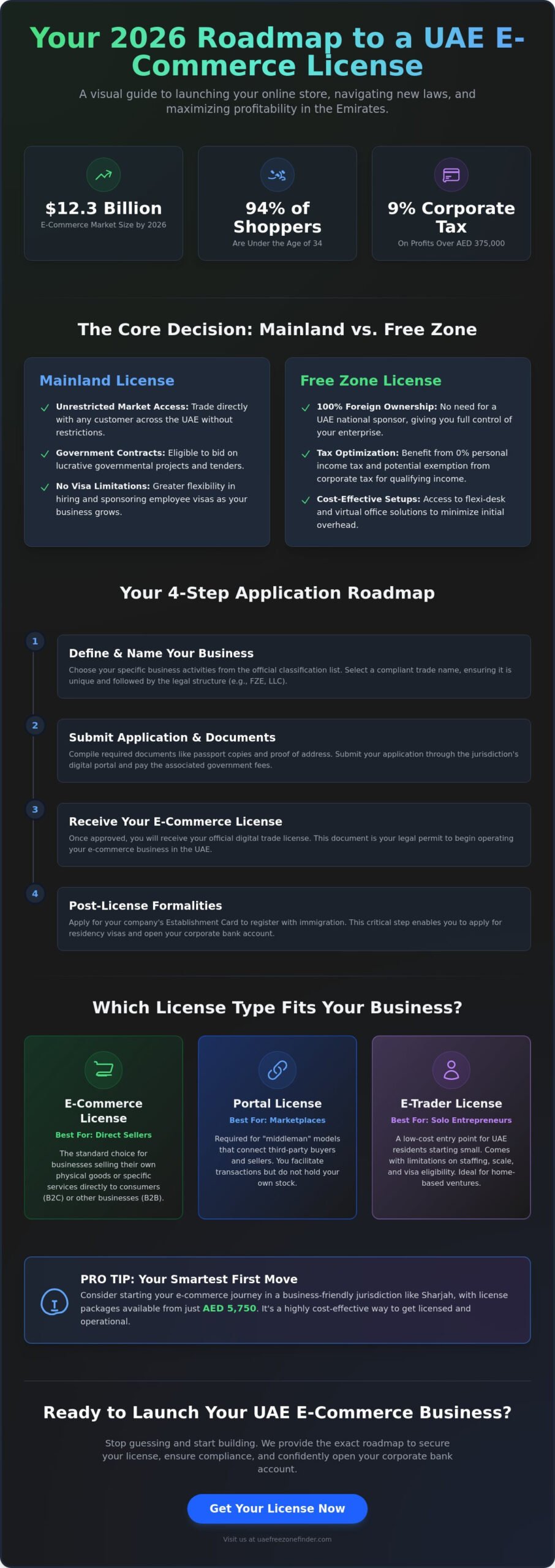
With the UAE e-commerce market hitting USD 12.8 billion in 2026 and 94% of shoppers under the age of 34, the digital gold rush is officially here. You’ve probably felt the excitement of this growth, yet you’re likely stalled by the same questions that stop most entrepreneurs. Should you choose a mainland setup or a free zone? How do you handle the 9% corporate tax on income over AED 375,000 without losing your margins?
It’s completely normal to feel overwhelmed by the shifting regulatory landscape, especially with the new Child Digital Safety Law that took effect on January 1, 2026. We’re here to clear the fog. This guide provides the exact roadmap you need to secure your e commerce license uae while ensuring full legal compliance from day one. You’ll learn how to claim Small Business Relief before it expires in December 2026 and discover why starting in Sharjah for AED 5,750 might be your smartest move. We’ll walk through the specific steps to choose your jurisdiction, calculate your total cost of ownership, and open a corporate bank account with total confidence.
Key Takeaways
- You’ll learn the exact steps to secure your e commerce license uae and avoid the steep fines that come with operating outside the law.
- Compare Mainland and Free Zone jurisdictions to find the perfect fit for your specific market reach and tax optimization needs.
- Get a clear breakdown of the application process, ensuring your trade name and business activities meet current UAE legal standards.
- Understand the critical requirements for opening a corporate bank account, which remains the most vital hurdle after you get licensed.
- Stay ahead of 2026 compliance by learning how the 9% corporate tax and VAT registration thresholds impact your store’s profitability.
Understanding the UAE E-commerce Licensing Landscape
Securing an e commerce license uae isn’t just a bureaucratic formality; it’s the legal foundation of your entire digital enterprise. Whether you’re planning a B2B platform or a B2C storefront, the UAE government requires every digital seller to hold a valid permit. This regulatory framework ensures that the Economy of the United Arab Emirates remains transparent, secure, and attractive to global investors. Without this document, your business operates in a legal vacuum. You won’t just face administrative hurdles; you’ll risk heavy financial penalties and the potential blocking of your website by the Telecommunications and Digital Government Regulatory Authority (TDRA). It’s a high price to pay for skipping a step that we can help you complete efficiently.
Many entrepreneurs worry about the overhead of a physical office. It’s a common concern, but for most online-only ventures, a traditional lease isn’t a requirement. Many jurisdictions offer “flexi-desk” or “virtual office” solutions. These allow you to fulfill legal residency and licensing requirements without the burden of a long term commercial lease. This flexibility is a key reason why the UAE has become a global hub for digital nomads and tech startups alike. You get the prestige of a UAE business address while keeping your capital focused on inventory and marketing.
The Legal Framework for Online Trading
The UAE’s legal system is designed to protect both the merchant and the consumer. By obtaining your license, you’re signaling to banks and payment processors that you’re a verified entity. This is the only way to open a corporate bank account or integrate local payment gateways like Telr or Checkout.com. Federal Decree-Law No. 14/2023 on trade through modern technology serves as the primary legislation governing all digital transactions, mandating clear pricing and robust cybersecurity standards for every licensed merchant. It’s a comprehensive law that ensures your business stays on the right side of the country’s strict consumer protection standards.
License Types: Which One Fits Your Business?
Choosing the right category is vital for your operational success. If you’re building a marketplace that connects third party buyers and sellers without holding your own stock, you’ll need a Portal License. This is the preferred choice for “middleman” business models. If you’re selling your own physical goods or specific services directly to the public, the standard e commerce license uae is your go-to option. For solo entrepreneurs and residents who want to start small, the E-trader license offers a low cost entry point, though it comes with specific limitations regarding staff and scale. We’ll help you match your business model to the license type that offers the most room for growth.
Step-by-Step: How to Apply for Your E-commerce License
Applying for an e commerce license uae requires a methodical approach. It’s not just about filling out forms; it’s about aligning your business model with the UAE’s rigid classification system. Your first task is to identify your specific business activities from the national classification list. This is a critical step because choosing the wrong activity can lead to complications when you eventually apply for a corporate bank account. You’ll also need to select a trade name that adheres to local conventions. Avoid any religious references, names of countries, or offensive language; the name must be followed by the legal structure, such as “LLC” or “FZE”.
Once your name is reserved and activities are set, you’ll submit your application to the relevant regulatory body. In 2026, most jurisdictions have moved to fully digital portals, making the process significantly faster than in previous years. After paying the required fees, you’ll receive your digital trade license. This document is your “green light” to begin operations, but the work doesn’t stop there. You must then apply for your establishment card, which allows the company to register with the Ministry of Human Resources and Emiratisation and start the residency visa process for you and your employees.
Document Requirements for Entrepreneurs
The paperwork is relatively straightforward but requires absolute accuracy. You’ll need clear passport copies, proof of your current visa status, and a recent proof of address. While many free zones only require these basics, some jurisdictions will ask for a detailed business plan, especially if you’re entering a regulated niche. This plan should reflect the current UAE e-commerce market overview, proving you understand the local landscape. If you’re selling specialized items like pharmaceuticals or certain electronics, be prepared to seek third party approvals from the Ministry of Health or other relevant authorities before your license is finalized. If you find these technicalities confusing, you can always consult with a specialist to ensure your documents are investor-ready.
Timeline and Approval Process
Speed is a hallmark of the UAE’s business environment. You can typically expect an initial approval or a request for clarification within the first 48 hours of submission. Once the payment is processed, the digital license is often issued instantly and can be downloaded from the jurisdiction’s portal. Delays usually happen because of naming conflicts or incomplete document attestation for foreign owners. By double checking your trade name availability and ensuring all passport copies are high resolution, you can avoid these common bottlenecks and stay on track for a rapid launch. Getting your e commerce license uae shouldn’t take weeks if you follow this structured path.
Mainland vs. Free Zone: Choosing the Right Jurisdiction
Deciding where to anchor your business is the most significant strategic choice you’ll make. This decision dictates your tax obligations, your ability to trade locally, and your long term overhead costs. In the UAE, you’re essentially choosing between two distinct environments: the Mainland, governed by the Department of Economic Development (DED), and various Free Zones, which operate under their own independent regulatory frameworks. While both paths lead to a valid e commerce license uae, the operational “boundaries” of each are very different. You shouldn’t pick based on price alone; you need to pick based on where your customers actually live.
The Strategic Benefits of Free Zones
Free Zones are designed as specialized clusters that cater specifically to digital entrepreneurs. The primary draw is the financial optimization they offer. Most Free Zones provide 100% corporate tax exemptions on “Qualifying Income,” provided you meet certain substance requirements. You also benefit from 100% capital and profit repatriation and zero personal income tax. For an e-commerce business, these zones often act as dedicated hubs, offering simplified customs procedures that make international shipping and receiving inventory much faster. If your business model involves importing goods to a warehouse and shipping them globally, a Free Zone is likely your best fit. You can explore the specific setup costs and benefits in our Free Zone company formation guide.
When Should You Choose a Mainland License?
A Mainland license is the gold standard if you want to sell directly to the local UAE market without any geographical restrictions. Unlike Free Zone companies, Mainland entities can bid for lucrative government contracts and open physical retail outlets anywhere in the country. This path became even more attractive following the June 2021 amendments to the Commercial Companies Law, which now allow 100% foreign ownership for most e-commerce activities without the need for a local Emirati partner. While you’ll be subject to the standard 9% corporate tax on profits exceeding AED 375,000, the ability to trade freely across all seven Emirates often outweighs the tax cost for high-volume domestic retailers. You’ll also find more flexibility in office space options, ranging from small tech hubs to large scale distribution centers. To understand the full scope of these legal requirements, it’s helpful to review the UAE government e-commerce regulations. This official portal outlines how Mainland structures align with national consumer protection laws, ensuring your e commerce license uae provides the broadest possible market access.
Beyond the License: Setting Up Your Digital Infrastructure
Once you’ve secured your e commerce license uae, you’ve passed the legal finish line, but the operational race has just begun. This is where many entrepreneurs stumble. They assume the hard part is over, only to find that the local banking and logistics landscape requires just as much strategic planning as the incorporation itself. You need a system that doesn’t just work; it must align with the specific habits of UAE consumers. From digital wallets to last-mile delivery, your infrastructure is what actually turns a permit into a profitable business.
Banking for E-commerce Startups
Opening a corporate bank account is the most critical hurdle for new e-commerce ventures in 2026. UAE banks are highly selective. They perform rigorous Know Your Customer (KYC) checks to ensure compliance with international anti-money laundering standards. To avoid a rejection, you must present a professional image from day one. This includes having a functional website, a clear business plan, and a transparent source of funds. Banks want to see that your business has “substance” and isn’t just a shell company.
You’ll need these essentials ready for your meeting:
- Your original e commerce license uae and establishment card.
- Passport and Emirates ID copies for all shareholders.
- Six months of personal or corporate bank statements from your current country of residence.
- Proof of address, such as a recent utility bill or Ejari contract.
If the process feels daunting, you aren’t alone. Many startups fail their first application because they lack a proper business profile. Our corporate bank account opening assistance article provides a deeper look at how to navigate these institutional requirements and increase your chances of approval.
Payment Gateways and Logistics
Trust is the primary currency of the UAE’s digital market. While digital wallet usage grew to 53% in 2024, a significant portion of the market still relies on “Cash on Delivery” (COD). Integrating local payment gateways like Telr or Checkout.com is essential, but you should also consider “Buy Now, Pay Later” (BNPL) services like Tabby and Tamara. These options are incredibly popular with the 94% of shoppers who are under 34 years old. They expect flexibility at the checkout.
Logistics is your brand’s physical touchpoint. Last-mile delivery in the UAE is highly competitive, so partnering with national couriers like Aramex or DHL is vital for efficient fulfillment. With smartphones accounting for 78.67% of transaction volume in 2025, your entire fulfillment chain, from order placement to delivery tracking, must be mobile-optimized. Efficient warehousing, whether through a third-party logistics (3PL) provider or your own facility, ensures you can meet the “next-day delivery” standard that UAE customers now demand.
Ready to build your digital foundation? Connect with our consultants to optimize your UAE business setup.
Navigating Post-Incorporation: Tax, Compliance, and Growth
Compliance isn’t a hidden tax. It’s the price of admission to a market projected to reach USD 21.01 billion by 2031. Many entrepreneurs worry that the cost of staying legal will eat their margins, but the reality is far more manageable with proper planning. While the initial cost of your e commerce license uae is a one-time investment, staying on the right side of the law requires an ongoing commitment to the UAE’s evolving tax framework. We’ll help you turn these requirements into a competitive advantage through strategic fiscal management.
Corporate Tax and VAT Essentials
The UAE’s tax system is designed to support growth, not stifle it. You’ll need to register for Corporate Tax regardless of your income level, but you only start paying the 9% rate once your taxable profit exceeds AED 375,000. For smaller players, the Small Business Relief scheme is a vital lifeline. If your revenue stays below AED 3 million, you can elect to be treated as having no taxable income for the period. However, you must act fast; this specific relief is currently set to expire on December 31, 2026. Don’t wait until the deadline to structure your accounts properly.
Value Added Tax (VAT) is a separate consideration. Registration becomes mandatory once your taxable turnover hits AED 375,000 within a 12 month period. You can choose to register voluntarily at AED 187,500, which often makes sense if you want to reclaim the VAT paid on your setup costs and inventory. Keeping a clear distinction between tax registration and tax payment is the first step toward maintaining a healthy cash flow.
Maintaining Your Legal Standing
Your e commerce license uae isn’t a “set it and forget it” document. You must renew it annually to avoid steep administrative fines and potential suspension of your payment gateways. Some jurisdictions also mandate annual audits to ensure your bookkeeping reflects the reality of your digital sales. This is where professional PRO services become invaluable. They handle the heavy lifting of visa renewals, license updates, and Ministry of Labour filings, allowing you to focus entirely on scaling your customer base.
Staying compliant is the only way to ensure your business remains an attractive asset for future investors or partners. If you’re ready to move from planning to execution, we can provide the clarity you need. Contact us for a tailored e-commerce setup plan and let’s launch your venture with full legal confidence.
Launch Your UAE Digital Storefront with Confidence
The roadmap to your e commerce license uae is now clear. You’ve seen how choosing between Mainland and Free Zone jurisdictions dictates your market reach and how securing a corporate bank account is the true final step in your setup. With the UAE e-commerce market projected to reach USD 21.01 billion by 2031, there’s never been a more strategic time to establish your presence. Compliance with the 9% corporate tax and VAT regulations doesn’t have to be a burden; it’s simply a part of growing a sustainable, world-class business.
You don’t have to navigate this complex regulatory landscape alone. As part of the UAE Free Zone Finder family, With practical UAE setup experience, UAE Free Zone Finder helps coordinate documentation, authority steps and post-setup requirements without promising official approvals. We provide end-to-end support that covers everything from initial licensing to corporate banking and residency visas. Our team ensures you find the perfect fit for your business model so you can focus on what you do best: selling. Get Your UAE E-commerce License Today and take the first step toward your global expansion. Your future in the Middle East’s most dynamic digital economy starts now.
Frequently Asked Questions
Can I sell online in the UAE without a license?
No, you cannot legally sell goods or services online in the UAE without a valid license. Operating without one violates Federal Decree Law No. 14/2023 and puts your business at risk of immediate website blocking by the TDRA. You’ll also face heavy financial penalties from the Department of Economic Development. Holding a permit is the only way to integrate payment gateways and build trust with a consumer base where 94% of shoppers are under 34.
What is the cost of an e-commerce license in the UAE?
Licensing costs depend heavily on your chosen jurisdiction. In 2026, an e commerce license uae in Sharjah’s SHAMS Free Zone starts at approximately AED 5,750, while Abu Dhabi offers options from AED 5,500. For Dubai residents, an E-trader license costs roughly AED 1,370. Non-resident licenses in Dubai free zones typically start around AED 11,500. These figures generally cover the base permit fee and don’t include visa or establishment card charges.
Do I need a physical office to get an e-commerce license?
You don’t need a traditional brick-and-mortar office for most digital ventures. Most free zones provide “flexi-desk” or virtual office solutions that satisfy the legal requirement for a registered business address. These options are ideal for startups that don’t require on-site staff or physical storage. While Mainland licenses offer more office flexibility, many entrepreneurs still opt for co-working spaces to keep their initial overhead low while fulfilling residency requirements.
Can a foreigner own 100% of an e-commerce business in the UAE?
Yes, international investors can enjoy 100% ownership of their e-commerce companies in both Free Zones and the Mainland. While Free Zones have traditionally offered this benefit, the June 2021 amendments to the Commercial Companies Law expanded this right to the Mainland for most digital activities. This means you can maintain full control over your operations and profits without the need for a local Emirati partner to hold a majority stake in your venture.
How long does it take to get an e-commerce license?
You can typically expect your digital license to be issued within 48 hours of submitting a complete application. The UAE’s advanced digital portals have made the incorporation process incredibly fast in 2026. While the permit itself arrives quickly, you should account for an additional 7 to 10 working days to finalize your establishment card and residency visa. Most of our clients are fully operational, including their digital infrastructure, within three weeks of starting.
What is the difference between an E-trader license and an E-commerce license?
The main difference is eligibility and operational scale. The E-trader license is specifically for UAE residents and GCC nationals running home-based businesses; it doesn’t allow for hiring staff or opening a warehouse. A standard e commerce license uae is a full commercial permit open to all nationalities. It allows you to sponsor employees, lease large scale fulfillment centers, and provides a much more robust framework for long term regional growth.
Can I use my personal bank account for my online business?
You cannot use a personal bank account to conduct business transactions in the UAE. Banks and payment processors require a dedicated corporate account to comply with strict anti-money laundering (AML) and “Know Your Customer” (KYC) regulations. Attempting to use a personal account for commercial purposes can lead to account freezes and legal complications. It’s vital to separate your personal and business finances immediately after your trade license is issued.
Is VAT mandatory for all e-commerce businesses in the UAE?
VAT registration is only mandatory if your taxable turnover exceeds AED 375,000 per year. If your annual revenue is between AED 187,500 and AED 375,000, you can choose to register voluntarily, which allows you to reclaim the 5% tax paid on your business expenses. However, even if you’re below these thresholds, you must maintain precise financial records to prove your status to the Federal Tax Authority if they conduct an audit.
Disclaimer
The information provided in this article is intended for general informational purposes only and reflects conditions as understood at the time of publication. Free zone regulations, fees, and requirements in the UAE are subject to change. Readers are advised to verify details with the relevant free zone authority or regulatory body before making any business decisions. For personalised guidance, our business setup experts at UAE Free Zone Finder are available to assist — contact us at info@uaefreezonefinder.com or call +971-507864823.