Trade Licence UAE: The Complete 2026 Guide to Business Licensing
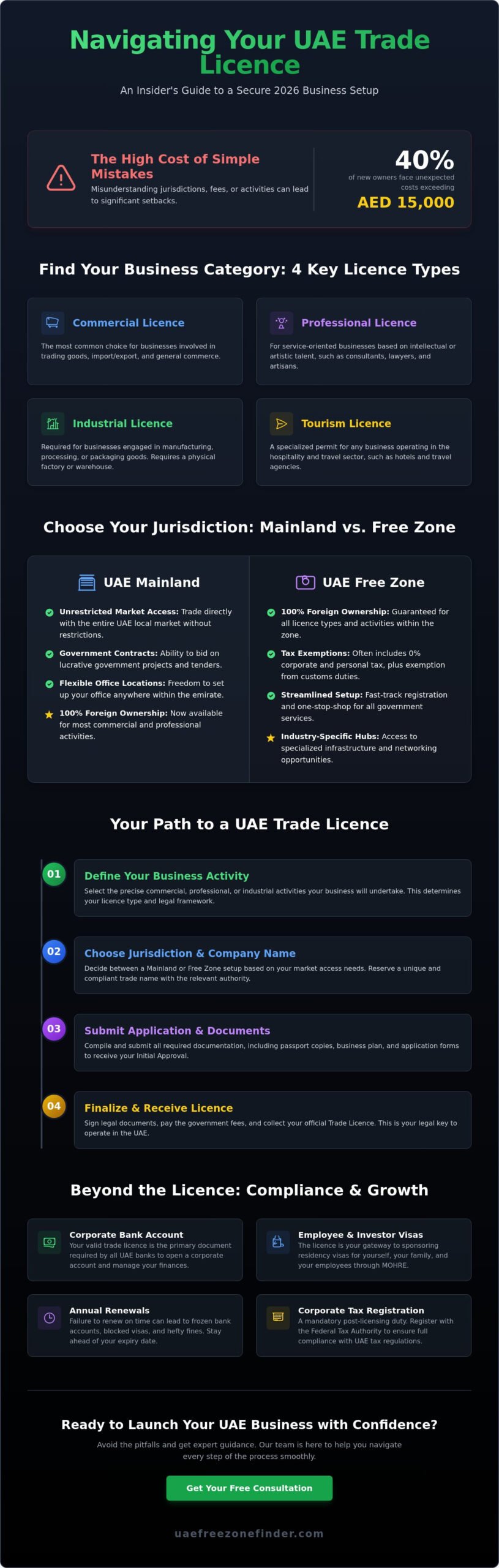
What if the most expensive mistake you make this year isn’t your office rent, but a simple misunderstanding of your jurisdiction? Data from 2024 industry reports suggests that 40% of new business owners in Dubai face unexpected expenses exceeding AED 15,000 because they didn’t account for specific document attestation or activity-based fees. You’ve likely felt that same hesitation while researching a trade licence uae, wondering if the “all-inclusive” packages you see online actually cover the fine print.
It’s a valid concern, and we’re here to provide the steady hand you need. This guide promises to strip away the complexity by offering an insider’s breakdown of setup costs, category selection, and strategic positioning for the 2026 market. You’ll move from confusion to confidence with a clear roadmap that ensures your business isn’t just launched, but fully optimized for the latest tax regulations. We’ll walk you through the precise differences between mainland and free zone requirements so you can find the perfect fit for your commercial goals.
Key Takeaways
- Identify the critical differences between commercial and professional categories to ensure your business activity aligns with the right legal framework.
- Evaluate the strategic trade-offs between mainland and free zone jurisdictions to secure the best market access and ownership structure for your goals.
- Follow our expert-led, step-by-step roadmap to obtain your trade licence uae without getting stuck in common bureaucratic bottlenecks.
- Gain a clear understanding of mandatory post-licensing duties, including Corporate Tax registration and annual renewal cycles, to keep your operations compliant.
- Learn how to optimize your setup costs and navigate the latest 2026 regulations to build a professional foundation for your company’s growth.
What is a Trade Licence in the UAE and Why is it Mandatory?
A trade licence uae is much more than a simple permit; it’s the legal foundation of your business identity. It acts as the official certification that allows you to conduct specific commercial, industrial, or professional activities within the Emirates. Without this document, your company doesn’t legally exist in the eyes of the government. It’s issued by various licensing authorities depending on your location and business type, serving as the primary bridge between your entrepreneurial vision and the UAE’s robust economic ecosystem.
In the 2026 landscape, the UAE has fully integrated the National Economic Register (NER). This digital transformation means every trade licence uae is now linked to a unified database. This makes it easier for government agencies, landlords, and partners to verify your business status instantly. You can’t skip this step because it’s the gateway to essential services. Your legal protection under UAE corporate law, your ability to sponsor employees, and your eligibility for a corporate bank account all hinge on this single document.
The Role of Licensing Authorities
The authority overseeing your application depends entirely on your chosen jurisdiction. If you’re setting up a mainland business, the local Department of Economy and Tourism (DET) in your specific Emirate is your primary regulator. For those in Free Zones, the specific hub’s authority manages your permit. Your licence acts as a corporate passport. When you approach a bank for a corporate account, they use your licence to assess your risk profile and operational scope. The Ministry of Economy provides the overarching federal framework, but your day-to-day compliance is managed at the local or Free Zone level.
Legal Consequences of Unlicensed Trading
The UAE takes regulatory compliance seriously. Operating without a valid permit isn’t a minor slip-up; it’s a major legal risk. Financial penalties often start at AED 5,000 and can climb to AED 50,000 for repeated or serious violations. If you let your licence expire, the fallout is immediate. Most banks freeze corporate accounts within 30 days of a licence expiry date. Furthermore, the Ministry of Human Resources and Emiratisation (MOHRE) will block your ability to issue or renew residency visas. You can check the validity of any company’s status through the National Economic Register or local DET portals to ensure you’re always on the right side of the law.
Types of Trade Licences: Finding Your Business Category
Choosing the correct trade licence uae category is the first real hurdle in your entrepreneurial journey. It isn’t just a label; it defines your legal boundaries, your tax profile, and the specific activities you’re allowed to perform. The UAE government classifies businesses into four primary categories to ensure every company operates under the right regulatory framework.
- Commercial Licence: This is the most common choice for businesses involved in trading. Whether you’re importing electronics or exporting textiles, this licence covers general and specialized trading.
- Professional Licence: If your business relies on your specific skills or intellectual effort, this is for you. It’s designed for consultants, lawyers, auditors, and artisans.
- Industrial Licence: You’ll need this if you plan to manufacture, process, or package goods. It requires a physical warehouse or factory space within the UAE.
- Tourism Licence: This is a specialized permit for travel agencies, hotels, and any business operating within the hospitality and travel sector.
Selecting the wrong category can lead to fines or delays in your bank account opening. It’s often helpful to consult a business setup expert to ensure your chosen activities align with your long-term goals.
Commercial vs. Professional: Which Fits You?
The main difference between these two lies in the ownership structure and the nature of the work. Historically, professional licences allowed 100% foreign ownership while commercial licences required a local partner. However, following the landmark 2021 amendments to the Commercial Companies Law, many commercial activities now also allow 100% foreign ownership in mainland jurisdictions. You’ll select your specific activity from a unified directory of over 2,000 codes. This Guide for global business owners highlights how these choices impact your operational flexibility and tax residency status.
Specialized and Industrial Permits
Industrial licences come with more stringent requirements than a standard commercial setup. You must obtain additional approvals from the Ministry of Industry and Advanced Technology (MoIAT) and the local municipality. These authorities check that your facility meets environmental and safety standards before the licence is issued. If you want to expand, you can often add multiple related activities to a single licence. For instance, a manufacturer might add a commercial activity code to trade their own produced goods. This keeps your corporate structure lean while allowing for significant growth. You’ll need to provide a detailed feasibility study and proof of a physical site to secure these permits.
Choosing Your Jurisdiction: Mainland vs. Free Zone Setup
Selecting the right jurisdiction isn’t just a legal formality; it’s a strategic move that determines your company’s growth ceiling. Your trade licence uae will fall into one of three categories: Mainland, Free Zone, or Offshore. Each serves a distinct purpose depending on your operational needs and where your customers live. Making the wrong choice early on can lead to expensive restructuring costs later, so getting this right is your first priority.
Mainland Benefits and Requirements
Mainland companies are licensed by the Department of Economic Development (DED) in their respective Emirate. The biggest shift in the UAE business landscape occurred in June 2021, when the government amended the Commercial Companies Law. This change allows 100% foreign ownership for over 1,000 commercial and industrial activities, removing the previous requirement for a local partner to hold 51% of shares. If your business plan involves bidding for government contracts or opening multiple retail outlets across the city, a mainland licence is the standard choice. It offers the freedom to trade anywhere in the UAE and internationally without restrictions.
The Advantage of Free Zone Licensing
Free zones are designated areas that offer highly specialized infrastructure and tax benefits. You can find the best free zone company formation by looking for hubs that cater specifically to your industry, such as tech, media, or logistics. These zones provide 100% import and export tax exemptions and simplified customs procedures. However, there’s a trade-off. A free zone company cannot trade directly with the local UAE market without using a mainland agent or distributor. This makes free zones ideal for service providers, consultants, and businesses focused on international trade.
Offshore Setup and Decision Framework
Offshore jurisdictions, like JAFZA or RAKICC, aren’t designed for active local operations. These are used primarily for international asset holding, succession planning, or owning property. You won’t get a physical office or residency visas with an offshore setup, and you can’t conduct business within the UAE borders.
To decide which path fits your goals, use this simple framework:
- Target Market: If your primary clients are UAE government entities or local consumers in residential areas, choose Mainland.
- Ownership & Tax: If you want a specialized ecosystem with 0% corporate tax on qualifying income and don’t need a local retail presence, a Free Zone is usually better.
- Physical Presence: Mainland licences require a physical office or shop space, while many free zones offer “flexi-desk” arrangements that keep overheads low for startups.
- Budget: Initial setup costs vary, but free zones often provide bundled packages that include the trade licence uae and visa processing for a fixed annual fee.
Your choice should align with where you see the business in five years. While free zones offer a quick and cost-effective entry, the mainland provides the scale required for national expansion.
The Step-by-Step Path to Securing Your UAE Trade Licence
Getting your trade licence uae doesn’t have to be a bureaucratic headache. The process is now more digitized than ever, reflecting the country’s push for a paperless economy. First, you’ll define your business activity. This choice dictates your legal structure, whether it’s a Limited Liability Company (LLC) or a Sole Proprietorship. In 2026, mainland LLCs allow 100% foreign ownership for over 1,000 commercial and industrial activities, making the choice between mainland and free zone more about strategy than ownership limits.
Second, you’ll register your trade name. Avoid religious or provocative terms and ensure it doesn’t infringe on existing brands. Once the Department of Economy and Tourism (DET) or your chosen free zone clears the name, you’ll receive an initial approval. This document confirms the UAE government has no objection to you starting a business and allows you to proceed with the next legal steps.
Third, you must draft your Memorandum of Association (MOA). For mainland setups, this usually requires a visit to a public notary, though digital notarization via video call is now the standard. If you’re establishing a professional sole establishment, you’ll sign a Local Service Agent (LSA) agreement instead. This document outlines the relationship between the owner and the agent, who handles administrative liaisons without taking equity.
Fourth, you need to find your base. A physical address is mandatory to finalize your trade licence uae. For mainland firms, this means securing an Ejari (an attested lease agreement). Free zone entities often opt for “flexi-desks,” which are cost-effective shared spaces that satisfy the legal requirement for a physical presence without the high overhead of a private office.
Finally, submit all documents through the relevant digital portal, pay the licensing fees, and download your digital licence. Some “Instant Licences” are issued in just five minutes for specific activities that don’t require external approvals.
Documentation and Attestation Checklist
You’ll need clear passport copies, visa pages, and a No Objection Certificate (NOC) if you’re currently employed in the UAE. International documents, such as degree certificates for consultancy roles, must be attested by the Ministry of Foreign Affairs (MOFA). This attestation usually takes 2 to 4 working days. Most submissions now happen through the “Invest in Dubai” platform or unified free zone apps, which has reduced manual paperwork by 80% compared to the start of the decade.
Timeline and Expected Costs
Standard processing takes 5 to 7 working days. However, security clearances for certain nationalities or specialized activities might add 48 hours to the timeline. Government fees vary based on the jurisdiction. A mainland professional licence might start around AED 15,000, while free zone packages can begin as low as AED 10,000. These figures include administrative charges but exclude the refundable 5% housing fee calculated on your office rent. To avoid delays, ensure your activity perfectly matches your office’s zoning regulations.
Ready to find the most cost-effective jurisdiction for your startup? Let us help you compare UAE free zone packages and find your perfect fit today.
Post-Licensing: Renewals, Compliance, and Growth
Securing your trade licence uae marks the end of the setup phase and the beginning of your operational journey. You’ve got the paperwork. Now you need to keep it valid. Most jurisdictions require annual renewals. If you miss your expiry date, expect monthly fines that start around AED 200 in many mainland districts. It’s not just about the money; an expired licence freezes your bank account and halts visa processing. Staying active means staying compliant with every local regulation.
Once you have your physical licence, you can open a corporate bank account to manage your capital. This step is often the most time-consuming part of the post-licensing phase. Simultaneously, you’ll begin visa processing for yourself and your team. In 2026, the UAE continues to offer 2-year and 10-year residency options depending on your investment level and sector. Managing these residency permits for families and employees requires a clear timeline to avoid overstay penalties.
Navigating the 2026 Tax Landscape
The tax environment shifted significantly after June 1, 2023. Now, businesses with profits exceeding AED 375,000 face a 9% Corporate Tax rate. You must register with the Federal Tax Authority (FTA) even if you expect your revenue to fall below this threshold. Keep your books clean. Even small enterprises must maintain records for at least five years. If your taxable turnover hits the mandatory threshold of AED 375,000, VAT registration at 5% is required. Don’t wait for a tax audit to get your accounting in order. Accurate bookkeeping is the only way to satisfy annual audit requirements and maintain your standing with the authorities.
Managing Licence Renewals and Amendments
Growth often means change. You might start with a consultancy licence but later decide to trade physical goods. Upgrading your activities requires a formal amendment to your trade licence uae. This process involves getting approvals from relevant departments like the Department of Economy and Tourism (DET) or your specific Free Zone authority. For renewals, start the process 30 days before your current licence expires. Consider these steps for a smooth transition:
- Verify Lease Validity: Ensure your office or warehouse tenancy contract (Ejari) is active.
- Update Documents: Have your latest audit reports ready if your jurisdiction requires them.
- Clear Fines: Pay any outstanding traffic or municipal fines linked to the company.
Hiring a professional PRO service saves you from the bureaucracy of government portals. They handle the document clearing while you focus on scaling your revenue. This expert matching ensures your business stays on the right side of the law as you expand across the Emirates.
Launch Your UAE Success Story in 2026
Securing your trade licence uae is the essential first step toward establishing a commercial presence in one of the world’s most dynamic markets. You now understand that selecting the right jurisdiction from over 40 available options is a strategic decision that impacts your tax residency and operational flexibility. Success depends on following a precise step-by-step path, from choosing your business category to managing post-licensing compliance. Navigating these regulatory requirements doesn’t have to be a source of stress for your leadership team.
With practical UAE setup experience, UAE Free Zone Finder helps coordinate documentation, authority steps and post-setup requirements without promising official approvals. We provide expert guidance across 40+ jurisdictions and offer comprehensive support that extends from initial licensing to securing residency visas for your staff. We focus on the administrative heavy lifting so you can concentrate on your market entry strategy. We’ve helped thousands of entrepreneurs turn complex bureaucratic hurdles into a straightforward path to incorporation.
Get your personalized UAE business setup quote today
The Emirates offer a landscape of unparalleled opportunity for those who start with a solid legal foundation. Your vision for global expansion is within reach, and we’re ready to help you build it with confidence.
Frequently Asked Questions
How much does a trade licence cost in the UAE?
A trade licence uae cost typically ranges from AED 5,000 in certain Northern Emirate free zones to over AED 40,000 for complex mainland setups. These figures include registration fees and initial approvals but exclude office rent or multi-year visas. You’ll find that Sharjah Research Technology and Innovation Park (SRTIP) or Meydan Free Zone often provide competitive entry-level packages for startups starting at AED 12,500.
Can I get a trade licence without a physical office?
You can obtain a licence without a traditional physical office by opting for a flexi-desk or virtual office package. Most free zones, such as IFZA or Dubai CommerCity, offer these “e-office” solutions specifically for digital nomads and consultants. It’s a cost-effective way to meet legal requirements while maintaining a professional business address in the UAE, often saving you over AED 20,000 in annual rent.
What is the difference between a trade licence and a business licence?
A trade licence is a specific legal document that allows you to carry out commercial, industrial, or professional activities within a chosen jurisdiction. While people use “business licence” as a general term, the Department of Economy and Tourism (DET) issues specific categories like Commercial, Industrial, or Professional licences. Each category dictates your legal structure and the scope of operations you can perform, ensuring you stay compliant with federal laws.
How long is a UAE trade licence valid for?
Most UAE trade licences are valid for one year and require annual renewal to remain compliant. However, several jurisdictions now offer multi-year options, allowing you to pay for two or three years upfront to secure current rates. You must initiate the renewal process at least 30 days before the expiry date to avoid late fines, which usually start at AED 200 per month and can escalate quickly.
Can I have more than one business activity on a single licence?
You can bundle multiple business activities on a single licence, provided they fall under the same category, such as commercial or professional. Most free zones allow up to three related activities for a flat fee, while additional activities might incur a charge of AED 1,000 to AED 2,000 each. It’s vital to ensure your activities are compatible to avoid needing two separate licences, which would double your annual administrative costs.
Do I need a local partner to get a trade licence in 2026?
You don’t need a local Emirati partner for the vast majority of business activities in 2026. Following the landmark changes to the Commercial Companies Law in 2021, over 1,000 commercial and industrial activities now allow 100% foreign ownership on the mainland. Free zones have always offered full ownership, making the UAE one of the most accessible markets for international investors looking for complete control over their ventures.
How do I check the status of my trade licence application online?
You can track your application status through the official portal of the relevant licensing authority, such as the Dubai DET “e-Services” platform or the Abu Dhabi “TAMM” portal. For a broader search, the UAE’s National Economic Register (NER) provides a unified database where you can verify the status of any trade licence uae by entering the company name or licence number. These digital platforms provide real-time updates on approvals.
Is it possible to convert a Free Zone licence to a Mainland licence?
It’s not possible to “convert” a licence directly; instead, you must establish a new mainland entity or open a mainland branch of your existing free zone company. This process involves a fresh application with the Department of Economy and Tourism and potentially liquidating the original free zone entity if it’s no longer needed. Many entrepreneurs choose to keep both to balance free zone tax benefits with direct access to the local UAE market.
Disclaimer
The information provided in this article is intended for general informational purposes only and reflects conditions as understood at the time of publication. Free zone regulations, fees, and requirements in the UAE are subject to change. Readers are advised to verify details with the relevant free zone authority or regulatory body before making any business decisions. For personalised guidance, our business setup experts at UAE Free Zone Finder are available to assist — contact us at info@uaefreezonefinder.com or call +971-507864823.