Cost of Hiring Your First Employee in the UAE: 2026 Complete Guide
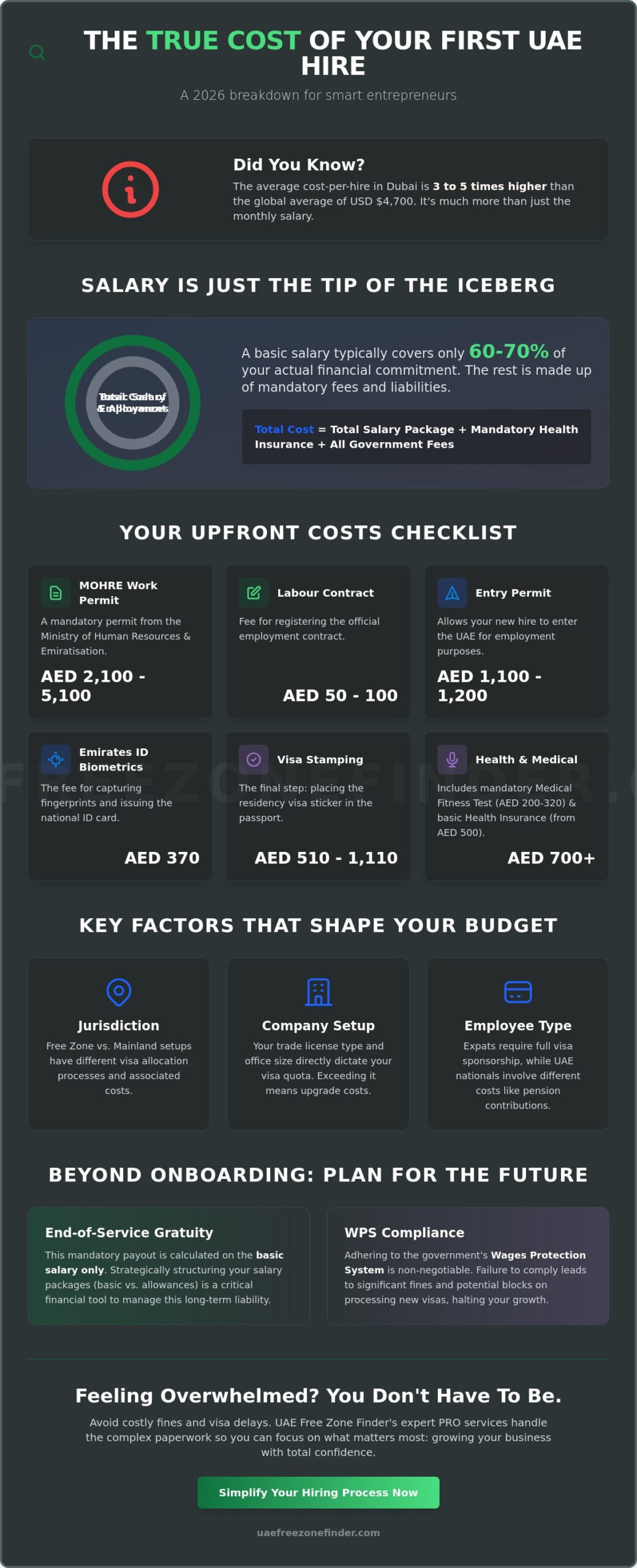
Did you know that the average cost-per-hire in Dubai is actually three to five times higher than the global average of USD 4,700? While scaling your business is a major milestone, the financial reality often catches entrepreneurs off guard. You’ve likely realized that the cost of hiring first employee in uae involves much more than just a monthly salary. Between mandatory government fees and the nuances of the Wages Protection System, it’s easy to feel overwhelmed by the complexity of the regulatory landscape.
We understand that you want to grow your team without the fear of unexpected MOHRE fines or miscalculating long-term gratuity liabilities. This guide provides a complete breakdown of every expense you’ll face in 2026, from medical fitness tests starting at AED 200 to the AED 370 Emirates ID biometrics fee. You’ll gain a clear, predictable budget and a checklist of legal requirements to ensure you stay fully compliant. We’re going to walk through the exact numbers so you can focus on your business expansion with total confidence.
Key Takeaways
- Calculate the true Total Cost of Employment by recognizing that a basic salary typically only covers about 70% of your actual financial commitment.
- Identify the non-negotiable government expenses you’ll face, ranging from entry permits and medical fitness tests to Emirates ID registration fees.
- Compare the visa allocation processes between mainland and free zone jurisdictions to determine which setup offers the most budget-friendly hiring path.
- Master the financial nuances of the cost of hiring first employee in uae by planning for mandatory health insurance, WPS compliance, and long-term gratuity liabilities.
- Discover how strategic jurisdiction selection and professional PRO services can protect your bottom line from unexpected administrative fines and visa delays.
Beyond the Salary: What Does Hiring Actually Cost in the UAE?
When you prepare your first job offer letter, the monthly figure you’ve discussed with your candidate is only one part of the equation. In this region, we use a concept called the Total Cost of Employment (TCE). This figure represents the actual drain on your corporate bank account once all legal and operational obligations are met. As the UAE’s economic landscape continues to diversify in 2026, the regulatory environment has become more sophisticated, making precise budgeting a necessity rather than an option.
Your journey begins with your trade license. Many entrepreneurs don’t realize that their license type and office size directly dictate their visa quota. Whether you’re on the mainland or in a free zone, your jurisdiction sets a limit on how many staff members you can sponsor. If you’ve reached your limit, you might face the unexpected cost of a license upgrade or a larger office lease before you can even issue an entry permit. This link between company setup and recruitment is a critical factor in the cost of hiring first employee in uae.
The Hidden “Onboarding Tax”
Think of the initial administrative fees as a mandatory “onboarding tax.” These are the upfront costs required to move a candidate from “hired” to “legal resident.” This includes the entry permit, medical fitness tests, and the issuance of the Emirates ID. While these feel like one-time expenses, they’re actually recurring. Most residency visas in the UAE operate on a two or three-year cycle. You’ll need to budget for these same fees every time a renewal comes around. It’s also vital to distinguish between expat and national hires. While expats require full residency sponsorship, hiring a UAE national involves specific pension contributions and social security registrations that follow a different cost structure.
Why Quoted Salary is Only the Starting Point
In the UAE, it’s standard practice to split a salary into a “Base” amount and various “Allowances” for housing, transport, or utilities. This isn’t just a clerical preference; it’s a strategic financial tool. Since the law calculates end-of-service gratuity based only on the basic salary, the way you structure the package significantly impacts your long-term liabilities. Typically, the basic salary only represents about of to 70% of the true cost to the company. Total Cost of Employment is the sum of the total salary package, mandatory health insurance premiums, and all government-related levies. If you only budget for the monthly transfer, you’ll find your margins shrinking faster than expected.
The 5 Mandatory Costs You Can’t Avoid
While understanding the Total Cost of Employment is great for high-level planning, you need to see the actual line items on your invoice. The cost of hiring first employee in uae is built on five pillars that every business owner must fund before the first day of work. These aren’t suggestions; they’re the legal barriers to entry. According to Bank Bank data on the UAE, the labor market here is highly regulated to ensure stability, and these fees are the mechanism for that oversight. You’ll need to budget for the MOHRE work permit application, which currently ranges from AED 2,100 to AED 5,100 depending on your company’s classification, along with a labour contract registration fee of AED 50 to AED 100.
Visa and Immigration Processing
The journey from offer letter to residency visa stamping is a multi-step sprint. First, you’ll secure an entry permit, costing between AED 1,100 and AED 1,200. If your hire is already in the country on a tourist or previous employment visa, you’ll pay an additional fee for a “change of status” to avoid them having to exit and re-enter. Once they’re here, the mandatory medical fitness test (AED 200 to AED 320) and the Emirates ID biometrics (AED 370) must be completed. Finally, the residency visa stamping costs between AED 510 and AED 1,110. Managing these shifting fees can be a full-time job. Many founders find that utilizing professional PRO Services is the most efficient way to avoid the fines associated with missed deadlines or incorrect filings.
Mandatory Health Insurance Tiers
You cannot complete a visa stamping without proof of health insurance. In 2026, the UAE continues to enforce strict insurance mandates that vary by Emirate. For employees in lower salary bands, the Essential Benefits Plan (EBP) provides a cost-effective compliance route, with premiums starting around AED 500. However, for mid-level and senior talent, premiums can exceed AED 4,000 annually. Age and gender significantly affect these rates; for example, premiums for female employees of child-bearing age are typically higher due to mandatory maternity coverage. You’ll also need to factor in the Worker Protection Insurance (Taa-meen), a lean AED 120 annual fee that replaced the old, expensive bank guarantee system, providing a safety net for employee wages and benefits.
Free Zone vs. Mainland Hiring: Which Is More Cost-Effective?
Choosing the right jurisdiction for your business is the single most important decision affecting the cost of hiring first employee in uae. While the core visa fees are relatively similar across the country, the administrative framework and physical requirements differ significantly between Mainland and Free Zone setups. On the Mainland, your relationship is direct with the Ministry of Human Resources and Emiratisation (MOHRE). In a Free Zone, the specific authority acts as an intermediary, effectively “sponsoring” the employee on your behalf. This distinction impacts everything from your initial paperwork to your annual renewal fees.
Visa Quotas and Office Requirements
One of the most overlooked costs in recruitment is the physical space required to legally house your staff. Most jurisdictions operate on a “square footage per visa” rule. On the Mainland, you typically need about 80 to 100 square feet of office space for every visa quota you request. If you’re looking for a leaner start, many Free Zones offer “flexi-desk” or “coworking” packages. These usually permit between one and three visa allocations without the need for a traditional private office. Understanding these UAE Free Zone Company Formation options is essential, as the wrong choice could force you into an expensive office lease just to hire your first team member.
Government Levies and Emiratisation
The regulatory landscape in 2026 places a heavy emphasis on the Nafis program and Emiratisation targets. Currently, Mainland companies with 50 or more employees must increase their Emirati workforce by 2% annually or face a non-compliance fine of AED 72,000 per unfilled position per year. While these quotas don’t yet apply to most small startups or Free Zone entities, Mainland firms must stay vigilant about shifting thresholds. Free Zones remain a popular choice for international investors because they’re currently exempt from these specific hiring quotas, providing a more predictable path for expat-only teams. You should also factor in the annual Establishment Card renewal, which is a recurring cost for both Mainland and Free Zone companies, though the exact fee varies depending on the specific Emirate and authority you choose.
Ultimately, the Mainland offers more flexibility for local trade, but the Free Zone model often provides a more streamlined, “all-in-one” approach to visa processing. By centralizing the bureaucracy, Free Zones can often reduce the time and indirect costs associated with your first hire. However, if your business model requires a physical presence in the local market, the higher overhead of a Mainland setup might be a necessary trade-off for your long-term growth strategy.
Avoiding Compliance Traps: WPS, Gratuity, and Insurance
Managing the ongoing cost of hiring first employee in uae requires a shift from one-time visa fees to recurring compliance obligations. While your initial focus was likely on the entry permit and medical tests, your monthly cash flow is now governed by the Wage Protection System (WPS). This isn’t just a standard bank transfer; it’s a monitored electronic salary transfer system that ensures every dirham reaches your employee on time and in full. Failing to navigate this correctly doesn’t just result in unhappy staff; it triggers automatic flags in the MOHRE system that can lead to license suspensions and heavy financial penalties.
The Wage Protection System (WPS) Workflow
To stay compliant, you must register your company with a UAE-based bank or a certified exchange house that supports WPS. Every month, you’ll generate a Salary Information File (SIF). This digital document contains specific data points, including the employee’s unique labor ID, their fixed salary, and any deductions. As of 2026, the enforcement of these payments has moved to a rolling obligation. If you’re late by even a few days, the system may automatically block your company from issuing new visas or renewing existing ones. You should budget approximately AED 300 for the initial WPS bank setup charges to ensure your payroll infrastructure is solid from the start.
Calculating End-of-Service Gratuity
While WPS handles the present, gratuity covers the future. Under current UAE Labour Law, employees are entitled to an end-of-service benefit if they’ve completed at least one year of service. The standard formula is 21 days of basic salary for each year of the first five years of employment. For any service beyond five years, the rate increases to 30 days of basic salary per year. Accruing for gratuity from day one prevents a massive cash-flow shock when an employee eventually departs. It’s a common mistake for first-time employers to ignore this accrued debt until the resignation letter hits their desk.
In recent years, the government has introduced voluntary “Gratuity Fund” schemes. These allow you to pay a small monthly contribution into a regulated investment fund rather than carrying the total liability on your company balance sheet. This can be a more sustainable way to manage the long-term cost of hiring first employee in uae. Because the legal landscape for payroll and benefits is constantly evolving, many founders choose to outsource their Bookkeeping and Accounting Services to maintain perfect compliance and avoid the stress of manual calculations. By treating these future liabilities as current expenses, you protect your business from the “hidden” costs of growth.
How UAE Free Zone Finder Simplifies Your First Hire
Managing the cost of hiring first employee in uae doesn’t have to be a source of constant stress. While the technical details we’ve discussed, from visa fees to gratuity accruals, might seem daunting, they’re simply steps in a well-defined process. Our role at UAE Free Zone Finder is to act as your expert bridge, translating complex government mandates into a clear, actionable roadmap. We don’t just provide raw data; we offer the strategic direction needed to ensure your first hire is a financial success rather than a compliance headache.
From Formation to First Hire
Your recruitment strategy actually starts during your company formation. If you choose a jurisdiction without considering your future team size, you might find yourself trapped with a limited visa quota or expensive office requirements. Our team utilizes an “Expert Matching” process to align your business license with your hiring goals from day one. We handle the heavy lifting of securing your establishment card and managing the visa quota application, so you can focus on finding the right talent. Our comprehensive support for residency visa processing ensures that your new team member moves from “candidate” to “legal resident” without the typical delays that inflate onboarding costs.
Outsourcing the Administrative Burden
Once your employee is on board, the focus shifts to maintaining long-term compliance. The 2026 regulatory environment requires precise attention to VAT registration, Corporate Tax filings, and the monthly WPS cycle. We provide integrated Bookkeeping and Accounting Services that take these burdens off your desk, ensuring your records are always audit-ready. To facilitate a smooth payroll setup, our corporate bank account assistance connects you with the right financial institutions to handle your Salary Information Files (SIF) correctly.
If you’re ready to scale, don’t leave your budget to chance. We invite you to book a consultation with our team for a custom breakdown of the cost of hiring first employee in uae tailored to your specific industry and jurisdiction. By letting our PRO services handle the bureaucracy, you ensure that your business growth is built on a foundation of legal accuracy and financial transparency. We’re here to make sure your first hire is simply the first of many successful additions to your team.
Secure Your UAE Growth Strategy for 2026
Success in the Emirates depends on looking far beyond the monthly salary figure. You now understand that the true cost of hiring first employee in uae is a sophisticated calculation involving upfront government levies, mandatory insurance tiers, and long-term accrued liabilities. Whether you’ve decided on the streamlined path of a free zone or the local market reach of a mainland LLC, your budget must account for every line item from the initial entry permit to the final end-of-service gratuity. Navigating these requirements shouldn’t feel like a barrier to your expansion.
Don’t let administrative complexity or the fear of MOHRE fines slow your momentum. We provide expert PRO services across all 40+ free zones and specialized support for mainland LLC formation to ensure your residency visa management is entirely hassle-free. Our team acts as your steady hand in this complex regulatory environment, helping you transition from a solo founder to a team leader with total confidence. Get a custom breakdown of your hiring costs today and build your team with absolute financial clarity. Your first hire is a major milestone; let’s make sure it’s the solid foundation your global business deserves.
Frequently Asked Questions
Do I need a physical office to hire my first employee in the UAE?
Yes, you’ll need a registered physical address, but the type of space depends on your jurisdiction. Mainland companies must have a physical office with specific square footage per employee. Many Free Zones offer flexi-desk options that allow you to manage the cost of hiring first employee in uae without the overhead of a private office lease.
Can I hire an employee on a freelance visa if I have my own company?
You can engage freelancers, but they must hold a valid UAE freelance permit and you must secure a work permit for them to work for your entity. It’s a common mistake to assume a freelance visa covers all work; they still need specific authorization from the relevant authority to legally serve your business.
How much is the mandatory health insurance for an employee in 2026?
Mandatory insurance starts at approximately AED 500 for the Essential Benefits Plan (EBP). For mid-level or senior roles, premiums often climb above AED 4,000 depending on the employee’s age and gender. These 2026 rates include mandatory maternity and emergency coverage as required by UAE law.
What happens if I don’t pay my employee through the WPS?
Failing to use the Wages Protection System triggers immediate administrative penalties. Your company will be blocked from issuing new visas, and you’ll face fines that scale with the duration of the delay. The MOHRE system monitors these transfers in real-time to ensure labor law compliance.
Is the end-of-service gratuity mandatory for all employees?
Gratuity is a legal requirement for all expat employees who complete at least one year of continuous service. It’s calculated based on the employee’s final basic salary and length of tenure. UAE and GCC nationals are the only exception, as they’re enrolled in the national pension scheme instead.
Can a Free Zone company hire employees from the UAE mainland?
Yes, Free Zone entities can hire talent from the mainland, but the employee must undergo a formal visa transfer. You’ll need to cancel their mainland residency and issue a new visa through your Free Zone authority. This ensures the employee is legally sponsored by the entity they’re actually working for.
What are the costs for a visa for a family member of my employee?
While not a legal requirement for employers, family visa costs include entry permits, medical tests, and Emirates ID fees, similar to employee costs. You’ll also need to provide a registered tenancy contract to prove the employee has adequate housing. These costs are usually handled by the employee unless otherwise negotiated.
How long does the visa process take for the first hire?
The total timeline for the cost of hiring first employee in uae usually spans 10 to 15 working days. While 2026 government updates have reduced entry permit processing to just 5 working days, you still need to factor in time for medical fitness results and Emirates ID biometrics.
Disclaimer
The information provided in this article is intended for general informational purposes only and reflects conditions as understood at the time of publication. Free zone regulations, fees, and requirements in the UAE are subject to change. Readers are advised to verify details with the relevant free zone authority or regulatory body before making any business decisions. For personalised guidance, our business setup experts at UAE Free Zone Finder are available to assist — contact us at info@uaefreezonefinder.com or call +971-507864823.