The Strategic Guide to Company Formation in the UAE (2026)

By 2026, the “set it and forget it” era of international business in the UAE has officially ended. You’ve probably realized that choosing between 40 plus free zones isn’t just about finding the lowest price anymore; it’s about long term compliance and operational survival. It’s natural to feel a bit of anxiety over the 9% corporate tax introduced in June 2023 or the high rejection rates for corporate bank accounts that many founders still face today. We know you want a straightforward path to 100% foreign ownership and a valid residency visa for your family without getting stuck in bureaucratic loops during your company formation UAE, UAE business setup, or UAE company registration.
This strategic guide simplifies the entire process by providing a clear, expert led roadmap. We’ll show you how to master the complexities of free zone business setup while ensuring your venture remains a successful piece of international business UAE. You’ll get a direct look at the latest 2026 regulations, license requirements, and the specific steps needed to ensure your bank account stays active and compliant from day one. By the end of this article, you’ll have the clarity needed to transform administrative hurdles into a competitive advantage.
Key Takeaways
- Identify the ideal legal framework for your specific goals by comparing the operational benefits of Free Zone, Mainland, and Offshore jurisdictions.
- Navigate the complexities of company formation UAE and UAE business setup with a clear roadmap that prioritizes initial approvals before you commit to office leases.
- Align your trade license selection with specific banking requirements to avoid the common pitfalls that often delay corporate account openings.
- Secure your long-term presence in the region by mastering essential post-incorporation steps, including residency visas and modern regulatory compliance.
- Gain an insider’s perspective on how to position your business as a strategic gateway to high-growth markets across the MEASA region in 2026.
Navigating the UAE Business Setup Landscape in 2026
The United Arab Emirates isn’t just a regional hub; it’s the definitive gateway to the Middle East, Africa, and South Asia (MEASA) markets. By 2026, company formation UAE has matured into a sophisticated strategic choice for brands looking to access a consumer base of over 2.4 billion people. While the global economy faces various shifts, the UAE continues to stand out as a top-tier destination because of its pro-business policies and unmatched connectivity. You aren’t just registering a business here; you’re plugging into a global network that operates 24/7.
Many investors initially worried when the UAE moved from a zero-tax environment to a 9% corporate tax on profits exceeding AED 375,000. However, this transition has actually boosted the country’s global credibility. It signals to the world that the UAE is a transparent, regulated, and mature economy. This shift helped the nation secure its position as a compliant, white-listed financial hub, making it much easier for companies to open international bank accounts and engage in cross-border trade without the stigma often associated with tax havens.
Choosing the right path requires understanding the nuances of UAE Corporate Law Explained, which provides the legal foundation for mainland and free zone entities. As we look at the landscape in 2026, the decision between these economic zones depends entirely on your specific operational needs and target audience.
Why International Business Chooses the UAE
- Full Control: The 100% foreign ownership rules now apply to more than 1,000 commercial and industrial activities, removing the old requirement for a local Emirati partner in most sectors.
- Global Talent Pool: World-class infrastructure and flexible visa options, such as the Green Visa and Golden Visa, make it simple to attract and retain the brightest minds from across the globe.
- Strategic Timing: The GMT+4 time zone is a massive advantage. It’s the perfect bridge that allows you to close deals in East Asia in the morning and start your calls with New York by late afternoon.
The 2026 Regulatory Environment
The Ministry of Economy has been instrumental in modernizing business laws to keep pace with the digital age. They’ve streamlined UAE business setup by digitizing almost every step of the incorporation process. A major focus remains on Ultimate Beneficial Ownership (UBO) transparency, which ensures that all entities operate with high levels of integrity and accountability. The UAE is currently recognized as a fully compliant, white-listed financial hub that meets all international standards for anti-money laundering and tax transparency. This regulatory clarity gives you the peace of mind that your investment is protected by a stable and predictable legal framework.
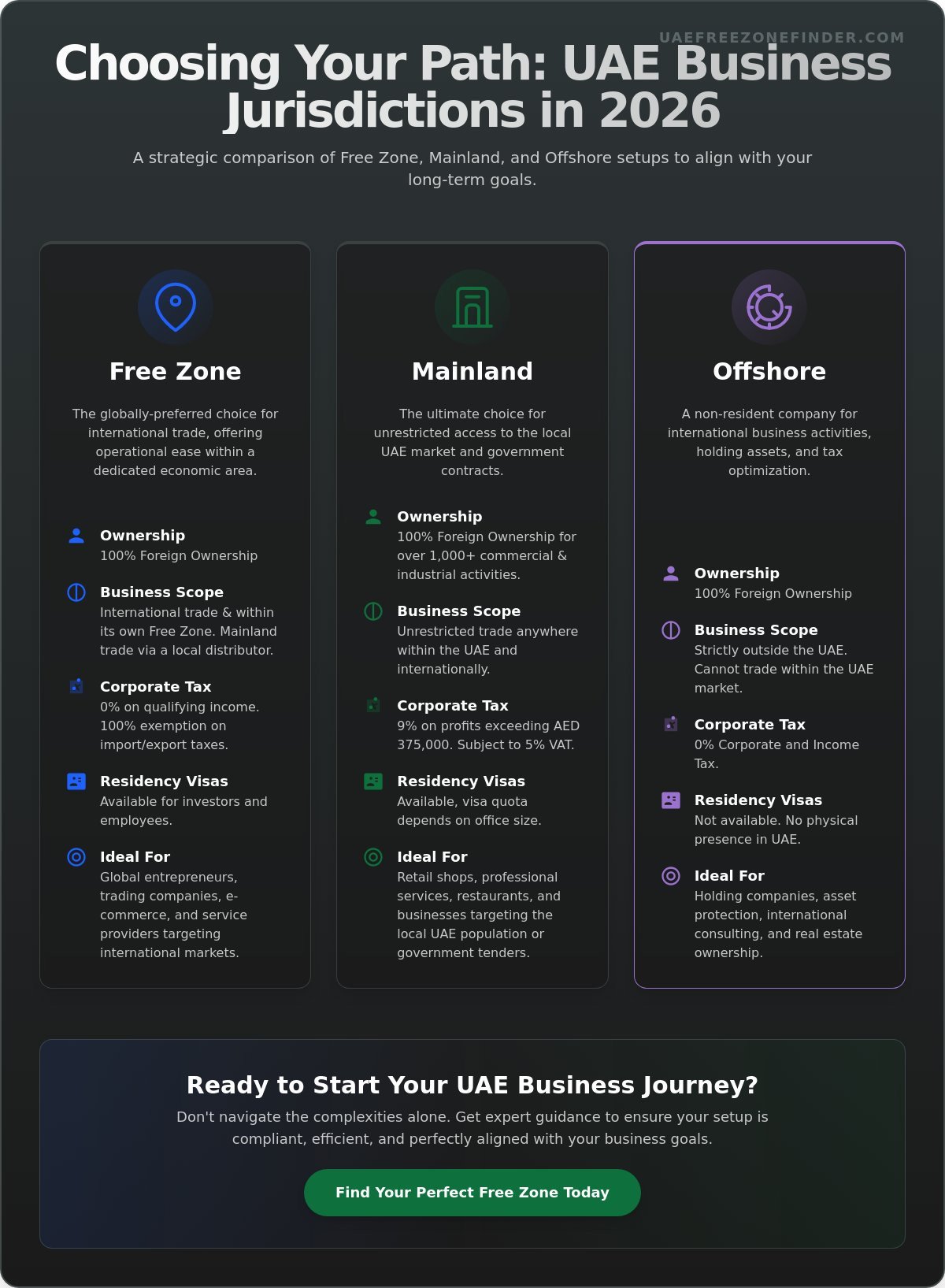
Deciphering Jurisdictions: Free Zone, Mainland, and Offshore
Selecting the right legal framework for company formation UAE is the most critical decision an investor makes. Many entrepreneurs mistakenly prioritize setup costs above all else. In reality, your choice dictates where you can trade, who your clients can be, and how you handle taxes. You must distinguish between onshore and offshore entities before signing any contracts. Onshore companies, which include both Mainland and Free Zone setups, allow you to obtain residency visas and maintain a physical presence. Offshore entities are strictly for international business outside the UAE and don’t provide residency options.
The World Bank’s Doing Business report for the UAE highlights the country’s efficiency in regulatory processes, yet each jurisdiction has its own rules. For instance, specific Free Zones are classified as “Designated Zones” under Cabinet Decision No. 59 of 2017. This status means they are considered outside the UAE for VAT purposes on certain goods, which provides a significant cash flow advantage for logistics and manufacturing firms. Understanding these nuances ensures your UAE business setup remains compliant and profitable from day one.
Free Zone Company Formation: The Global Choice
Free zones are geographically defined areas that offer 100% foreign ownership and 100% import and export tax exemptions. They operate as one-stop-shops where the zone authority handles your licensing, visas, and office leasing. It’s the favorite route for startups and tech firms because it removes the complexity of dealing with multiple government departments. If you’re focusing on international business UAE or digital services, a free zone business setup offers the most streamlined path to market entry without the need for a local service agent.
Mainland Business Setup: Unlimited Local Access
A Mainland registration is your ticket to the entire UAE market. Unlike free zones, Mainland companies can trade directly with local consumers and bid for lucrative government contracts without restrictions. You aren’t limited to a specific geographic area for your office space; you can set up shop anywhere in the Emirate of registration. A major shift occurred in June 2021 when the UAE government removed the requirement for a local majority shareholder for more than 1,000 commercial and industrial activities. This means you can now maintain 100% ownership while enjoying full access to the local economy. If you need help deciding which path fits your goals, you can find your ideal jurisdiction through our expert matching service.
Selecting the Right Trade License for Your Business
Your trade license is the most vital piece of the puzzle. It acts as your legal identity and determines exactly which commercial activities you can legally perform within the Emirates. Picking the wrong one isn’t just a minor paperwork error; it’s a mistake that can block your corporate bank account application or lead to heavy penalties from the Ministry of Economy. Most entrepreneurs don’t realize that banks have their own internal risk appetite lists. If your license activity is flagged as high-risk, such as certain types of unregulated brokerage or high-volume cash trading, you’ll find it nearly impossible to secure a local account at institutions like Mashreq or Emirates NBD.
Flexibility is a major theme for company formation UAE in 2026. Many jurisdictions now allow you to group up to 10 related activities under a single license fee. This is a game-changer for startups that need to pivot. You might start with IT consultancy but later decide to add software publishing. Having these activities under one roof saves you from the expense of a second registration, which can cost anywhere from د.إ 10,000 to د.إ 20,000 depending on the zone. You must distinguish clearly between commercial, professional, and industrial categories before submitting your initial approval request.
Commercial and Trading Licenses
Commercial licenses are designed for those who move physical goods. You can opt for a specific trading license, like “Medical Equipment Trading,” or a General Trading license. While General Trading offers the most freedom, it usually carries a higher annual premium and requires more robust warehouse documentation. For the 2026 market, e-commerce licenses have become the standard for online sellers. These licenses are tailored for digital storefronts and often include integrated “e-channel” services to speed up visa processing. If you’re running an international business UAE hub, these licenses often grant you access to specialized bonded warehouses, which helps you manage import duties more effectively.
Professional and Service Licenses
If your business is built on your personal expertise or technical skills, a professional license is your best fit. This is the preferred route for designers, legal consultants, and tech specialists. Historically, many professionals chose a “Sole Establishment” structure. This allows 100% ownership but links your personal liability to the business. Today, it’s more common to form a company with limited liability to protect your personal assets. You should understand the nuances of free zone LLC structures before you commit to a specific legal form. Choosing a professional license often requires you to show proof of educational qualifications, especially for regulated fields like engineering or accounting, so keep your attested degrees ready for the UAE business setup process.
A Step-by-Step Guide to UAE Company Registration
Establishing a presence in the Middle East starts with a clear, logical sequence of actions. You shouldn’t jump straight into renting an expensive office in Downtown Dubai or a warehouse in Sharjah. Instead, follow a structured path that protects your capital. The process moves from reserving your identity to securing your legal right to trade. In 2026, the company formation UAE landscape is designed for speed, but skipping a step can lead to costly delays. Most entrepreneurs can now complete this entire journey remotely, using digital verification tools that didn’t exist a decade ago.
We always advise clients to secure their initial approvals before committing to any long-term office leases. This ensures that the relevant authorities have vetted your specific business activity. If you sign a lease and your activity is later restricted or requires additional third-party approvals from bodies like the UAE Central Bank or the Knowledge and Human Development Authority (KHDA), you could be stuck with a contract you can’t use. Success in UAE business setup relies on this methodical approach.
Phase 1: Pre-Approval and Documentation
Your first task is trade name reservation. The UAE has strict rules here. You must avoid offensive language, religious references, or any names of existing government entities. We suggest submitting at least three options in order of preference. Once your name is reserved, you’ll need to gather your core documentation. For most jurisdictions, this includes:
- Clear passport copies for all shareholders and directors.
- A detailed business plan (often required for specific free zones).
- A professional CV for the lead manager.
This phase culminates in the “Initial Approval.” This is a critical milestone where the government confirms they have no objection to you starting a business. It doesn’t grant you the license yet, but it gives you the green light to proceed with legal contracts. This vetting process is why UAE company registration is held in such high regard globally; it maintains a high standard of corporate integrity.
Phase 2: Finalizing the Legal Structure
Once you have your initial approval, you’ll move to the Memorandum of Association (MOA). This is the constitution of your company. It outlines how profits are shared, how the business is managed, and what happens if a shareholder wants to exit. Simultaneously, you’ll finalize your physical or virtual workspace. Whether it’s a dedicated office on the mainland or a flexi-desk in a free zone, the lease agreement is a mandatory requirement for the final license issuance. Digital signatures are now widely accepted for incorporation, which means you can sign these legal documents from your home country via secure portals like UAE Pass.
The final step involves submitting these signed documents to the relevant Economic Department or Free Zone Authority. After a final review and payment of the licensing fees, your corporate license is issued. This marks the official start of your international business UAE operations. You can now open corporate bank accounts and begin the residency visa process for your team.
Beyond the License: Visas, Banking, and Compliance
Holding your trade license feels like a major win. It is. But your UAE business setup isn’t truly functional until you can hire staff, move money, and stay on the right side of the Federal Tax Authority (FTA). Most entrepreneurs underestimate the operational reality of “Phase 2.” We’re here to ensure you don’t hit a wall after the initial incorporation. Running a business here requires a shift from administrative setup to active compliance management.
UAE Residency and Investor Visas
Your license is your ticket to residency. If you’re a business owner, you’re typically eligible for an Investor Visa, which usually grants residency for two years in most jurisdictions. For those making a larger impact, the Golden Visa offers a 10-year residency option. This is available to investors with at least AED 2,000,000 in local property or business capital. It provides long-term stability without the need for a local sponsor.
The process is methodical. Once your entry permit is issued, you’ll undergo a medical fitness test involving a blood test and chest X-ray. You’ll also visit a government center for your Emirates ID biometrics. This ID is essential. You can’t rent an apartment, sign a utility contract, or get a mobile phone plan without it. We typically see this entire process wrap up within 7 to 10 working days if your documentation is in order.
Corporate Banking and Tax Compliance
Opening a bank account is the biggest hurdle for new arrivals. Since 2022, global anti-money laundering (AML) regulations have made UAE banks very selective. They’ll scrutinize your business plan, your professional background, and your expected annual turnover. It’s not impossible; it just requires precision. You can explore our corporate bank account opening assistance to skip the common trial-and-error phase that costs many founders months of delays.
Tax is no longer a “zero” conversation. Since June 1, 2023, the UAE has implemented a 9% Corporate Tax on taxable profits exceeding AED 375,000. This has fundamentally changed how we approach company formation UAE strategies. You also need to track your revenue closely. Once your taxable supplies and imports exceed AED 375,000 over a 12-month period, VAT registration at 5% becomes mandatory.
Maintaining “Good Standing” involves three core tasks:
- Filing annual audited financial statements (required by most free zones).
- Updating your Ultimate Beneficial Ownership (UBO) register.
- Renewing your trade license and establishment card annually.
We act as your steady hand in this complex environment. We don’t just hand you a folder and walk away. We handle these administrative weights so you can focus on the growth of your international business.
Secure Your Competitive Edge in the Emirates
The UAE market in 2026 is built for those who value speed and precision. Selecting the right jurisdiction is the most critical decision you’ll make, as it dictates your tax obligations and operational reach. From navigating the nuances of UAE company registration to securing your corporate bank account, every step must be handled with an eye on long-term compliance. You don’t have to guess which path is right for your goals.
We’ve spent over 15 years refining the company formation UAE process through our partnership with Virtuzone. Our specialists provide a dedicated compliance and tax advisory team to protect your interests, while our PRO and visa support ensures your staff and family are settled without delay. We take the complexity out of UAE business setup, free zone business setup, and launching an international business UAE so you can start generating revenue immediately.
Find your perfect UAE jurisdiction with our expert matching tool
The doors to the Middle East are wide open. Take the lead and establish your presence in a global hub that rewards innovation and ambition.
Frequently Asked Questions
Can I own 100% of my UAE company as a foreigner?
Yes, you can certainly own 100% of your business in the UAE. Since the update to the Commercial Companies Law in 2021, foreign investors no longer need a local Emirati partner for most mainland activities. All free zones also offer full ownership as a standard feature, making it a straightforward choice for your UAE company registration.
How much does it cost to set up a business in the UAE in 2026?
Setting up a business usually starts around AED 12,500 for a basic freelance permit and can exceed AED 50,000 for complex mainland setups. These figures include registration fees, trade license costs, and initial administrative charges. You’ll also need to budget for visa processing and office space, which vary depending on the specific jurisdiction you choose.
How long does the UAE company registration process take?
The company formation UAE process typically takes between 3 and 10 working days. If you’re opting for a free zone, you might receive your license in as little as 48 hours through digital portals. Mainland registrations often take slightly longer due to additional approvals from the Department of Economy and Tourism, but the Instant License initiative has reduced this to a single day for many activities.
Do I need a physical office to get a trade license in the UAE?
You don’t always need a traditional physical office to obtain a trade license. Most free zones offer Flexi-desk or Virtual Office packages that satisfy legal requirements for a registered address without the high overhead of a private suite. However, if you’re hiring more than three employees, the Ministry of Human Resources and Emiratisation usually requires a physical space of at least 10 square meters per person.
Is corporate tax mandatory for all companies in the UAE?
Corporate tax is mandatory for all businesses with taxable profits exceeding AED 375,000. Since June 1, 2023, the UAE has implemented a standard 9% rate to align with international standards. Free zone companies can still benefit from a 0% rate on qualifying income, provided they maintain adequate substance and comply with all regulatory filings.
Can I apply for a UAE residency visa if I open a free zone company?
Opening a free zone business setup entitles you and your employees to apply for UAE residency visas. Most licenses allow for at least two visa allocations, though this number can increase based on the size of your office space. Once your visa is stamped, you can sponsor your family members and open personal bank accounts within the country.
What is the difference between a trade license and a business license?
While people often use these terms interchangeably, a trade license specifically refers to commercial activities like importing, exporting, and selling goods. A business license is a broader term that encompasses professional, industrial, and tourism licenses as well. Your specific activity determines which category the authorities will assign to your international business UAE during the registration phase.
Is it possible to open a corporate bank account for a new UAE company?
It’s definitely possible to open a corporate bank account, though it’s often the most time-consuming part of the setup. Banks in the UAE have strict Know Your Customer protocols that require you to show proof of business activity and residency. Expect this process to take anywhere from 4 weeks to 3 months, depending on your business model and the bank’s internal compliance checks.
Disclaimer
The information provided in this article is intended for general informational purposes only and reflects conditions as understood at the time of publication. Free zone regulations, fees, and requirements in the UAE are subject to change. Readers are advised to verify details with the relevant free zone authority or regulatory body before making any business decisions. For personalised guidance, our business setup experts at UAE Free Zone Finder are available to assist — contact us at info@uaefreezonefinder.com or call +971-507864823.