UAE Company Legal Structures Comparison: A 2026 Strategic Guide for Investors
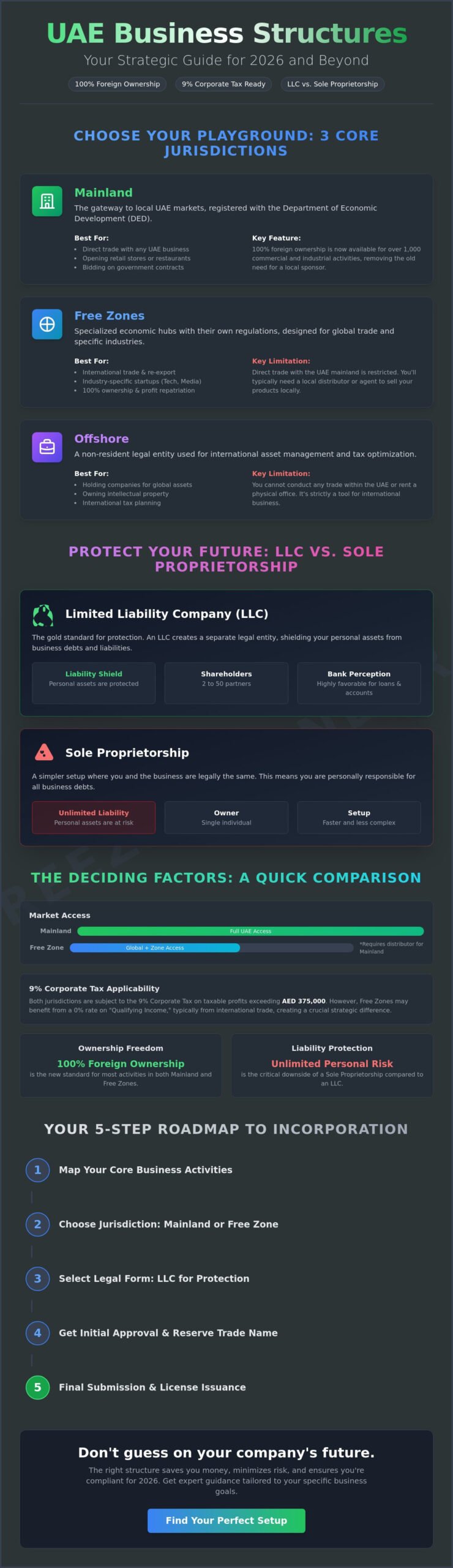
The most obvious choice for your business setup might actually be the one that limits your growth the most. Many international investors still believe that 100% foreign ownership is strictly reserved for Free Zones, but recent reforms mean the mainland is now a powerhouse for global entrepreneurs. This uae company legal structures comparison cuts through the noise of the 2026 regulatory shifts, especially as the 9% Corporate Tax and new share class rules change the math on your long term profitability.
It’s frustrating to feel like you’re constantly chasing a moving target with UAE compliance, especially when the legacy of “local sponsor” rules clashes with modern ownership rights. We know you want a setup that doesn’t just work for today, but stays compliant as your revenue crosses the AED 375,000 tax threshold. This guide promises to simplify those complexities, giving you the clarity needed to choose between an LLC and a Sole Proprietorship with total confidence. We’ll explore the latest amendments to the Commercial Companies Law and provide a strategic roadmap to ensure your 2026 operations are both tax-optimized and fully protected.
Key Takeaways
- Identify the critical differences between Mainland and Free Zone jurisdictions to ensure your business has the right trade scope from day one.
- Use our comprehensive uae company legal structures comparison to determine if an LLC or a Sole Proprietorship offers the best liability protection for your specific goals.
- Discover how the 100% foreign ownership reforms apply to your industry and what they mean for your 2026 tax strategy under the 9% corporate tax regime.
- Learn how to map your core business activities to the most cost-effective legal form to maximize your operational efficiency and scalability.
- Get a step-by-step roadmap for incorporation that simplifies everything from initial activity selection to final license issuance.
Understanding the UAE’s Three Primary Jurisdictions
Picking your spot in the Emirates isn’t just about finding an office; it’s about choosing which legal boundaries your business will live within. The UAE operates under a unique three-tiered system: Mainland, Free Zones, and Offshore. Each serves a specific strategic goal. If you’re looking for a uae company legal structures comparison, the first thing to grasp is the “regulatory wall.” This invisible barrier dictates where you can sell your products and how much tax you’ll eventually navigate. For a deeper dive into the legal framework, this UAE corporate law overview provides the foundational context you’ll need to understand how these jurisdictions interact.
Mainland: The Gateway to Local Markets
Mainland companies are registered through the Department of Economic Development (DED) in their respective emirate. This is the only structure that offers truly unlimited trade scope within the UAE. If your 2026 goal involves bidding for government contracts or opening a retail chain in a local mall, the mainland is your primary path. It allows you to trade directly with any local business or consumer without needing a middleman.
The biggest shift in recent years is the move to 100% foreign ownership. Gone are the days when you needed a local partner to hold 51% of your shares for most commercial activities. Now, for over 1,000 industrial and commercial activities, you can own the entire entity while still enjoying full access to the local market. It’s a massive advantage for those who want to avoid the “local sponsor” legacy while scaling their business across all seven emirates.
Free Zones: The Hub for Global Trade
Free Zones are specialized economic hubs that act as independent jurisdictions. Each zone has its own authority that serves as a one-stop-shop for everything from your trade license to residency visas. They’re designed for speed and efficiency. They often cater to specific industries, like technology, media, or logistics, providing built-in ecosystems for like-minded entrepreneurs. This focus makes them incredibly attractive for startups looking for a community of peers.
While Free Zones offer incredible benefits, they do come with a trade-off. You’re generally restricted from trading directly with the UAE mainland unless you work through a distributor or set up a mainland branch. This distinction is vital for your uae company legal structures comparison because it impacts your logistics and how you handle VAT. If your customers are primarily located outside the UAE, a Free Zone is often the most efficient choice.
Offshore: Holding and Optimization
Offshore entities exist primarily for international asset holding. They don’t allow you to trade within the UAE or rent physical office space here. Instead, they’re used for tax optimization, owning intellectual property, or acting as a holding company for global subsidiaries. It’s a “non-resident” status that keeps your operations outside the local regulatory environment while benefiting from the UAE’s stable legal reputation. It’s a lean way to manage global wealth without the overhead of a full operational license.
A Comparison of Legal Forms: LLC vs. Sole Proprietorship vs. Branch
Once you’ve settled on a jurisdiction, the next step is choosing the legal vehicle that carries your business forward. This decision isn’t just about paperwork; it’s a fundamental risk management choice. Your uae company legal structures comparison must weigh the protection of your personal assets against the simplicity of the setup. While the UAE offers several forms, most investors gravitate toward the Limited Liability Company (LLC), the Sole Establishment, or a Branch Office. Each has distinct implications for how you’ll handle the 2026 regulatory environment and the 9% Corporate Tax framework.
The Limited Liability Company (LLC) Advantage
The LLC is widely regarded as the gold standard for protection in the Emirates. It requires a minimum of two shareholders and can accommodate up to 50. The primary draw is the “limited” nature of the liability. If the business faces financial trouble, your personal assets are shielded; you’re only liable to the extent of your capital contribution. This clear separation between personal and corporate wealth is exactly what local banks look for. It’s often much easier to secure corporate bank account opening assistance when your business is structured as an LLC, as it demonstrates a commitment to a formal corporate governance model.
Under the updated Commercial Companies Law effective from January 2026, LLCs now have even more flexibility. You can issue different classes of shares with varying rights. This is a game changer for startups looking to attract investors without giving up full control. It brings the UAE’s legal framework closer to international standards found in major global financial hubs. For a deeper look at these requirements, this UAE business setup guide offers excellent context on how the Department of Economic Development manages these licenses.
Branch vs. Subsidiary: Which Is Better for Global Brands?
If you’re already running a successful business abroad, you might be torn between opening a branch or a subsidiary. A branch is essentially a mirror of your parent company. It doesn’t have a separate legal identity, which means the parent company remains fully liable for the branch’s actions in the UAE. It’s often a low-risk entry strategy for those testing the waters without wanting to manage a completely separate legal entity.
A subsidiary, on the other hand, is usually set up as an LLC. It’s a separate legal person. This means if the UAE operation runs into debt, the parent company’s global assets are generally protected. In the 2026 tax climate, a subsidiary might also offer cleaner tax residency status, making it easier to manage the 9% Corporate Tax threshold locally. For professional services like law or consulting, you might also consider a Civil Company, which allows for 100% ownership but often requires a local service agent for administrative tasks.
Ownership, Tax, and Trade: Comparing Operational Limits
Choosing a structure isn’t just about who owns the shares; it’s about how the Federal Tax Authority views your revenue. In this uae company legal structures comparison, we have to look at the intersection of ownership and the 2026 tax reality. While 100% foreign ownership is now the standard for most mainland and free zone activities, the operational limits on where you trade and how you’re taxed vary wildly. You don’t want to find yourself in a structure that’s optimized for trade but creates a massive tax liability because you missed a residency nuance.
Corporate Tax Impact in 2026
The standard corporate tax rate is 9% on taxable income exceeding AED 375,000. If your profit stays below this threshold, you’ll benefit from a 0% rate. However, your legal form dictates whether you can claim “Qualifying Free Zone Person” status. This status allows certain free zone entities to maintain a 0% tax rate on “Qualifying Income,” but it’s not automatic. You have to meet strict “adequate substance” requirements, which means having a physical presence, local expenditures, and full-time employees in the UAE. It’s a high bar that requires careful planning.
If you’re looking for tax optimization, you can’t ignore Economic Substance Regulations (ESR). In 2026, simply having a virtual desk isn’t enough for many “Qualifying” activities. You’ll likely need a physical office to prove your business is actually managed and controlled from within the UAE. This is a critical factor when deciding between a lean startup model and a more robust corporate structure. If your income is “Non-Qualifying,” you’ll likely face the standard 9% rate regardless of your free zone location, making the choice between mainland and free zone more about trade scope than tax savings.
Trade Scope and Market Access
Operational limits are the “invisible walls” of UAE business. Understanding where you can sell is just as important as knowing what you can own. Here is how the jurisdictions stack up:
- Mainland: You have full, unrestricted access to the local UAE and GCC markets. There are no limits on who you can sell to, making this the only choice for retail, local distribution, and government contracts.
- Free Zone: You’re optimized for international trade and business within your specific zone. To sell directly to the mainland market, you’ll need to work through a local distributor or open a mainland branch.
- Offshore: These entities are strictly for holding assets or international trade. You can’t trade within the UAE at all, and you won’t get a residency visa through an offshore setup.
Understanding these trade boundaries is essential for long term scalability. If your primary clients are local government entities, a mainland LLC is non-negotiable. If you’re an e-commerce brand shipping globally, a Free Zone setup offers the most optimized path. We can help with Corporate Tax registration to ensure you’re compliant from day one, no matter which structure you choose.
Strategic Selection: How to Choose Your Structure
Selecting the right setup is less about following a trend and more about mapping your five year plan. A uae company legal structures comparison only becomes useful when you align it with your specific revenue streams and operational needs. You’ve got to ask yourself where your customers are located, how many employees you’ll need to hire, and whether you plan to sell the business in the future. In the 2026 market, your choice of jurisdiction is the foundation of your entire corporate strategy.
Selection Guide by Business Type
Your core activity is the primary filter for your decision. If you’re a consultant or a professional service provider, a Free Zone professional license offers a fast, cost-effective entry point. However, if you’re a law firm or a specialized consultancy that needs a physical presence in the heart of a city, a Mainland Civil Company might be the better fit. It allows you to operate locally while maintaining the professional nature of your practice.
For retailers, the choice is usually made for them. A Mainland LLC is non-negotiable if you plan to open a physical shop, a restaurant, or a showroom in a local mall. You need that direct access to the local consumer base that only a mainland license provides. On the other hand, tech startups often prioritize intellectual property protection. Certain Free Zones have built specialized legal frameworks that mirror international IP laws, making them the ideal hub for software developers and innovative tech founders who want to protect their code and patents.
Visa and Residency Considerations
Your legal structure also dictates your lifestyle in the UAE. Every license comes with a specific visa quota, which determines how many staff members you can sponsor. Mainland companies often have more flexible quotas based on the size of their physical office space, whereas Free Zones typically offer fixed visa packages. If you’re looking for long term stability, you should investigate how your structure impacts your eligibility for the UAE Golden Visa. Certain categories of investment and professional roles within specific structures can fast-track this ten year residency.
Managing family residency is another critical factor. It’s usually a straightforward process once your corporate license is active, but the requirements for your personal salary and office space can vary. Finally, don’t forget your exit strategy. LLCs are generally the easiest to sell or liquidate because they exist as separate legal persons. If you plan to scale and exit within a few years, an LLC structure provides the cleanest transfer of ownership for a potential buyer. We can simplify this process for you through our expert Mainland company formation services, ensuring your structure is built for growth from day one.
Setting Up for Success: Your Roadmap to UAE Incorporation
Establishing a business in the Emirates doesn’t have to be an ordeal if you follow a logical, structured sequence. Once you’ve finalized your uae company legal structures comparison and selected the jurisdiction that fits your 2026 goals, the actual incorporation follows a clear path. It’s a journey of five distinct milestones. It begins with activity selection and name reservation, where you’ll align your business goals with the official activity lists provided by the authorities. This step is vital because it dictates your license type and future trade permissions. From there, you’ll move into the jurisdiction selection phase, officially committing to either a Mainland, Free Zone, or Offshore form.
The middle phase of the roadmap involves securing initial approval and handling document attestation. For international investors, this often requires getting documents legalized in your home country before they’re accepted locally. Once these are in order, you’ll move to finalizing the Memorandum of Association (MoA) and receiving your license. This final administrative hurdle is what officially gives your business its legal “breath” in the UAE, allowing you to start the final phase of post-setup compliance, which includes tax registration and financial onboarding.
Navigating the Documentation Maze
The Memorandum of Association (MoA) is the backbone of your company’s legal standing. It’s easy to overlook small details in the MoA that can lead to costly re-filing fees or operational delays later. For instance, incorrectly defining management powers can stall your ability to sign contracts or hire staff. Expert consultation at this stage isn’t just a luxury; it’s a safeguard that prevents these administrative bottlenecks. Our PRO services act as your dedicated liaison, handling the complex communication with government departments so you don’t have to manage the bureaucratic nuances yourself.
Post-Incorporation Essentials
Receiving your trade license is a major win, but your 2026 compliance journey is just starting. Your first priority should be securing your corporate bank account. In the current regulatory climate, banks require thorough documentation and proof of economic substance before they’ll open an account. It’s a rigorous process that benefits from having a clear, professional business plan ready from day one.
You’ll also need to register for VAT and Corporate Tax with the Federal Tax Authority (FTA) within the mandated timeframes to avoid heavy penalties. Staying compliant in 2026 means more than just paying taxes; it requires ongoing trade license management and annual renewals. Letting a license lapse, even for a short period, can disrupt your residency status and freeze your corporate bank accounts. We provide the steady hand you need to manage these post-incorporation requirements, ensuring your business remains a “Qualifying” entity that’s fully optimized for the UAE’s evolving tax landscape.
Future-Proof Your Business Strategy Today
Your 2026 success depends on more than just a great idea; it requires a rock-solid legal foundation. This uae company legal structures comparison shows that whether you choose the unrestricted reach of the Mainland or the specialized efficiency of a Free Zone, your structure must be built for tax optimization and future scale. Protecting your assets through an LLC and ensuring you meet the requirements for a “Qualifying” tax status are the smartest moves you can make today. Navigating these shifting regulations doesn’t have to be a solo mission.
With practical UAE setup experience, we provide the steady hand you need for a seamless setup. From dedicated PRO support to ensuring your tax compliance is airtight, we handle the heavy lifting so you can focus on growth. It’s time to turn your vision into a compliant, profitable reality. Find your perfect UAE business structure with our expert matching tool and take the first step toward your global expansion. The Emirates are ready for your business, and we’re here to make sure you start on the right foot.
Frequently Asked Questions
Can I have 100% ownership in a UAE Mainland LLC in 2026?
Yes, you can own 100% of a UAE Mainland LLC for the vast majority of commercial and industrial activities. This follows significant reforms to the Commercial Companies Law that removed the old requirement for a 51% local partner. This shift is a major factor in any modern uae company legal structures comparison, as it gives international investors full control over their local operations without needing an Emirati shareholder.
What is the main difference between a Free Zone LLC and a Mainland LLC?
The primary difference is the trade scope and the regulatory body that issues your license. A Mainland LLC, licensed by the DED, can trade anywhere in the UAE and bid for government contracts without restrictions. A Free Zone LLC is restricted to trading within its specific zone or internationally. To sell to the local market, a Free Zone entity generally needs a distributor or a mainland branch.
Do I need a local partner for a Sole Proprietorship in the UAE?
You don’t need a local partner who holds equity, but you might need a Local Service Agent (LSA) for certain professional licenses. The LSA is a UAE national who assists with administrative tasks and government liaisons for a fixed fee. They don’t own any shares in your business. This means you retain 100% of the profits and full decision making power over your company’s direction.
Which legal structure is best for avoiding the 9% Corporate Tax?
A “Qualifying Free Zone Person” is the only structure that can potentially maintain a 0% rate on qualifying income. However, for most businesses, the 9% Corporate Tax only kicks in once taxable income exceeds the AED 375,000 threshold. It’s essential to understand that tax residency and “adequate substance” rules apply regardless of which uae company legal structures comparison you’re reviewing for your 2026 setup.
Can a Free Zone company trade with a Mainland company?
Yes, but there are specific operational limits you’ll need to follow. A Free Zone company can sell to a Mainland company through a local distributor or agent. If you want to trade directly with the local market without intermediaries, you’ll generally need to establish a Mainland branch or a separate Mainland LLC. This ensures you’re compliant with the customs and VAT rules governing different jurisdictions.
What is a Civil Company and who should use it?
A Civil Company is a legal form specifically designed for professional activities like law, medicine, or consulting. It’s ideal for partners who want to provide services based on their professional expertise rather than commercial trading. While it allows for 100% foreign ownership, partners usually carry unlimited liability for the company’s debts. This makes it a popular choice for doctors, engineers, and legal professionals.
How long does it take to change a company legal structure in the UAE?
The process of changing your legal structure usually takes between four to eight weeks depending on the jurisdiction. You’ll need to submit a formal application to the DED or your Free Zone Authority, update your Memorandum of Association, and potentially re-attest certain documents. It’s a deliberate process that ensures all liability and ownership transitions are legally recorded and updated on your trade license.
Is an Offshore company a legal structure for trading in the UAE?
No, an Offshore company is not permitted to conduct any commercial activity within the UAE. Its primary purpose is to act as a holding entity for international assets, intellectual property, or real estate. If you want to trade locally, open a physical shop, or hire employees within the Emirates, you must choose a Mainland or Free Zone structure instead. Offshore setups don’t provide residency visas.
Disclaimer
The information provided in this article is intended for general informational purposes only and reflects conditions as understood at the time of publication. Free zone regulations, fees, and requirements in the UAE are subject to change. Readers are advised to verify details with the relevant free zone authority or regulatory body before making any business decisions. For personalised guidance, our business setup experts at UAE Free Zone Finder are available to assist — contact us at info@uaefreezonefinder.com or call +971-507864823.
Founders evaluating multiple jurisdictions will find our UAE vs Singapore company comparison 2026 helpful — it covers tax, ownership rules and setup costs side by side.