UAE Holding Company Structure Benefits: A 2026 Strategic Guide
You might think the 9% corporate tax signaled the end of the UAE’s appeal for international investors, but it’s actually done the opposite. By providing a stable, OECD-compliant framework, the Emirates has finally given global wealth the legal certainty it needs for long-term growth. It’s completely normal to feel a bit uneasy about the shift from a “zero-tax” era to a world of EmaraTax portals and 15% minimum taxes for large multinationals. Navigating the uae holding company structure benefits in this new environment requires a sharper strategy than it did a few years ago.
This guide will show you exactly how a well-placed holding entity can ring-fence your global assets and optimize your tax position while keeping the bureaucracy at bay. We’ll explore which jurisdictions, such as ADGM or DIFC, provide the strongest legal shield for your specific asset types and how to maintain your 0% rate through the Small Business Relief window ending in December 2026. You’ll gain a clear roadmap for profit repatriation and asset protection that works for your global business goals.
Key Takeaways
- Understand how a parent-subsidiary model separates your asset ownership from operational risks to create a robust legal shield.
- Compare the distinct advantages of English Common Law in ADGM and DIFC versus Mainland structures for different asset classes.
- Learn to maximize uae holding company structure benefits by utilizing participation exemptions for dividends and capital gains under the 2026 tax rules.
- Discover a strategic framework for balancing setup costs with jurisdictional reputation to ensure your entity meets global banking standards.
- Identify why professional matching is the only way to avoid costly mistakes when aligning your structure with UAE residency and tax compliance.
What is a UAE Holding Company Structure?
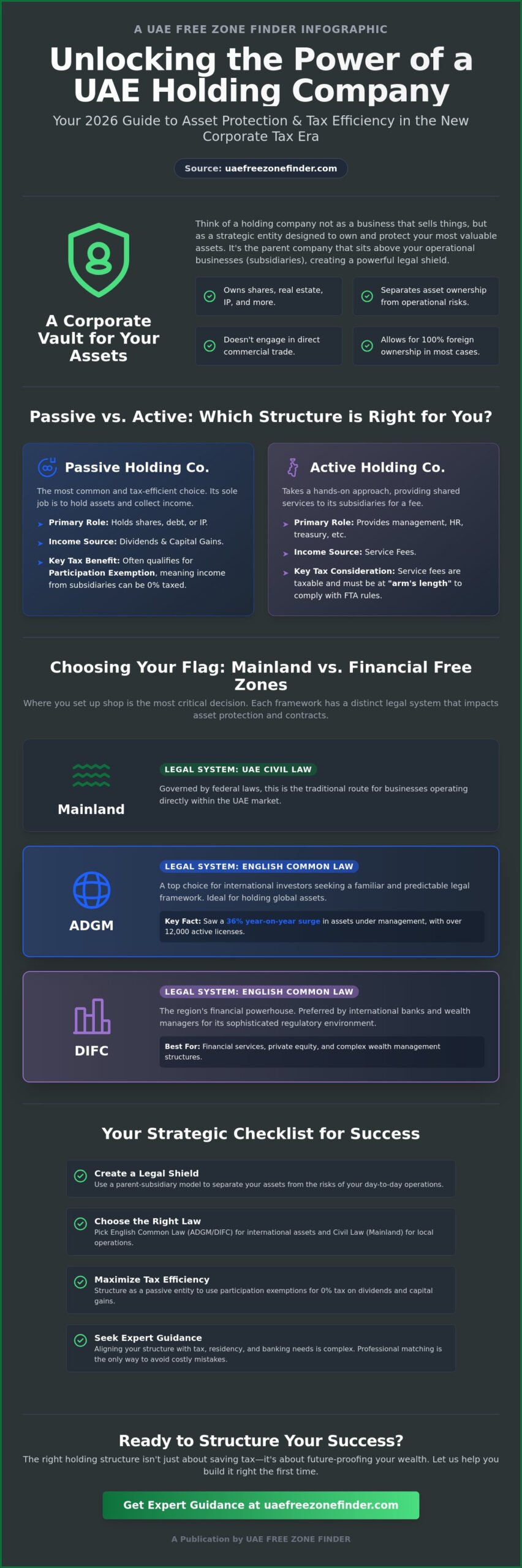
Think of a holding company as a corporate vault. Unlike a traditional trading business that sells products or services, a holding company exists primarily to own assets. These assets can include shares in other companies, real estate, intellectual property, or private equity. In the Emirates, this entity acts as the “Parent,” sitting at the top of a corporate hierarchy to oversee “Subsidiaries” that handle the day-to-day operations. Understanding What is a Holding Company? is the first step in realizing how it simplifies management while providing a layer of separation between your wealth and operational risks.
While these entities don’t engage in commercial trade themselves, they’re the backbone of modern corporate governance. They provide a centralized structure to dictate policy and manage capital across a group. One of the most significant uae holding company structure benefits is the ability to maintain 100% foreign ownership. Following the landmark 2021 amendments to the Commercial Companies Law, international investors no longer need a local partner for most activities, making the UAE one of the most attractive jurisdictions for global asset consolidation in 2026.
The Core Purpose of a Holding Entity
Managing a diverse portfolio can become a logistical nightmare without a central anchor. A holding structure allows you to consolidate multiple businesses under one umbrella, providing a single dashboard for your global interests. This isn’t just about convenience; it’s about survival. By ring-fencing liabilities, you ensure that if one subsidiary faces a legal claim or financial failure, the parent company and its other holdings remain protected. It’s a strategy designed to stop a single leak from sinking the entire ship.
Succession planning is another vital driver. For family offices and high-net-worth individuals, centralizing assets within a UAE holding company makes the transfer of wealth to the next generation much cleaner. Instead of navigating the complex transfer of dozens of individual properties or licenses, you simply transfer the shares of the holding company itself. This ensures continuity and avoids the heavy administrative burden often found in other global markets.
Passive vs. Active Holding Companies
The distinction between passive and active holdings is critical for your 2026 tax strategy. A passive holding company is the most common choice in the UAE. Its sole job is to hold shares, debt instruments, or IP, and its income comes from dividends or capital gains. These are often the most tax-efficient structures because they typically fall under the participation exemption rules, meaning that income from subsidiaries may be exempt from the 9% corporate tax if certain substance requirements are met.
Active holding companies take a more hands-on approach. They might provide management services, shared HR, or treasury functions to their subsidiaries in exchange for fees. While this offers more control, it also changes your tax profile. In 2026, the Federal Tax Authority (FTA) looks closely at these service fees to ensure they’re conducted at “arm’s length.” Choosing the right path impacts your filing requirements and your eligibility for specific exemptions, which is why matching your structure to your actual business activity is a non-negotiable step for any serious investor.
The Three Main UAE Holding Structures: Mainland, ADGM, and DIFC
Choosing where to plant your flag is the most consequential decision you’ll make. The UAE Business Landscape offers three distinct legal frameworks, each catering to specific asset types and risk profiles. While the mainland operates under UAE Civil Law, financial free zones like ADGM and DIFC utilize English Common Law. This distinction isn’t just academic; it dictates how your contracts are interpreted and how your assets are protected during a dispute. Understanding these nuances is key to maximizing your uae holding company structure benefits and ensuring your wealth is managed under the right set of rules.
Common Law Jurisdictions: ADGM and DIFC
These are the heavy hitters of the region. ADGM reached over 12,000 active licenses in early 2026, seeing a 36% year-on-year surge in assets under management. International investors gravitate here because the legal system is familiar, predictable, and highly sophisticated. These zones are famous for their Special Purpose Vehicles (SPVs), which are flexible entities used to hold specific assets like shares, global real estate, or even private jets. High-tier international banks often prefer these jurisdictions due to their rigorous compliance and transparency standards. If you’re looking for the highest level of institutional trust, starting your Free Zone Company Formation in one of these hubs is often the most strategic move for long-term stability.
Mainland and RAK ICC Options
Mainland holding companies are the strategic choice if your goal is to own physical real estate across all seven Emirates or if your subsidiaries are primarily onshore trading businesses. Since the 2021 ownership reforms, you can maintain 100% control without a local sponsor. Initial setup costs for a mainland license in Dubai usually range between AED 25,000 and the applicable current amount. Specific fees for this path include Name Approval at the applicable authority fee, Initial Approval at AED 120, and Memorandum of Association drafting at AED 1,500. It’s a direct route for those who want their holding entity to have deep roots in the local economy.
For those who don’t need a physical presence or residency visas, RAK ICC is a powerful alternative. It’s an offshore jurisdiction, which means you won’t be renting office space in the UAE, but it’s exceptionally efficient for holding intellectual property or global investment portfolios. It’s a “pure” holding environment that keeps your overhead low while still providing a recognized legal entity. It’s often the perfect fit for non-resident investors who want to ring-fence global assets without the administrative weight of a full onshore operation.
Strategic Benefits: Tax Efficiency and Asset Protection
The UAE has transitioned from a tax-free haven into a transparent, low-tax jurisdiction that prioritizes legal certainty. This shift actually strengthens uae holding company structure benefits by providing a globally recognized framework for wealth management. While the introduction of federal corporate tax might seem like a hurdle, the system is specifically designed to support holding entities. Most holding companies find that their primary sources of revenue, such as dividends and capital gains, remain largely untouched by the 9% tax rate due to generous exemptions.
One of the most powerful tools in your arsenal is the UAE’s extensive network of over 100 Double Taxation Agreements (DTAs). These treaties ensure that international investors don’t pay tax on the same income in two different countries. Combined with the fact that the UAE imposes 0% withholding tax on profit repatriation, moving capital across borders becomes a cost-effective process. It allows you to reinvest global profits or return them to your home jurisdiction without losing a significant percentage to local levies.
Navigating the 2026 Corporate Tax Landscape
In 2026, maintaining a 0% tax rate on “Qualifying Income” in a free zone requires strict adherence to substance rules. You can no longer rely on a “paper company” alone; you must demonstrate that your entity has adequate staff and premises in its chosen zone. A critical update for this year is that all Qualifying Free Zone Persons must now submit audited financial statements to maintain their tax-exempt status. If your taxable income from non-qualifying activities exceeds the AED 375,000 threshold, the standard 9% rate will apply to that portion of your earnings.
Holding companies typically meet the “Participation Exemption” criteria by maintaining at least a 5% ownership stake in a subsidiary for a minimum period of 12 months, which renders dividends and capital gains from that subsidiary tax-exempt. This rule is the cornerstone of UAE tax planning, allowing you to grow your portfolio without the burden of recurring corporate taxes on your investment returns.
Legal Safeguards and IP Protection
A holding structure acts as a fortress for your most valuable assets, particularly Intellectual Property (IP). By holding trademarks, patents, or copyrights in a parent company and licensing them back to operational subsidiaries, you create a layer of separation. If a subsidiary faces a legal claim, your core IP remains safe within the parent entity. This “ring-fencing” strategy is vital for long-term risk mitigation in volatile global markets.
UAE courts have become increasingly sophisticated in protecting corporate shareholders and enforcing clear governance rules. Transferring wealth or reorganizing your portfolio is also significantly easier within a holding structure. Instead of dealing with the complex sale of individual assets or real estate titles, you can simply transfer shares of the holding company. This streamlined process reduces administrative costs and ensures that your succession planning remains uninterrupted by local bureaucratic delays.
How to Choose Your Jurisdiction: A Decision Framework
Selecting the right jurisdiction for your holding entity isn’t a one-size-fits-all process. It’s a strategic trade-off between prestige, cost, and the specific nature of your assets. If you’re looking for global recognition and the highest level of institutional trust, ADGM and DIFC are the premier choices. For instance, the registration fee for a non-financial company in ADGM is USD 5,500, with an annual renewal fee of USD 5,000. While these costs are higher than an offshore entity like RAK ICC, the uae holding company structure benefits in terms of banking of and investor confidence often outweigh the initial investment.
The nature of your assets dictates your legal path. If your primary goal is to own and manage physical real estate within the UAE, a mainland structure is usually the most direct route. However, if you’re holding global shares, intellectual property, or diversified investment portfolios, a financial free zone SPV provides a more flexible legal framework. Your future exit strategy is also a factor. Selling a business held within an ADGM or DIFC structure is often much smoother for international buyers who are already familiar with English Common Law contracts.
Key Selection Criteria for Investors
Before committing to a zone, you need to define your primary objective. Is it purely tax optimization, or is robust legal protection against foreign claims your main priority? You should also consider whether you or your team will need to apply for resident visas in the UAE. While mainland and free zone entities allow for residency, offshore structures do not. Finally, look at your expected annual turnover. If your subsidiaries generate significant revenue, the enhanced compliance and reporting standards of a top-tier financial zone will help you avoid friction with international tax authorities.
Comparing Setup Timelines
Speed of incorporation varies significantly across the three main paths. Mainland setups in Dubai are remarkably efficient, often taking only a few days once the initial approvals are secured. Financial free zones like ADGM or DIFC involve a more rigorous application process, as they require a detailed look at your business plan and beneficial ownership. Offshore entities are the quickest to form, but they often face the longest wait times for banking. Because many institutions have strict requirements for non-trading entities, getting Corporate Bank Account Opening Assistance is a vital step to ensure your capital doesn’t sit idle while you wait for approvals.
Choosing the wrong jurisdiction can lead to expensive restructuring later. It’s about matching your business DNA to the right legal environment from day one. Whether you prioritize the speed of a mainland license or the common law security of a financial hub, your choice should reflect where you want your business to be in five years, not just where it is today.
Setting Up Your UAE Holding Company with Expert Guidance
Attempting a DIY setup for a holding company is often a recipe for a regulatory headache. It’s not just about filling out a form; it’s about aligning your asset types with the right legal framework to maximize uae holding company structure benefits. A minor oversight in the Memorandum of Association can prevent you from opening a bank account or, worse, disqualify you from the participation exemption that makes the UAE so attractive. Expert guidance ensures that your structure is built to last, not just to exist.
In 2026, the stakes for compliance are higher than ever. The Federal Tax Authority (FTA) now uses digital traceability through the EmaraTax portal, making every entity visible to regulators. If you miss a corporate tax registration deadline, the financial impact is immediate. For instance, ADGM applies a fixed AED 10,000 penalty for late corporate tax registration. You’ll also need to manage Economic Substance Regulations (ESR) and potentially VAT filings if your holding entity provides management services to its subsidiaries. Professional consultants act as a steady hand, helping you find your way through these pitfalls before they become expensive mistakes.
Beyond Incorporation: Ongoing Support
Managing a holding company doesn’t end when you receive your trade license. Securing corporate bank account opening assistance is often the most critical hurdle for non-trading entities. Many banks view holding companies as high-risk, requiring detailed proof of the source of funds and highly specific business plans. We help you package this information to meet institutional standards on the first try. It’s about presenting a profile that gives the bank confidence in your long-term stability.
Beyond the initial setup, dedicated PRO services handle the yearly cycle of license renewals and residency visa maintenance. This allows you to focus on asset growth while we handle the administrative heavy lifting. The necessity of professional bookkeeping can’t be overstated. To maintain the 0% corporate tax rate in a free zone, you must provide audited financial statements. Keeping your records in order from day one isn’t just good practice; it’s a legal requirement for maintaining your tax-efficient status and proving your eligibility for exemptions.
The UAE Free Zone Finder Advantage
We act as your bridge to the UAE’s complex bureaucratic systems, offering access to a comprehensive comparison of all 40+ UAE Free Zones. Our strategic advice on free zone company formation goes beyond the paperwork to include tax registration and residency support. We don’t just provide data; we offer the wisdom needed to find the perfect fit for your investment profile. This ensures your jurisdiction matches your actual business activity.
You don’t have to walk this path alone. We provide a single point of contact for your legal, tax, and residency needs, ensuring a transparent and efficient incorporation journey. Whether you’re ring-fencing global assets or planning for the next generation, we’re here to ensure your structure is optimized for success. Get a customized holding company consultation today and secure your global assets for the future. We’ll help you get it right from the start.
Secure Your Global Legacy in the UAE
The shift toward a more regulated environment doesn’t diminish the value of an Emirates-based entity. It actually makes the legal protections more robust. By choosing between the common law security of ADGM or the real estate flexibility of the mainland, you’re building a foundation that lasts for generations. You’ve seen how the uae holding company structure benefits your bottom line through participation exemptions and risk ring-fencing. Now it’s time to move from theory to implementation.
Success in this landscape requires more than just a trade license. It demands precise tax registration and a banking partner that understands your non-trading profile. With practical UAE setup experience, we provide the steady hand you need. Our team offers dedicated support for Corporate Tax and VAT compliance, alongside a proven track record in complex corporate bank account openings. We don’t just set up companies; we match you with the perfect jurisdiction for your specific goals.
Find your perfect UAE holding company structure with our expert matching tool and take the first step toward a secure, tax-optimized future. Your global expansion starts with the right foundation. We’re ready to help you build it.
Frequently Asked Questions
Can a UAE holding company own property in the UAE?
Yes, a holding company can own property, but the location of the assets dictates which jurisdiction you should choose. Mainland entities have the right to own real estate across the entire country. Free zone holdings are generally restricted to designated freehold areas or must own property through a mainland subsidiary. If your goal is a diverse local property portfolio, a mainland structure is usually the most efficient path.
Do I need a physical office for a holding company in a UAE free zone?
Requirements vary based on your jurisdiction and your tax objectives. To qualify for the 0% corporate tax rate as a “Qualifying Free Zone Person,” you must demonstrate adequate substance, which includes having a physical office or premises within the zone. While offshore entities like RAK ICC don’t permit office space, standard free zone holdings usually require at least a flexi-desk or a physical office lease to maintain their license.
Is a UAE holding company eligible for the 0% Corporate Tax rate?
A holding entity can benefit from a 0% rate through the participation exemption on dividends and capital gains, provided it meets specific ownership criteria. To maximize uae holding company structure benefits in 2026, you’ll need to maintain at least a 5% stake in a subsidiary for a minimum of 12 months. Additionally, all entities seeking this status must now submit audited financial statements to the Federal Tax Authority to remain compliant.
Can a holding company sponsor residency visas for its owners?
Mainland and free zone holding companies can sponsor residency visas for shareholders and their families, but offshore entities cannot. The number of visas available usually depends on the size of your physical office space or the specific license package you choose during incorporation. This is a primary reason why many international investors opt for a free zone structure over a pure offshore one, as it provides a gateway to UAE residency.
What is the minimum capital requirement for a UAE holding company?
Most UAE jurisdictions don’t enforce a high minimum paid-up capital for holding entities, often allowing you to start with as little as AED 10,000 to AED 50,000. Some free zones even permit “zero-capital” incorporation on paper. However, financial hubs like ADGM or DIFC may have specific requirements depending on the legal form of the entity, so it’s vital to check the current 2026 regulations for your chosen zone before starting the process.
How does a holding company protect my assets from creditors?
The structure protects your assets by creating a legal “firewall” between the parent company and its subsidiaries. If one subsidiary faces a financial claim or bankruptcy, those creditors generally cannot target the assets held by the parent or other subsidiaries. This ring-fencing strategy is particularly effective in common law jurisdictions like ADGM, where corporate veils are robust and legal precedents for asset protection are well-established and predictable.
Can I open a corporate bank account for a non-trading holding company?
Opening a bank account for a non-trading entity is entirely possible but requires a high level of transparency and documentation. Banks will scrutinize your source of wealth and the nature of your subsidiaries’ activities more closely than they would for a trading business. We find that having a physical office and a clear business plan significantly speeds up the process. It’s often the most challenging part of the setup, requiring a well-prepared application package.
What are the annual renewal requirements for a UAE holding company?
You must renew your trade license and office lease annually to stay compliant and keep your corporate bank account active. In 2026, you’re also required to handle corporate tax filings and, if applicable, Economic Substance Regulations (ESR) notifications. Audited financials are now a mandatory part of the renewal cycle for any entity wishing to maintain its tax-exempt status in a free zone, ensuring full transparency with the Federal Tax Authority.
Disclaimer
The information provided in this article is intended for general informational purposes only and reflects conditions as understood at the time of publication. Free zone regulations, fees, and requirements in the UAE are subject to change. Readers are advised to verify details with the relevant free zone authority or regulatory body before making any business decisions. For personalised guidance, our business setup experts at UAE Free Zone Finder are available to assist — contact us at info@uaefreezonefinder.com or call +971-507864823.