Sole Proprietorship in the UAE: A Complete 2026 Business Guide

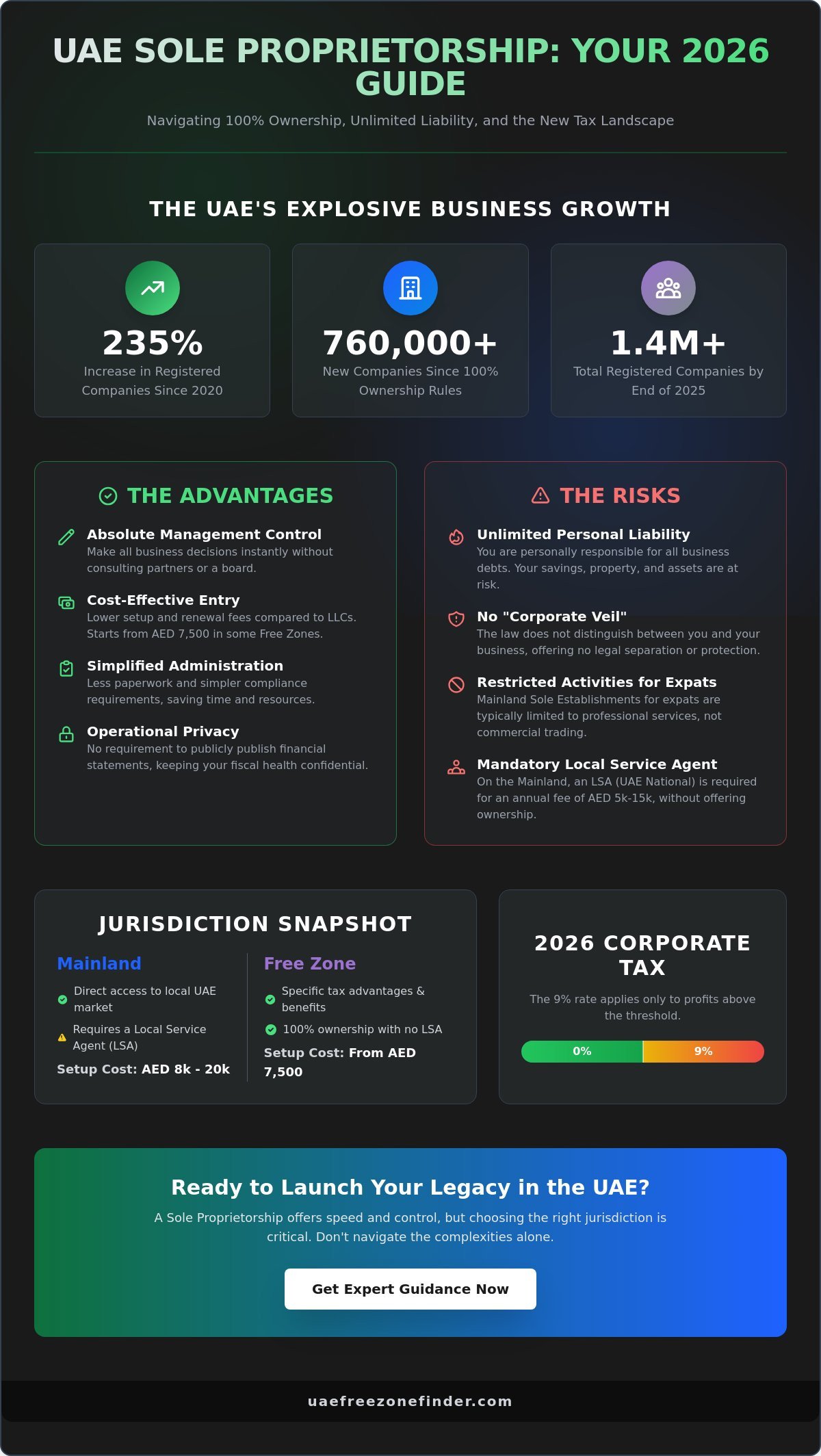
By the end of 2025, the UAE saw its business landscape explode to over 1.4 million registered companies, a staggering 235% increase since 2020. Many of these new arrivals are solo entrepreneurs looking for total control, yet they often feel paralyzed by the shift in 2026 regulatory demands. You’re likely excited about the 100% ownership rules but worried about how a sole proprietorship links your personal bank account to your business risks. It’s a valid concern in a market that’s evolving as fast as this one, and you aren’t alone in feeling that pressure.
This guide gives you the clarity you need to handle everything from legal liability to the latest 2026 tax mandates. We’ll break down how the 9% corporate tax rate applies to your profits above AED 375,000 and explain why many companies have entered the market since ownership rules changed. You’ll walk away with a clear understanding of Mainland versus Free Zone costs and the exact steps to secure your license. We’ve simplified the complex hurdles so you can focus on what matters: building your legacy in the world’s most dynamic economy.
Key Takeaways
- Understand why a sole proprietorship offers unmatched management control while requiring a careful strategy to manage personal liability.
- Compare Mainland and Free Zone options to decide if you need local market access or the specific tax advantages of a specialized zone.
- Navigate the 2026 corporate tax landscape with confidence, knowing exactly when the 9% rate applies to your business earnings.
- Master the step-by-step registration process, from selecting the right business activity to reserving your unique trade name.
- Recognize the growth ceiling of a solo setup and learn when it’s time to transition to an LLC to protect your personal assets.
Understanding the Sole Proprietorship in the UAE Landscape
When you look at global business definitions, a sole proprietorship is often described as an unincorporated business owned by one person. While that’s technically true here, the UAE adds its own unique legal flavor. In local regulatory circles, this entity is officially known as a “Sole Establishment.” It’s the simplest way to enter the market, but it comes with a specific set of rules that separate it from the corporate structures you might find in Europe or North America. The most critical factor to grasp is that a Sole Establishment isn’t a separate legal entity from its owner. You and the business are legally one and the same.
This structure is highly popular among consultants, tech specialists, and creative professionals. Since the landmark changes to the Commercial Companies Law in September 2021, the UAE has made it significantly easier for expatriates to maintain 100% ownership of their ventures. However, this total control is a double edged sword. Because there’s no “corporate veil” to hide behind, you’re personally responsible for every debt, lease agreement, and professional liability the business incurs. If the business faces a financial shortfall in 2026, your personal assets, including your savings and property, are on the line to settle those obligations.
The Legal Identity of a Sole Establishment
In a UAE Sole Establishment, the trade license is issued directly in your name. You won’t find a board of directors, a table of shareholders, or a complex memorandum of association here. The management structure is as lean as it gets because you hold all the decision making power. This simplicity is why setup costs are often lower, ranging from AED 8,000 to AED 20,000 on the mainland depending on your specific activity. However, you must remember that the business’s credit rating and legal standing are tied to your personal Emirates ID and passport. There’s no separate “business personality” that survives independently of you.
Who Can Open a Sole Proprietorship?
The UAE has opened its doors wide, but there are still clear boundaries based on nationality and activity type. Here’s how the landscape looks for 2026:
- Expatriates: Foreign nationals can own 100% of a sole proprietorship if they’re providing professional services. This includes fields like management consultancy, software development, or architectural design.
- Local Service Agent (LSA): If you’re an expat opening a mainland establishment, you’re required to appoint a UAE National as a Local Service Agent. This person has 0% ownership and no say in your operations; they simply facilitate government relations for an annual fee, typically between AED 5,000 and AED 15,000.
- UAE and GCC Nationals: These citizens have broader access and can open sole establishments for commercial or industrial activities, such as general trading or manufacturing, which are often restricted for solo expats on the mainland.
It’s a strategic choice. While you gain 100% of the profits and total autonomy, you must be comfortable with the direct link between your business performance and your personal financial security.
Strategic Pros and Cons of Going Solo
Choosing a sole proprietorship is essentially a trade-off between total administrative freedom and personal financial risk. It’s a high-stakes decision that requires you to weigh the speed of market entry against your long-term comfort with liability. In the UAE’s fast-paced 2026 economy, where 250,000 new companies were registered in 2025 alone, many entrepreneurs opt for this path because it cuts through the red tape that often slows down more complex corporate structures. You get to move at the speed of your own ideas without waiting for a partner’s signature.
Why Entrepreneurs Choose This Structure
The primary draw is the absolute management control you retain. You don’t have to answer to a board or consult shareholders before making a strategic pivot. It’s also the most cost-effective entry point. With setup costs starting as low as AED 7,500 in certain free zones, it’s significantly more accessible than forming an LLC. Beyond the initial price tag, the ongoing administrative burden is lighter. You’ll enjoy lower annual renewal fees and a level of operational privacy that corporations simply don’t have. Since there’s no requirement to publish your financial statements for public consumption, your business’s fiscal health remains your private business. If you’re unsure which jurisdiction offers the best balance of cost and privacy for your niche, finding the right setup partner can save you weeks of trial and error.
The Reality of Unlimited Liability
While the perks are attractive, the legal exposure is absolute. Under UAE commercial law, a sole proprietorship has no separate legal identity. This means you have “unlimited liability.” If your business defaults on a loan or loses a legal battle, creditors have a legal right to pursue your personal bank accounts, vehicles, and real estate to settle the debt. It’s not a scenario to take lightly. Your personal wealth is the collateral for your business’s success.
To mitigate this, professional indemnity insurance is non-negotiable for solo owners in 2026. This coverage acts as a vital safety net, protecting your personal assets from claims of professional negligence or error. You should also consider the “growth ceiling” inherent in this model. Because you cannot issue shares or bring on equity partners, raising capital is restricted to personal savings or bank financing. If you plan to scale rapidly or require significant outside investment, the solo route might eventually become a bottleneck for your expansion plans.
Choosing Your Jurisdiction: Mainland vs. Free Zone
Your first major fork in the road is deciding where your license will live. In the UAE, this choice isn’t just a matter of address; it dictates who you can sell to and how much you’ll pay in annual overhead. If you’re building a sole proprietorship to serve the local market directly, the Mainland is your likely destination. However, if your eyes are on global consulting or digital services, a Free Zone might be the more efficient path. It’s a strategic decision that depends entirely on your client base and your long term scaling goals.
Mainland Sole Establishments
A Mainland license, issued by the Department of Economic Development (DED), offers the highest level of geographic flexibility. You can open an office anywhere in your chosen Emirate and bid for lucrative government contracts without restrictions. This is the gold standard for entrepreneurs who need to trade directly with the local UAE market. While foreign nationals can now enjoy 100% ownership in most professional sectors, you’ll still need to appoint a Local Service Agent (LSA).
Think of the LSA as a facilitator rather than a partner. They’re a UAE National who handles government liaisons and helps you clear bureaucratic hurdles. They don’t have an ownership stake in your business and aren’t involved in your daily operations. You’ll typically pay them an annual fee, which verified market data shows ranges from AED 5,000 to AED 15,000. Setup costs for a Mainland establishment generally fall between AED 8,000 and AED 20,000, making it a robust but slightly more expensive entry point.
Free Zone Sole Proprietorships
Free Zones like IFZA, Meydan, or RAKEZ offer a different set of advantages. These jurisdictions are designed for efficiency and ease of entry, often providing the fastest visa processing in the country. The biggest draw for many is the total absence of an LSA. You’ll have 100% direct ownership without needing a local representative, regardless of your business activity. You also benefit from 100% import and export tax exemptions, which is a massive win for those in the trading sector.
The trade off is geographic. A Free Zone sole proprietorship is generally restricted to operating within its specific zone or internationally. If you want to sell services to a company on the UAE Mainland, you might face some regulatory limitations. However, for digital nomads, IT consultants, and creative freelancers, the lower setup costs (starting from AED 7,500 to AED 15,000) and the streamlined digital application process often make this the most logical starting point. We’ll help you match your specific activity to the right zone to ensure you don’t overpay for features you don’t need.
The Setup Journey and 2026 Compliance
Getting your license isn’t a one and done event. It’s a structured journey that requires precision to avoid costly delays. For a sole proprietorship, the sequence of your application matters. You’ll start by selecting your business activity, which is the most critical step. This choice determines if you need a Local Service Agent on the mainland or if you qualify for specific Free Zone incentives. Once your activity is locked in, you’ll reserve your trade name. Expect to pay between the applicable authority fee and AED 800 for this reservation. After securing initial approval from the DED, which typically costs between AED 1,000 and AED 2,000, you’ll need to secure a physical address. Most jurisdictions require at least a flexi desk lease before they’ll issue your final trade license.
The final step is the most vital for 2026. Once your license is issued, you must register for Corporate Tax with the Federal Tax Authority. Even if you’re a solo operator, this isn’t optional if your annual turnover exceeds AED 1 million. Failing to register can lead to immediate administrative penalties that eat into your startup capital.
Corporate Tax and VAT for Sole Owners
The tax landscape has matured significantly. As of May 2026, the UAE applies a 0% corporate tax rate on taxable profits up to AED 375,000. If your sole proprietorship earns more than that, the portion above the threshold is taxed at 9%. You should also look into Small Business Relief, which can provide a much needed buffer for individuals just starting out. VAT is another threshold to watch. Registration becomes mandatory once your taxable turnover hits AED 375,000, though you can choose to register voluntarily if your turnover is at least AED 187,500. Staying ahead of these filings is much easier when you partner with setup experts who understand the local tax nuances.
Ongoing Regulatory Requirements
Compliance is a continuous cycle. You’re required to file an Ultimate Beneficial Owner (UBO) declaration, even if it seems redundant as the only owner. This is a non negotiable transparency requirement in the UAE. If your business falls under “Designated Non-Financial Businesses and Professions,” such as real estate or jewelry trading, you’ll also need to implement strict Anti-Money Laundering (AML) protocols. Don’t forget your annual license renewal either. Trade license fees usually range from AED 3,000 to AED 7,000 annually. Keeping your PRO services active ensures you don’t miss these deadlines, as a lapsed license can result in your corporate bank account being frozen within days of the expiry date.
Scaling Up: When to Transition to an LLC
A sole proprietorship is an excellent launchpad, but it isn’t designed to carry you through every stage of a global empire. There comes a moment for every successful solo entrepreneur where the simplicity of the structure starts to feel like a cage. This is what we call the “growth ceiling.” In the UAE’s hyper-competitive market, which saw a 235% increase in registered businesses between 2020 and 2025, staying small can eventually become a strategic liability. If your vision involves outside investment or a massive workforce, you’ll need to move beyond the solo model.
Signs You’ve Outgrown a Sole Establishment
The most obvious signal is a shift in your risk profile. As your turnover climbs well past the AED 375,000 corporate tax threshold, your contracts likely grow in size and complexity. If your business debt or lease obligations are increasing significantly, the unlimited liability of a sole proprietorship becomes a dangerous weight on your personal life. You’re no longer just risking your monthly profit; you’re risking your entire financial future on every deal.
Operations also dictate the need for change. If you need to hire a large team, you’ll find that managing dozens of employment visas is far smoother under a Limited Liability Company (LLC) structure. Each investor or residence visa costs between AED 3,500 and AED 5,000, and as these numbers add up, the legal protections of an LLC become more valuable. Finally, if you want to pitch for large scale venture capital, remember that investors can’t buy shares in a sole establishment. You must have a corporate structure that allows for equity distribution to attract serious funding.
The Restructuring Process
Converting your legal form is a methodical process that requires careful coordination with the Department of Economic Development or your Free Zone authority. You’ll need to draft a Memorandum of Association (MOA) and officially transfer all existing assets to the new entity. This transition isn’t just about the license; it involves a complete update of your operational foundation. You’ll have to notify all vendors and update your corporate bank account to reflect the new legal status.
Managing the transfer of visas and existing contracts is where most entrepreneurs hit a wall. It’s a logistical puzzle that can disrupt your cash flow if handled poorly. This is why professional help is vital during a scale up. Since the introduction of 100% foreign ownership in September 2021, many new companies have entered the market, many of which started solo and transitioned as they hit their stride. Getting expert guidance early ensures that your transition to an LLC is a strategic leap forward rather than a bureaucratic nightmare.
Launch Your UAE Vision with Confidence
Building a business in the Emirates is no longer just about getting a license; it’s about navigating a 2026 regulatory environment that rewards the well prepared. By now, you understand that a sole proprietorship offers the ultimate management control, provided you’re ready to manage the personal liability that comes with it. You’ve also seen how the 9% corporate tax threshold and the choice between Mainland and Free Zone jurisdictions will define your bottom line. Success here depends on matching your specific professional activity to the right legal framework from day one.
Don’t let the complexity of 40 plus Free Zones or the nuances of tax registration slow your momentum. We provide expert guidance, seamless bank account opening assistance, and comprehensive PRO support to ensure your setup is optimized for the long haul. Find the perfect jurisdiction for your sole proprietorship today and take the first step toward your global expansion. The UAE’s dynamic economy is ready for your contribution, and with the right partner, your entrepreneurial journey will be as rewarding as it is efficient.
Frequently Asked Questions
Can an expat own 100% of a sole proprietorship in the UAE?
Yes, expatriates can maintain 100% ownership of a sole proprietorship in the UAE if the business activity is classified as professional. Since the landmark changes to the Commercial Companies Law in September 2021, foreign nationals no longer need a local partner holding shares for most service based sectors. If you’re on the mainland, you’ll still need a Local Service Agent to facilitate government relations, but they hold 0% equity in your venture.
What is the difference between a freelance permit and a sole proprietorship?
A freelance permit is a personal license for an individual to provide services, while a sole proprietorship is a formal business entity registered as a Sole Establishment. While both allow for solo operations, the Sole Establishment structure typically offers more flexibility for hiring employees and securing multiple residency visas. It’s the preferred choice for entrepreneurs who plan to scale their operations beyond a single person and build a corporate identity.
Do I need a physical office for a sole proprietorship in 2026?
Yes, most licensing authorities in 2026 require a physical address to issue a trade license. On the mainland, this usually means a traditional office space with an Ejari certificate. However, many Free Zones offer more flexible “flexi desk” or “smart office” arrangements. These options provide a legal address at a lower cost, which is ideal for consultants and digital businesses that don’t need a large physical footprint to operate effectively.
How much does it cost to set up a sole establishment in the UAE?
The cost to establish a sole establishment varies significantly based on your chosen jurisdiction and business activity. For a mainland setup, you should budget between AED 8,000 and AED 20,000 for the initial license and registration fees. Free zone setups are often more economical, with prices starting from AED 7,500 and going up to AED 15,000. These figures don’t include visa costs, which typically add another AED 3,500 to AED 5,000 per person for investor residency.
Is a sole proprietorship liable for Corporate Tax in the UAE?
Yes, every business entity is subject to the UAE Corporate Tax regime that launched in 2023. You’ll pay a 0% rate on taxable profits up to AED 375,000, and a 9% rate on any profit exceeding that threshold. Registration with the Federal Tax Authority is mandatory if your annual turnover reaches AED 1 million, even if your actual profits fall below the taxable limit. It’s a critical compliance step for all solo owners in 2026.
Can I sponsor my family on a sole proprietorship license?
Yes, as the owner of a sole establishment, you’re eligible for an investor or residence visa, which allows you to sponsor your dependents. You’ll need to provide a valid tenancy contract and proof of a sufficient monthly income to satisfy the General Directorate of Residency and Foreigners Affairs. The process is straightforward once your own residence visa and Emirates ID, which costs approximately AED 370, are issued and active.
What happens to the business if the owner leaves the country?
Because a sole establishment has no separate legal identity, the business is legally tied to your personal residency status. If you leave the country permanently and cancel your visa, you’ll likely need to liquidate the business or convert it to an LLC with a new manager. It’s vital to have a clear exit strategy or a power of attorney in place to handle operations if you aren’t physically present in the UAE for extended periods.
Can I have multiple trade licenses under one sole proprietorship?
Typically, you’ll have one trade license for your business, but you can include multiple related activities on that single document. If you want to operate in entirely different industries, such as IT consulting and retail trading, you’ll usually need to apply for separate licenses or establish different legal entities. This ensures that each business line complies with its specific regulatory requirements and professional indemnity insurance needs.
Disclaimer
The information provided in this article is intended for general informational purposes only and reflects conditions as understood at the time of publication. Free zone regulations, fees, and requirements in the UAE are subject to change. Readers are advised to verify details with the relevant free zone authority or regulatory body before making any business decisions. For personalised guidance, our business setup experts at UAE Free Zone Finder are available to assist — contact us at info@uaefreezonefinder.com or call +971-507864823.