Is your personal bank account truly safe if your business hits a rough patch in Dubai? Many entrepreneurs worry that one legal misstep could jeopardize their life savings, especially with the recent updates to 100% foreign ownership rules. Deciding on a Sole Establishment vs LLC in UAE Mainland is the most critical strategic move you’ll make before your trade license is issued in 2026.
We understand that the fear of personal liability and the anxiety of bank account rejections can stall your progress. This guide provides the clarity you need by comparing asset protection, ownership structures, and tax efficiency under current UAE Ministry of Economy regulations. You’ll finish with a clear understanding of which legal vehicle protects your wealth and a step by step roadmap for a successful setup. We’ve broken down the complexities so you can focus on growth instead of administrative paperwork.
Key Takeaways
- Grasp the critical distinction between individual identity and legal personality to ensure your personal wealth isn’t at risk.
- Compare the Sole Establishment vs LLC in UAE Mainland to see which model offers the scalability you’ll need for long-term growth.
- Identify whether your specific business activity requires a professional or commercial license before you commit to a legal structure.
- Get a clear breakdown of setup costs and administrative steps to avoid common pitfalls during your DED registration process.
- Find out how expert PRO services can handle the heavy lifting of government liaison so you can focus entirely on your business launch.
Defining the Foundations: Sole Establishment and LLC in UAE Mainland
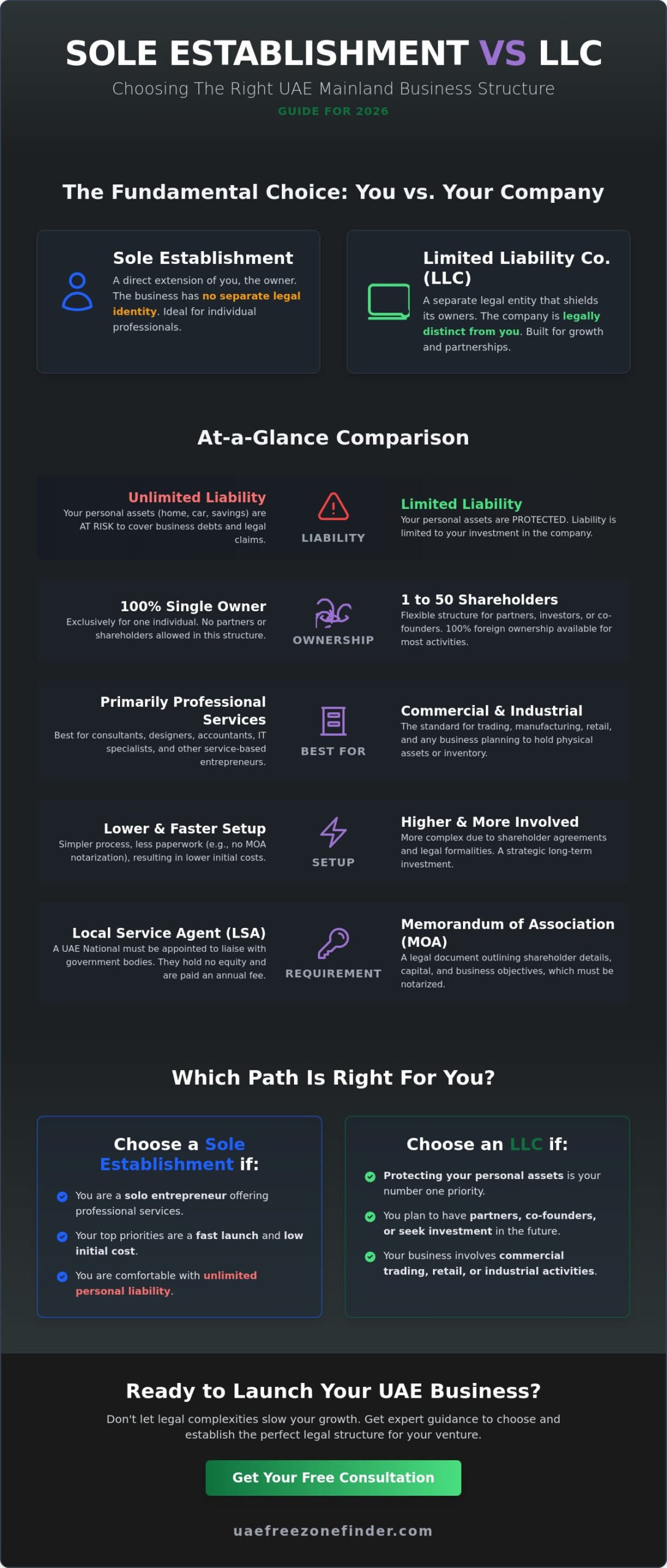
Choosing the right structure is the first high-stakes decision you’ll face as an entrepreneur in the Emirates. The debate of Sole Establishment vs LLC in UAE Mainland centers on one critical factor: legal personality. A Sole Establishment is effectively you, the individual, while a Limited Liability Company exists as a separate legal entity. This distinction dictates everything from your personal financial risk to how you’ll scale your operations across the seven Emirates.
Mainland jurisdictions are the gold standard for entrepreneurs who want unfettered access to the local UAE market. Unlike free zones, which often restrict your trade to specific geographical boundaries or require third-party distributors, a mainland license lets you bid for lucrative government contracts and set up shop in any high-traffic retail area. The landscape shifted significantly on June 1, 2021, when the UAE government allowed 100% foreign ownership for over 1,000 commercial and industrial activities. This move removed the historical requirement for a local partner to hold a 51% stake, making the mainland more attractive than ever for international founders.
Cost structures also vary based on your team size. Solo founders often find the initial setup for a Sole Establishment more affordable, with licensing fees typically starting lower because there’s no memorandum of association to notarize. However, multi-member teams almost always lean toward the LLC. The higher upfront cost of an LLC is a strategic investment in liability protection and structural clarity that pays dividends as the business grows.
What Is a Sole Establishment?
A Sole Establishment is a business owned 100% by one individual. It’s not a separate legal entity; it’s a professional extension of the owner. This means you have unlimited liability. If the business faces financial trouble, your personal assets are on the line. This structure is ideal for professional services like consultancy, accounting, or IT services. For these professional licenses, you must appoint a Local Service Agent (LSA). The LSA is a UAE National who handles government relations for a fixed annual fee, but they don’t own any equity in your firm.
What Is a Limited Liability Company (LLC)?
The Limited Liability Company (LLC) is the most popular choice for commercial trading and industrial ventures. Its primary benefit is the “corporate veil,” which ensures that your personal liability is limited to your share in the company’s capital. You can have a minimum of two and a maximum of 50 shareholders. It’s the preferred vehicle for founders who plan to raise capital or bring on partners later. Because the LLC is a distinct legal person, it can own property, enter contracts, and sue or be sued in its own name, providing a layer of professional security that a Sole Establishment simply can’t match.
The Sole Establishment: Simplicity with Unlimited Responsibility
The Sole Establishment represents the most direct path to market entry for individual entrepreneurs in the UAE. It functions as a legal extension of the person who owns it, rather than a separate corporate body. This structure is particularly popular among expatriates and locals who want to keep their operations lean and their decision-making processes fast. You don’t need to worry about shareholder agreements or complex board resolutions. When comparing a Sole Establishment vs LLC in UAE Mainland, the administrative burden is significantly lower here, making it an attractive starting point for those testing a new service concept.
Professional licenses are the heartbeat of this model. Consultants, designers, and IT specialists gravitate toward this setup because it prioritizes their individual expertise. While the 2021 update to the Commercial Companies Law allows for more flexibility, most Sole Establishments still focus on service-oriented activities. The primary risk is the lack of a “corporate veil.” Since there is no legal separation between the owner and the business, you carry unlimited personal liability. If the business fails to pay a supplier or faces a legal claim, your personal assets, including your car and home, can be used to settle those debts.
Ownership and Control Dynamics
You hold 100% of the decision-making power. This total control allows for rapid pivots in strategy without waiting for partner approval. Managing finances is equally straightforward. You can withdraw profits without the formal dividend declarations required by larger entities. It’s important to remember that the business’s legal life is often tied to your residency status. If you lose your UAE residency, the business license usually faces immediate challenges. If you are unsure which path suits your long-term goals, you can compare license types to find the right fit for your residency plans.
Activity Restrictions for Sole Establishments
This model isn’t built for every industry. You cannot engage in high-risk sectors like insurance, banking, or large-scale industrial manufacturing. These activities require the robust capital and governance structures of an LLC or a Joint Stock Company. Most Sole Establishments focus on the service sector where the overhead is lower. While you can hire employees, scaling a workforce beyond a dozen people often triggers administrative hurdles that make an LLC more practical. The focus remains on consultancy and specialized professional work where the owner’s talent is the main asset.
The LLC Advantage: Scalability and Asset Protection
Choosing between a Sole Establishment vs LLC in UAE Mainland often comes down to how much risk you’re willing to shoulder. For most growth-oriented founders, the Limited Liability Company (LLC) is the gold standard. The primary draw is the legal “corporate veil” it creates. Under the UAE Commercial Companies Law No. 32 of 2021, your personal assets stay separate from the business’s liabilities. If the company faces a financial shortfall or a legal dispute, your personal villa, car, and savings accounts in AED remain protected. This safety net is a non-negotiable for international investors who don’t want to gamble their life savings on a single venture.
Beyond protection, the LLC structure opens doors that remain closed to Sole Establishments. You’ll find it much easier to secure government contracts from entities like the Dubai Municipality or the RTA. These organizations view the LLC as a more stable, permanent entity. Financial institutions like Emirates NBD or ADCB also show a clear preference for LLCs. Because LLCs require more rigorous documentation and transparent shareholding structures, banks are typically more willing to approve corporate credit lines and high-limit business accounts.
- Expanded Activities: LLCs can engage in a vast range of industrial and commercial activities that are often restricted for individual professional licenses.
- Investor Confidence: The ability to bring in multiple partners makes the entity more attractive to venture capitalists and private equity firms.
- Perceived Longevity: An LLC exists independently of its owners, ensuring the business continues even if a shareholder exits.
Structuring Your LLC for Growth
Scaling a business requires a flexible foundation. An LLC allows you to have anywhere from 2 to 50 shareholders, making it easy to bring on new partners as you expand. You’ll define these relationships in the Memorandum of Association (MOA). This document is your company’s constitution; it dictates how profits are shared and how capital is distributed. If you need to pivot, amending the MOA to reflect new share values or ownership percentages is a standard administrative process at the Department of Economy and Tourism (DET).
Commercial Flexibility on the Mainland
Operating an LLC on the mainland gives you the freedom to trade across all seven Emirates without needing additional local agents for every move. You can open multiple branches under your main corporate umbrella, allowing for a unified brand presence from Abu Dhabi to Ras Al Khaimah. Additionally, LLCs typically qualify for larger employment visa quotas. While a Sole Establishment might be capped early, an LLC’s quota is often tied to the size of its office space, giving you the room to hire a massive team as your operations intensify. This makes the Sole Establishment vs LLC in UAE Mainland debate an easy win for those planning a large-scale workforce.
Direct Comparison: Which Structure Fits Your 2026 Goals?
Choosing between a Sole Establishment vs LLC in UAE Mainland depends on your appetite for risk and your five-year expansion plan. A Sole Establishment is often the fastest route to market; license issuance usually takes between 3 to 5 working days. It’s a cost-effective choice because you don’t need to draft a complex Memorandum of Association (MoA). However, you must remember that in this structure, you are the business. This means your personal assets, including your savings and property, are legally tied to the company’s liabilities. There’s no safety net if the business faces a lawsuit or debt.
An LLC requires more initial paperwork and involves higher government fees during the setup phase. Despite the cost, it provides a legal shield. Your liability is strictly limited to your share in the company’s capital. If you plan to scale rapidly or bring in equity partners by 2027, the LLC is the superior choice. While you can convert a Sole Establishment into an LLC later, the process is tedious. It requires a formal valuation of assets and a legal status change at the Department of Economy and Tourism (DET), which often costs more than starting as an LLC from day one.
2026 Tax and Compliance Landscape
The UAE Corporate Tax regime is now a permanent reality for every mainland founder. Both structures must register for Corporate Tax with the Federal Tax Authority (FTA). If your taxable income stays below AED 375,000, you’ll benefit from a 0% rate. For the 2026 tax year, the Small Business Relief remains a vital tool. If your gross revenue is under AED 3 million, you can elect to be treated as having no taxable income. Sole proprietors often mistakenly think they’re exempt from these rules, but you still need to maintain rigorous bookkeeping to prove your eligibility during an audit.
Banking and Financial Credibility
Banks in the UAE are notoriously cautious. An LLC structure signals a level of corporate maturity that sole proprietors often struggle to demonstrate. Most major institutions, such as Emirates NBD or ADCB, have streamlined KYC (Know Your Customer) processes for LLCs because the ownership and liability structures are transparently defined. Sole establishments frequently face longer lead times, more intrusive questioning, and higher minimum balance requirements. Success often depends on following a strategic guide for corporate bank account opening to navigate these internal compliance hurdles.
If you’re ready to secure your business future in Dubai or Abu Dhabi, contact our mainland specialists for a personalized consultation.
Ready to Launch? Navigating Your Mainland Setup
Deciding between a Sole Establishment vs LLC in UAE Mainland is a massive milestone, but it’s only the beginning of your journey. Once you’ve picked your structure, you face the practicalities of the Department of Economic Development (DED). This isn’t just about filling out forms. You need to select the exact activity from a list of over 2,000 options. Picking the wrong one can lead to restricted operations or issues with corporate bank account opening later. It’s a precise science that requires a deep understanding of local regulations.
Most founders underestimate the administrative weight of government liaison. This is where professional PRO services become vital. These experts act as your bridge to the Ministry of Human Resources and Emiratisation (MOHRE) and the Federal Authority for Identity, Citizenship, Customs & Port Security (ICP). Without an insider who knows the specific requirements of each government desk, you risk facing delays that can stretch into three or four months. Expert consultation doesn’t just save time; it protects your initial capital from being drained by avoidable fines and repetitive filing fees.
You’re not just building a company; you’re securing your future in the region. The transition from incorporation to obtaining your UAE investor visa is a multi-step process that demands accuracy. Your residency status depends on the integrity of your initial setup documents. Getting it right the first time ensures you can focus on scaling your business rather than chasing paperwork.
How UAE Free Zone Finder Streamlines the Process
We take the guesswork out of your mainland setup. Our team manages the heavy lifting, including document attestation and certified legal translations required by the DED. We don’t believe in a one-size-fits-all approach. We perform expert matching to ensure your license activity perfectly aligns with your 2026 business goals. For a deeper look at the broader landscape, read The definitive guide to company formation to see how mainland options compare to other jurisdictions.
Your 2026 Setup Checklist
- Trade Name Approval: You must finalize a name that complies with UAE guidelines, avoiding any religious or political references.
- Initial Approval: This is the DED’s “green light” that allows you to proceed with the legalities of your chosen Sole Establishment vs LLC in UAE Mainland structure.
- Office Space: You’ll need to secure a physical office or a verified virtual space and obtain an Ejari (tenancy contract) to finalize the license.
- Visa Processing: Once the license is issued, you can immediately initiate your investor visa application and those of your family or employees.
Taking the first step is often the hardest part of the process. By partnering with specialists who understand the 2026 regulatory environment, you transform a complex bureaucratic hurdle into a clear, manageable path toward your UAE business residency.
Launch Your 2026 Mainland Venture With Confidence
Deciding between a Sole Establishment vs LLC in UAE Mainland is a pivotal move that dictates your legal risk and growth potential. While a Sole Establishment offers simplicity for solo founders, it lacks the asset protection that a Limited Liability Company provides. As the UAE market evolves toward 2026, choosing a structure that supports scalability is more important than ever. You don’t have to figure this out alone. Since 2009, our parent company Virtuzone has paved the way for thousands of successful startups. We offer expert guidance, full PRO and visa support, and transparent fee structures for all mainland licenses. Our goal is to make your transition into the Dubai or Abu Dhabi markets as efficient as possible. You need a partner who understands the local landscape and the nuances of the Department of Economy and Tourism. Take the first step toward your new corporate identity today. Get a free consultation for your UAE mainland setup today. We look forward to building your success story together.
Frequently Asked Questions
Can a foreigner own 100% of an LLC on the UAE mainland in 2026?
Yes, you can own 100% of an LLC on the UAE mainland in 2026 for most commercial and industrial sectors. This change follows the 2020 amendment to the Commercial Companies Law, which removed the requirement for a local Emirati sponsor to hold 51% of shares. Today, over 1,000 activities allow full foreign control. It’s a game-changer for international founders looking at the Sole Establishment vs LLC in UAE Mainland decision.
Is a Sole Establishment cheaper to set up than an LLC?
A Sole Establishment is typically more affordable to launch because it requires less complex legal documentation. You won’t need a Memorandum of Association notarized by the court, which saves on administrative fees. However, while initial costs are lower, you should weigh this against the total absence of liability protection. Most entrepreneurs find the slightly higher LLC setup fee a small price for long-term asset security and peace of mind.
What happens to my personal assets if my Sole Establishment goes into debt?
Your personal assets are fully exposed if your Sole Establishment incurs debt or legal liabilities. Under UAE law, a Sole Establishment isn’t a separate legal entity from its owner. This means your personal savings, property, and cars can be seized to settle business obligations. It’s the primary reason why many growing businesses eventually transition to an LLC structure to protect their private wealth from professional risks.
Can I change my Sole Establishment into an LLC later on?
You can definitely convert your Sole Establishment into an LLC as your business scales. The process involves applying for a legal status change at the Department of Economy and Tourism. You’ll need to draft a new Memorandum of Association and update your trade license accordingly. This transition is common for founders who started small but now require limited liability to protect their growing assets and take on larger partners.
Do I need a local partner for an LLC on the mainland?
You don’t need a local partner for the vast majority of LLC activities on the mainland anymore. Since June 2021, the UAE has allowed 100% foreign ownership in most sectors. You’ll still need a Local Service Agent for professional licenses, but they don’t own any equity in your company. They simply facilitate government relations for a fixed annual fee, keeping you in full control of your business operations.
Which structure is better for getting a corporate bank account in the UAE?
An LLC is generally the superior choice for securing a corporate bank account quickly. UAE banks often view LLCs as more formal and stable structures compared to Sole Establishments. When comparing Sole Establishment vs LLC in UAE Mainland options, remember that compliance departments favor the clear governance and documentation of an LLC. This often leads to faster KYC approvals and higher credit limits for your daily business transactions.
Are Sole Establishments exempt from UAE Corporate Tax?
Sole Establishments aren’t exempt from the 9% UAE Corporate Tax if their annual taxable income exceeds AED 375,000. While the business is taxed as an extension of the individual, the same thresholds apply as they do for corporations. You might qualify for Small Business Relief if your revenue stays below AED 3 million, but you’ll still need to register with the Federal Tax Authority to stay legally compliant.
What business activities are restricted for Sole Establishments?
Sole Establishments are restricted from activities like banking, insurance, and large-scale investment management. These sectors require a corporate structure with specific capital requirements that a single individual cannot provide. Additionally, certain industrial activities and high-risk commercial operations are strictly reserved for LLCs. If you plan to bid on massive government contracts or engage in manufacturing, an LLC is almost always the mandatory legal requirement in the UAE.
Disclaimer
The information provided in this article is intended for general informational purposes only and reflects conditions as understood at the time of publication. Free zone regulations, fees, and requirements in the UAE are subject to change. Readers are advised to verify details with the relevant free zone authority or regulatory body before making any business decisions. For personalised guidance, our business setup experts at UAE Free Zone Finder are available to assist — contact us at info@uaefreezonefinder.com or call +971-507864823.