Mainland vs Free Zone for IT Company: The 2026 Founder’s Guide
Choosing a jurisdiction for your tech firm is no longer a simple choice of ownership. In 2026, the decision between a mainland vs free zone for it company is a high-stakes strategic move that determines your tax qualifying status and your ability to secure government contracts. You’re likely feeling the weight of the 9% corporate tax on your software services or the frustration of banking delays that stall your operations. These are valid anxieties in a market where digital tech spending is projected to reach AED 88 billion this year.
This guide provides the strategic direction you need to minimize your tax liability for the 2026 fiscal year and fast-track residency visas for your developers. We will examine the updated criteria for Qualifying Free Zone Person status and the operational freedom offered by mainland setups. You’ll gain a clear roadmap to navigate the UAE’s regulatory landscape with the confidence of an industry insider, ensuring your business is positioned for maximum efficiency and growth.
Key Takeaways
- Understand why 100% foreign ownership is now the standard across both jurisdictions, shifting your primary decision focus to market access and tax residency rules.
- Evaluate the mainland vs free zone for it company trade-off between securing lucrative UAE government contracts and maintaining the flexibility of international remote operations.
- Navigate the 2026 corporate tax landscape by identifying the AED 375,000 profit threshold and the specific criteria for maintaining 0% tax on qualifying income.
- Identify why the IT Consultancy license remains the most versatile regulatory framework for software development, SaaS, and hardware trading business models.
- Compare the operational requirements of a physical mainland office against the cost-efficiency of Free Zone flexi-desks to optimize your initial setup budget.
Beyond 100% Ownership: Choosing Your IT Jurisdiction in 2026
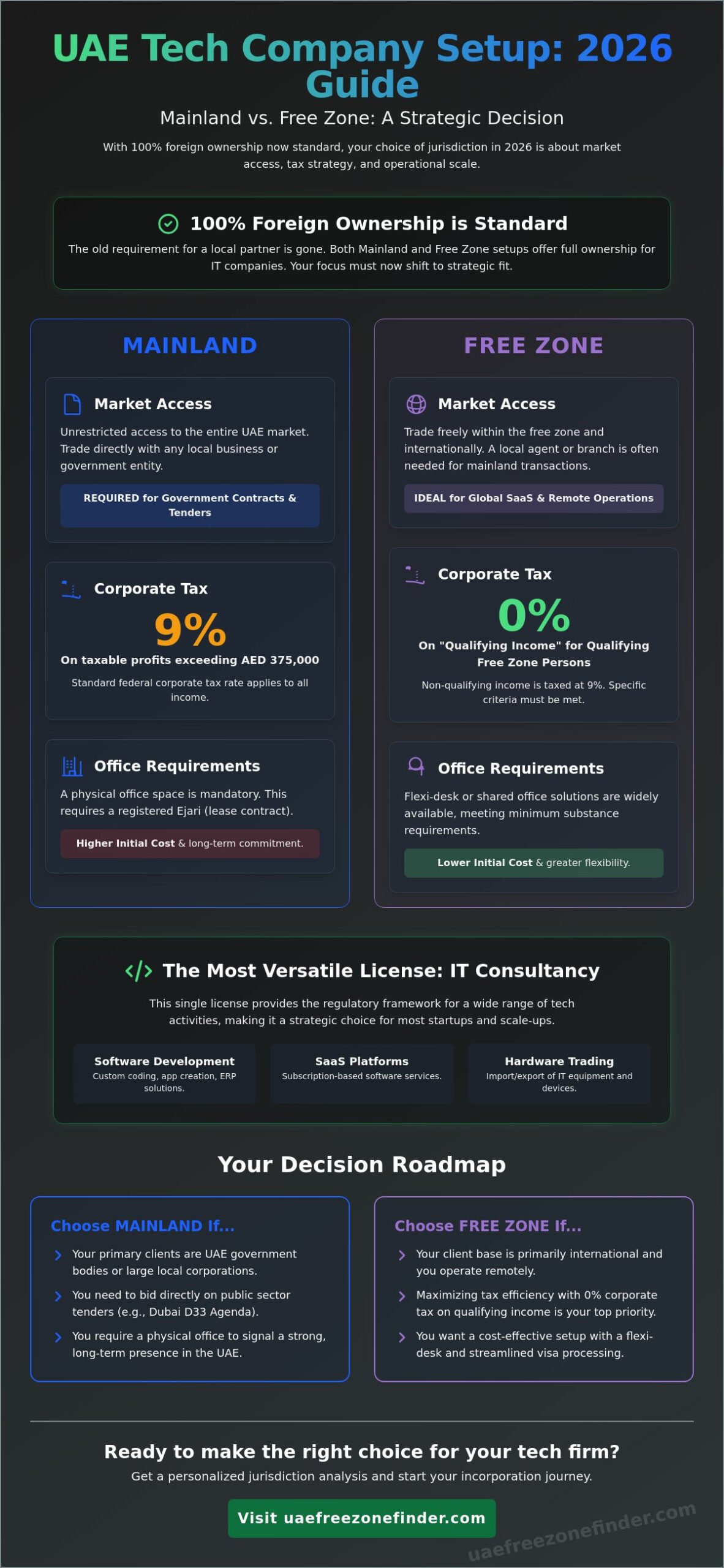
For years, the primary hurdle for international founders was the requirement of a local partner. That barrier has vanished. As of May 2026, 100% foreign ownership is the global standard across the Emirates, regardless of whether you choose a mainland license or a free zone setup. This shift means your evaluation of a mainland vs free zone for it company must move beyond ownership percentages to focus on operational scope, tax residency, and long-term scaling strategy.
Mainland entities operate under the Department of Economy and Tourism (DET) in their respective emirate. They’re considered “onshore” and possess the legal right to trade directly with any client or government entity in the UAE. Conversely, UAE free zones are specialized economic hubs, each governed by its own regulatory authority. These zones often cater to specific niches, such as software development or fintech, providing a tailored ecosystem for tech founders who primarily serve international markets.
The Evolution of UAE Company Formation
The legal transformation began with Federal Decree-Law No. 26 of 2020, which effectively removed the need for a UAE national shareholder for most commercial activities. By 2022, this became the operational reality for the tech sector. If you’re building a SaaS platform or an IT consultancy, you don’t need a local sponsor. The fear of losing control is a relic of the past. Your focus should now be on “Jurisdictional Fit”—matching your legal structure to your 2026 revenue goals and specific client base. It’s about choosing the jurisdiction that supports your growth rather than just your entry.
Immediate Pros and Cons for Tech Firms
Each path offers distinct advantages that impact your daily operations. When deciding on the mainland vs free zone for it company path, consider these core differences:
- Mainland: You gain unrestricted access to the local market. This is the preferred choice for firms targeting government contracts under the Dubai D33 Agenda. It requires a physical office space, which signals long-term commitment to the region but increases overhead.
- Free Zone: These hubs offer a streamlined path for those prioritizing tax efficiency and remote flexibility. They provide simplified visa processes and, for qualifying activities, the potential for 0% corporate tax. Most offer flexi-desk options, keeping your initial investment lower.
The 2026 reality is that both jurisdictions are highly viable. However, only one will be optimal for your specific business model. If your code is destined for local government infrastructure, the mainland is your home. If you’re building a global platform with a remote team, a free zone likely offers the path of least resistance.
Comparing Operational Freedom: Where Will Your Code Live?
Operational freedom defines your daily workflow and long-term scaling potential. While ownership is now equal, the physical and legal boundaries of your license dictate who you can invoice and how fast you can grow. Choosing between a mainland vs free zone for it company requires a clinical look at your intended client list. If your roadmap includes high-value contracts with local banks or federal agencies, the mainland provides a frictionless path that free zones cannot always match.
Trading and Client Access
Free Zone companies are technically considered “offshore” in the context of local UAE trade. If you’re a Free Zone software house wanting to sell a custom ERP solution to a Dubai-based retail group, you typically need a local distributor or a mainland branch to facilitate the transaction. This administrative layer can slow down your sales cycle and complicate your accounting.
Mainland licenses are the gold standard for Business-to-Government (B2G) contracts. They allow you to bid directly on tenders linked to the Dubai D33 Agenda without intermediaries. This is vital for firms specializing in cybersecurity or AI infrastructure for the public sector. However, for global SaaS distribution, both jurisdictions perform excellently. Your code can reach international markets seamlessly regardless of your UAE address. It’s a matter of whether your primary revenue comes from within the UAE borders or from the global cloud.
Visas and Global Talent Acquisition
Scaling a tech firm requires developers, and the resident visa uae process is the gateway to that talent. On the mainland, your visa quota is strictly tied to your physical office size. Usually, the authorities grant one visa per 80 to 100 square feet of leased space. This requirement can be a significant overhead for a growing startup that prefers a lean, remote-first model.
Free Zones offer significantly more flexibility for lean teams. Many jurisdictions provide “visa packages” that allow for 3 to 6 residency visas using only a flexi-desk or a shared workspace. This is an optimized solution for companies that don’t need a massive physical footprint but need to relocate key engineers quickly. Incorporation speed is also a factor. While mainland setups have become more efficient, Free Zone licenses for IT consultancy can often be issued within 24 to 48 hours. If you’re ready to start coding today, expert matching can help you identify the fastest-moving jurisdictions for your specific tech stack. It’s about finding the structure that matches your speed of execution without creating future bottlenecks.
The IT Filter: Matching License Activities to Your Business Model
While the ownership landscape has equalized, the operational reality of your firm depends on what we call the “IT Filter.” This is the process of aligning your specific license activities with your revenue model. When deciding between a mainland vs free zone for it company, you must look beyond the certificate and analyze your daily workflow. For instance, an IT Consultancy license is often the most versatile choice in the UAE. It allows for high-level advisory, software architecture, and project management without the heavy regulatory oversight associated with specialized engineering or hardware manufacturing licenses.
Your choice also dictates your access to specialized tech clusters. Free Zones like Dubai Internet City or Hub71 in Abu Dhabi act as incubators, offering networking opportunities and direct access to venture capital that mainland setups might lack. These ecosystems are designed for digital natives, providing a community of peers and structured support for startups aiming for rapid scaling by 2026.
SaaS and Software Development
Pure-play digital products and SaaS platforms are ideally suited for Free Zone environments. If your business model focuses on global distribution rather than local on-site support, a Free Zone offers the path of least resistance. Founders often prioritize jurisdictions like the DIFC or ADGM because they operate under common law frameworks. This provides a level of Intellectual Property (IP) protection that’s highly attractive to international investors during Series A or B funding rounds. It’s also significantly easier to manage a 100% remote team from these zones, as you aren’t forced to maintain large physical offices to justify your visa quotas.
Managed Services and On-Site Support
Mainland licenses are the essential choice for IT firms providing managed services or physical infrastructure support. If your engineers must enter client offices in Downtown Dubai or government sites in Abu Dhabi to perform on-site maintenance, you need a mainland license. Relying on a Free Zone license for these activities can lead to “illegal trading” penalties, as you’re technically performing services outside your designated zone. A mainland setup also simplifies the logistics of hardware trading. If your business involves importing servers, IoT devices, or networking equipment for local sale, the mainland structure allows you to distribute these goods across all seven emirates without needing a local agent or distributor. This direct access reduces your middleman costs and streamlines your VAT compliance for physical inventory.
Tax Residency and Banking: The 2026 Reality for Tech Firms
Since the UAE’s corporate tax regime became fully operational, the choice of mainland vs free zone for it company has shifted from a simple setup fee comparison to a complex calculation of net margins. For the 2026 fiscal year, all businesses must register for corporate tax, regardless of their jurisdiction. The standard rate is 9% on taxable income exceeding AED 375,000. For many IT startups, this threshold provides a significant cushion during the early growth phases, but your long-term tax strategy depends heavily on your specific “Qualifying Person” status.
Free Zone companies can still benefit from a 0% tax rate on “Qualifying Income,” provided they maintain adequate substance within the zone. This means your core income-generating activities, such as software coding or architecture design, must happen within your Free Zone office. If your IT firm earns more than 5% of its revenue from non-qualifying activities or mainland sources, you risk losing this exemption. Mainland companies don’t have this “Qualifying Income” complexity; they simply apply the 9% rate to all profits above the threshold, which often makes their accounting more straightforward even if the tax bill is higher.
Corporate Tax Nuances for IT Services
An IT consultant in a Free Zone doesn’t automatically get 0% tax. To qualify, you must ensure your services fall under the designated list of qualifying activities and that you don’t provide services to mainland individuals. This is where the 2026 regulations have become stricter. If your tech firm handles cross-border payments or international SaaS subscriptions, you must maintain meticulous records to prove your tax residency status. Mainland tax compliance is often perceived as simpler because it lacks these restrictive “qualifying” boundaries, though it requires regular VAT filings once your annual turnover exceeds AED 187,500.
The Banking Hurdle for Tech Founders
Securing a corporate bank account remains the most significant bottleneck for new IT licenses. Local banks often flag tech companies as “high risk” due to the intangible nature of digital services and the potential for complex cross-border transactions. To speed up the process, you’ll need to provide validated contracts, detailed CVs of the founders, and clear proof of previous professional experience. Your choice of jurisdiction influences this success rate. Mainland companies often find the process slightly faster because they’re seen as having a stronger local “onshore” footprint.
Startups frequently underestimate the scrutiny of compliance departments. Utilizing corporate bank account opening assistance is a strategic move to ensure your application is “bank-ready” from day one. If you want to avoid the 3 to 4 month waiting period that plagues many solo founders, you should consult with a banking specialist who understands the specific requirements for IT jurisdictions. Proper documentation isn’t just a formality; it’s the difference between a functional business and a legal entity that can’t actually trade.
Your Roadmap to Incorporation: Making the Right Call
Deciding between a mainland vs free zone for it company is the most critical architectural decision you’ll make for your business. By 2026, the UAE has streamlined both paths, yet they serve fundamentally different growth trajectories. To ensure you don’t commit to a structure that limits your scalability, use the following framework to finalize your decision.
Choose a Mainland (DET) License if:
- You’re targeting high-value B2G (Business-to-Government) contracts or tenders linked to the Dubai D33 Agenda.
- Your business model requires physical on-site engineers to visit client premises across all seven emirates.
- You plan to hire a large local team and require a physical office that scales with your visa needs.
- You intend to trade hardware or physical IT infrastructure directly in the local UAE market.
Choose a Free Zone License if:
- Your revenue is primarily derived from international SaaS subscriptions or remote software development.
- You want to optimize for 0% corporate tax on qualifying income for the 2026 fiscal year.
- You prefer a lean, remote-first operation using flexi-desk solutions to minimize initial overhead.
- You require a fast-tracked setup, as the free zone company formation process for IT licenses can often be completed in as little as 48 hours.
Cost Comparison: Initial Setup vs. Long-term ROI
Mainland setups involve higher upfront costs due to mandatory physical office leases and Department of Economy and Tourism (DET) registration fees. While this represents a larger initial investment, it offers an unlimited ROI potential by removing all geographic trading barriers within the UAE. In contrast, Free Zones offer a significantly lower entry point. However, founders must be cautious of “per-visa” hidden fees and the costs associated with upgrading to physical spaces later. The lower-cost license often becomes the most expensive mistake if it doesn’t support your 2026 hiring roadmap. We recommend looking at your three-year growth plan rather than just the first-year setup fee when evaluating mainland vs free zone for it company options.
Next Steps with UAE Free Zone Finder
Our role is to act as your Expert Guide, bridging the gap between your technical vision and the UAE’s regulatory requirements. We don’t just provide data; we offer a strategic matching service that aligns your IT activities with the jurisdiction that offers the best banking success rate and tax efficiency. From initial documentation to final residency visa processing, we handle the administrative burden so you can focus on building your product. Don’t leave your corporate structure to chance. Get your personalized IT company setup plan today and secure your firm’s future in the UAE’s thriving tech ecosystem.
Scale Your Tech Firm in the UAE
The decision between a mainland vs free zone for it company determines your operational ceiling for 2026 and beyond. While the mainland offers the gold standard for local government contracts, free zones provide the leanest path for global SaaS delivery and potential tax exemptions on qualifying income. Successfully navigating these jurisdictions requires more than just a trade license; it demands a strategic alignment with the UAE’s evolving corporate tax and banking compliance standards.
UAE Free Zone Finder has provided expert guidance since 2009 under the UAE Free Zone Finder umbrella. We ensure a seamless experience by managing your residency visas and corporate tax registration with absolute precision. You’ll receive a transparent breakdown of all trade license management fees, eliminating the uncertainty that often accompanies business setup in a foreign market. Our team acts as your steady hand, identifying the shortcuts and avoiding the pitfalls of a complex regulatory environment.
Start your IT business journey with an expert consultation to secure a compliant, high-growth future in the Middle East’s premier tech hub. Your vision deserves a foundation built on fifteen years of insider expertise and a genuine commitment to your success.
Frequently Asked Questions
Can an IT company in a Free Zone trade with Mainland clients?
Yes, you can trade with mainland clients, but there are specific regulatory boundaries to respect. While you can provide services remotely, physical work on-site at a mainland office typically requires a mainland branch or a local distributor. Additionally, to maintain your Qualifying Free Zone Person status for tax purposes, your mainland revenue must not exceed the 5% de minimis threshold of your total revenue.
Does an IT company in the UAE need a physical office in 2026?
Every licensed entity must have a registered physical address. Mainland companies require a traditional office space with a verified Ejari lease. Free Zones offer more flexibility for tech startups by providing “flexi-desk” or “smart office” solutions. These satisfy the legal requirement for a physical presence while allowing your team to work remotely or from co-working spaces.
Is the 9% corporate tax mandatory for all IT companies?
Registration for corporate tax is mandatory for every business, but the 9% rate only applies to taxable profits exceeding AED 375,000. Many IT firms qualify for Small Business Relief if their revenue stays below AED 3 million until the end of 2026. Free Zone entities may also access a 0% rate on qualifying income if they maintain adequate substance and meet all compliance requirements.
Which Free Zone is best for a software development startup?
The choice depends on your budget and networking needs. Dubai Internet City provides a premier ecosystem for established tech giants, while hubs like Sharjah Media City (SHAMS) or Masdar City offer cost-effective entry points for lean startups. When evaluating a mainland vs free zone for it company, consider that some zones offer specialized incubators and direct access to venture capital that can accelerate your development cycle.
How long does it take to get an IT business license in the UAE?
Free Zone licenses are often issued within 24 to 48 hours for standard software activities. A mainland license usually takes between 3 to 7 working days. The timeline depends on the speed of your document preparation and the specific approvals required for your chosen IT activities. We recommend having your passport copies and business plan ready to avoid unnecessary delays.
Can I hire remote developers with a Mainland IT license?
You can certainly hire remote developers based anywhere in the world. However, if you want to sponsor residency visas for developers to live in the UAE, your mainland quota is strictly linked to your office size. Typically, you’re granted one visa for every 80 to 100 square feet of physical office space you lease. This makes the mainland vs free zone for it company decision vital for firms planning rapid local team expansion.
What is the cost difference between Mainland and Free Zone for IT?
Free Zone setups are generally more affordable, with total first-year investment often ranging from AED 18,000 to AED 34,000. Mainland setups frequently exceed AED 40,000 because they must include the cost of a physical office lease and higher administrative fees. You should weigh these upfront costs against the long-term ROI of having direct access to local government contracts.
Do I need an Emirati partner for my IT company in 2026?
No, the requirement for a local partner is no longer applicable for the tech sector. Following the 2020 legal amendments, you can maintain 100% foreign ownership of your IT company on the mainland. This applies to consultancy, software design, and most digital activities, allowing you full operational and financial control over your business without needing a UAE national shareholder.
Disclaimer
The information provided in this article is intended for general informational purposes only and reflects conditions as understood at the time of publication. Free zone regulations, fees, and requirements in the UAE are subject to change. Readers are advised to verify details with the relevant free zone authority or regulatory body before making any business decisions. For personalised guidance, our business setup experts at UAE Free Zone Finder are available to assist — contact us at info@uaefreezonefinder.com or call +971-507864823.