How to Choose the Right Free Zone in UAE: A Strategic 2026 Guide
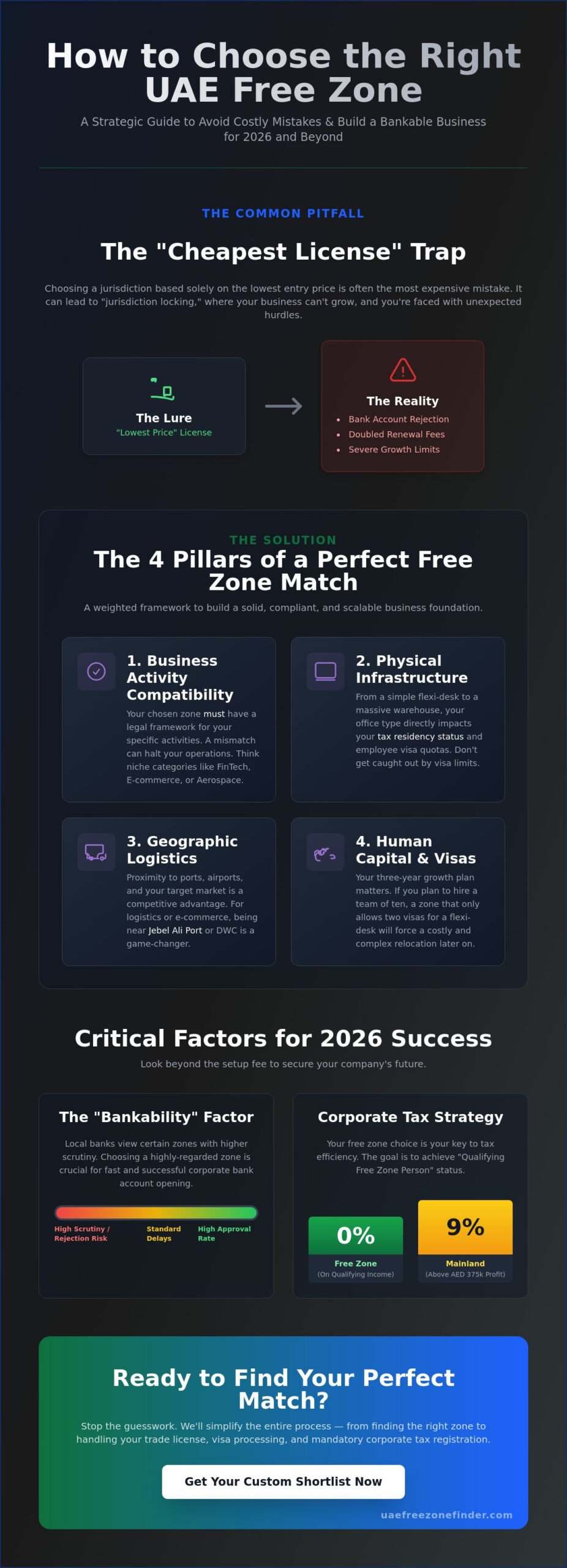
The cheapest trade license in the Emirates often turns out to be the most expensive mistake you’ll ever make. If you choose a jurisdiction based solely on the lowest entry price, you might find yourself with a company that local banks refuse to onboard or a renewal bill that doubles in year two. It’s a frustrating cycle. Many international investors face this hurdle when they don’t have a clear roadmap for the current regulatory landscape.
I know you’re likely feeling overwhelmed by the variety of over 40 jurisdictions and the fear of picking one that restricts your specific business activities. This strategic guide simplifies the process and shows you exactly how to choose the right free zone in uae without the usual guesswork. We’ll break down the 2026 bankability factors and the 9% corporate tax requirements so you can move forward with total confidence.
By the time you finish reading, you’ll have a shortlist of two or three zones that align with your budget and a clear understanding of the setup process. We’re going to move past the marketing fluff to ensure your business foundation is legally compliant and ready for rapid growth.
Key Takeaways
- Avoid the high costs of “jurisdiction locking” by selecting a zone that supports your three-year growth plan rather than just the lowest initial setup fee.
- Learn how to choose the right free zone in uae by matching your specific business activities with jurisdictions that carry high “bankability” scores for corporate account approval.
- Identify the physical infrastructure you actually need, whether it’s a simple flexi-desk for residency or dedicated warehouse space for logistics.
- Navigate the 2026 corporate tax landscape by choosing a zone that helps you maintain “Qualifying Free Zone Person” status to access the 0% tax rate.
- Simplify the entire incorporation process by using a single point of contact for your trade license, visa processing, and mandatory corporate tax registration.
The Paradox of Choice: Why Your Free Zone Selection Matters
The UAE currently hosts over 45 distinct jurisdictions, each offering a specific ecosystem for different industries. While having options is great, it creates a “paradox of choice” for the average entrepreneur. You aren’t just picking a location; you’re selecting a regulatory partner that determines your tax status, your banking success, and your future scalability. Looking at a complete list of UAE free zones reveals names catering to everything from heavy industry to digital media. Picking the wrong one leads to “jurisdiction locking,” a situation where your license doesn’t allow for the growth you planned, but moving to a new zone requires a full company liquidation and fresh setup fees.
Understanding how to choose the right free zone in uae starts with recognizing that these zones aren’t interchangeable. Some are tailored for high-volume logistics, while others are optimized for solo consultants. If you intend to trade directly with customers in the local Dubai market, a standard free zone license might limit you. You’d typically need a mainland branch or a local distributor to bridge that gap. This is why the initial strategy behind your free zone company formation is the most critical step in your entire Middle Eastern expansion.
The Hidden Costs of a Wrong Choice
Many founders focus on the initial setup fee without looking at the long-term operational constraints. If you decide to pivot your business model six months in, you might find that your chosen zone doesn’t support your new activities. Adding a new activity isn’t always a simple paperwork update; some zones have strict silos. There are several factors that can catch you off guard:
- Visa Quotas: Your visa limit is often tied to the physical square footage of your office. If you plan to hire a team of ten but start in a zone that only allows two visas for a flexi-desk, you’ll face a massive bill for an office upgrade.
- Banking Scrutiny: International regulators and local banks often view certain zones with higher scrutiny. This can delay your account opening by months or lead to an outright rejection.
- Audit Mandates: To maintain a 0% corporate tax status on qualifying income in 2026, you’ll need an audited financial statement from a UAE-registered auditor. Some zones have more complex reporting requirements than others.
Free Zone vs. Mainland: A Quick Reality Check
The core difference between these two paths is geographic flexibility. A mainland company can trade anywhere in the UAE and bid for government contracts without restrictions. Historically, people chose free zones for 100% foreign ownership, but many mainland activities now allow 100% ownership too. So why choose a free zone in 2026? It’s mostly about tax efficiency and industry focus. Free zone entities can still access a 0% corporate tax rate on “qualifying income,” whereas mainland companies are subject to the standard 9% rate once they cross the profit threshold. If your business focuses on exports, tech services, or international consulting, a free zone remains the most efficient vehicle for your capital. Knowing how to choose the right free zone in uae ensures you don’t pay for mainland permissions you’ll never actually use.
The 4 Pillars of a Perfect Free Zone Match
Most entrepreneurs start their search by looking for the lowest price tag. It’s a logical instinct, but it’s often the wrong one. To avoid the “jurisdiction locking” we discussed earlier, you need a weighted framework. Understanding how to choose the right free zone in uae requires looking at your business through four distinct lenses: activity, infrastructure, logistics, and human capital.
- Pillar 1: Business Activity Compatibility. Every free zone authority maintains a specific list of permitted activities. If your work falls into a niche category like fintech or aerospace, you need a jurisdiction that has the specific legal framework to regulate it.
- Pillar 2: Physical Infrastructure. Your choice ranges from a shared “flexi-desk” to a 50,000 square foot warehouse. In 2026, your office type isn’t just about where you sit; it’s a primary factor in your tax residency status.
- Pillar 3: Geographic Logistics. If you’re an e-commerce brand or a manufacturer, being ten minutes from Jebel Ali Port or Dubai Bank Central is a massive competitive advantage. If you’re a digital consultant, this matters less than high-speed connectivity.
- Pillar 4: Visa and Residency Requirements. Every square metre of office space you lease translates into a specific visa quota. If you plan to scale your team quickly, you need a zone that allows for easy quota upgrades without forcing a move.
If you’re feeling stuck between two similar options, our expert matching service can help you compare the fine print before you commit any capital.
Matching Your Activity to the Right Authority
Don’t assume that a “General Trading” license is a catch-all solution. While it offers flexibility, it can be more expensive to renew and might face higher scrutiny during bank account opening. It’s often better to join an industry cluster. For instance, being in a media-focused zone provides access to specialized talent and networking that a generic industrial zone simply can’t offer. Be wary of “unregulated” activities; if your authority doesn’t explicitly understand your tech stack or service model, you’ll face significant friction when trying to secure your license or process 2026 corporate tax filings.
Facilities and the “Virtual Office” Debate
The “virtual office” concept has evolved significantly. To qualify for the 0% corporate tax rate on qualifying income, you must demonstrate “adequate substance” in the UAE. This means having a physical presence. While a flexi-desk is a great entry point for freelancers, growing SMEs usually need dedicated suites. Your choice of facility also dictates your ability to secure a resident visa uae for yourself and your staff. Typically, visa fees range from AED 3,000 to AED 7,000 per person, and the number of visas you can apply for is strictly capped by the size of your physical premises. Always verify the “visa-to-space” ratio before signing a lease.
The “Bankability” Factor: Will You Get an Account?
A trade license is essentially a decorative document if you cannot move capital. In the UAE, the bank account is the true “final boss” of business setup. Many entrepreneurs overlook this until they’ve already spent thousands on a license, only to find that no Tier-1 bank will touch their chosen jurisdiction. This is why learning how to choose the right free zone in uae is as much a financial strategy as it is a legal one. Banks are selective. They have to be. They operate under strict international pressure to maintain high standards of transparency.
When you apply for an account, the compliance officer isn’t just looking at your passport; they’re evaluating the entire jurisdiction’s history of regulatory adherence. Banks categorize free zones into internal tiers based on their KYC (Know Your Customer) and AML (Anti-Money Laundering) standards. If a zone has a reputation for lax oversight, it ends up on an unofficial “high-risk” list. Your Memorandum of Association (MOA) also serves as a critical piece of evidence. Banks scrutinize this document to ensure your ownership structure is clear and your activities don’t stray into “gray” areas. I always recommend seeking corporate bank account opening assistance as a pre-setup step. It’s far better to know which banks favor which zones before you sign your lease.
What Banks Look for in a Jurisdiction
Transparency is the currency of the banking world. To approve your application, a bank needs to verify that your chosen free zone maintains a reliable, accessible registry. They also look for “substance,” which we touched on in previous sections. A physical office, even a small executive suite, carries significantly more weight than a purely virtual setup. Banks want to see that you’re a real entity with a footprint in the UAE. They also track the zone’s history of compliance with the UAE Central Bank’s evolving directives. If a jurisdiction is slow to adopt new federal regulations, its members will find their account applications gathering dust on a compliance officer’s desk.
Avoiding the “High-Risk” Trap
The “cheapest” license on the market often becomes the hardest to bank. If a jurisdiction attracts thousands of low-cost, low-oversight entities, banks naturally increase their scrutiny for everyone in that zone. In 2026, your legitimacy is also tied to your tax status. All free zone companies must now register for Corporate Tax. Failing to do so doesn’t just invite an AED 10,000 fine; it acts as a massive red flag for your bank. Proving that you’re a registered taxpayer with a plan for mandatory audits shows the bank that you’re a serious professional. Before you pay your deposit, check the zone’s reputation with local financial institutions. Understanding how to choose the right free zone in uae means looking past the initial setup cost to the long-term viability of your corporate treasury.
Step-by-Step: Narrowing Your Options from 40 to 1
Moving from theory to execution requires a cold, analytical approach to your business plan. You’ve already considered the four pillars and the banking hurdles. Now, it’s time to apply a filter to the remaining options. If you want to know how to choose the right free zone in uae effectively, you must treat it like a long-term investment rather than a one-time purchase. This process isn’t about finding a “good” zone; it’s about finding the one where your specific 2026 operations will face the least resistance.
- Step 1: Audit your 3-year growth plan. Don’t just look at your current needs. How many visas will you need in 24 months? Will you require physical storage later? Changing zones mid-growth is a logistical nightmare.
- Step 2: Filter by “Mandatory Activities.” Some zones have broader activity lists than others. Eliminate any jurisdiction that doesn’t explicitly support your core work or requires a third-party NOC that you can’t easily obtain.
- Step 3: Compare Total Cost of Ownership (TCO). Look past the “hook” price. Compare the combined cost of the license, residency visas, office lease, and the inevitable renewal fees.
- Step 4: Verify “Bankability.” Consult with a professional to see which banks are currently approving accounts for your shortlisted zones.
- Step 5: Review the 2026 Corporate Tax implications. Ensure the zone is structured to support “Qualifying Free Zone Person” status so you can legally access the 0% tax rate on qualifying income.
If you’re ready to skip the trial and error, you can get a personalized jurisdiction shortlist from our expert team today.
Calculating the Total Cost of Ownership (TCO)
The initial setup fee is often just the tip of the iceberg. In many cases, the license itself represents only about 40% of your total first-year expenditure. You have to factor in the mandatory corporate tax registration, which carries an AED 10,000 fine if missed. Then there are the annual audit fees. Since an audit is now required to qualify for the 0% tax rate, this is no longer an optional expense. Don’t forget the PRO service fees for visa management and the variable costs of Emirates ID processing. A “cheap” license in a Northern Emirate might end up costing more than a Dubai-based one once you factor in the travel and logistics of managing a remote office.
The Final Vetting Process
Before you sign any contracts, look at the zone’s digital infrastructure. A sleek digital portal for renewals and visa applications will save you dozens of hours every year. You should also verify if the zone is a “Designated Zone” for VAT purposes. This is critical if you’re handling physical goods, as it affects how 5% VAT is applied to your imports and exports. Finally, try to connect with other business owners in that jurisdiction. They’ll give you the honest truth about the speed of administrative support and whether those “hidden fees” actually stay hidden during the renewal cycle.
Expert Matching: Let UAE Free Zone Finder Do the Heavy Lifting
You’ve got the data. You understand the pillars of a solid setup and the banking risks involved. But knowing the theory of how to choose the right free zone in uae is quite different from managing the actual bureaucracy. You shouldn’t have to spend your first month in the country chasing paperwork or waiting in government queues. At UAE Free Zone Finder, we’ve spent years within the UAE Free Zone Finder family perfecting a data-driven approach to jurisdiction matching. We don’t just provide a list of options; we provide a strategic roadmap that secures your business foundation from day one.
By acting as your single point of contact, we eliminate the stress of managing multiple vendors. Whether you require initial free zone company formation, corporate tax registration, or ongoing bookkeeping and accounting services, we handle the technical details. You focus on your market entry; we focus on the compliance. Our team stays ahead of the 2026 regulatory shifts so you’re never caught off guard by a new audit requirement or a change in visa processing rules.
Why a Consultant Beats a DIY Approach
Government portals and official websites rarely tell the whole story. We know which zones are currently processing residency visas the fastest and which authorities are experiencing administrative backlogs. Our position in the market gives us access to “unlisted” packages and seasonal promotions that aren’t always advertised to the general public. More importantly, we ensures your Federal Tax Authority (FTA) registrations are handled with professional precision. This prevents the AED 10,000 fines associated with late registration and ensures you’re ready for your first mandatory audit. When you’re deciding how to choose the right free zone in uae, having an insider’s perspective on these operational realities is invaluable.
Your Journey Starts with a Single Call
We’ve simplified the entire setup into a clear, transparent journey. It starts with a Discovery Call where we audit your three-year growth plan and specific industry requirements. From there, we take over the heavy lifting. We manage everything from the Memorandum of Association (MOA) drafting to your corporate bank account opening assistance. You won’t be left guessing which document comes next. We guide you through every milestone until your trade license is in your hands and your team is on the ground. Book your free zone consultation today and let’s build your UAE success story together.
Secure Your Global Business Future Today
Selecting a jurisdiction is the most consequential decision you’ll make in your Middle Eastern expansion. We’ve explored how physical infrastructure, license compatibility, and the 2026 corporate tax landscape intersect to create a “bankable” entity. You now have the strategic framework to move past the distraction of low-cost entry fees and focus on long-term operational stability. Understanding how to choose the right free zone in uae is about more than just paperwork; it’s about protecting your capital and ensuring your company can actually function within the local financial ecosystem.
Don’t leave your incorporation to chance. With our UAE Free Zone Finder Group heritage and a commitment to 100% transparency on fees, we provide the steady hand you need in a complex regulatory environment. Our team offers dedicated PRO support to manage your visas and compliance while you focus on scaling your operations. It’s time to turn your global ambitions into a compliant, high-growth reality.
Find Your Perfect Free Zone Match Now
Frequently Asked Questions
Which is the low-cost free zone in the UAE for 2026?
Sharjah Media City (Shams) and several other jurisdictions in the Northern Emirates offer a lower-cost entry points with packages starting at approximately AED 5,750. When you’re researching how to choose the right free zone in uae, remember that these prices usually cover the license only. You’ll need to account for residency visas and the mandatory 2026 audit fees separately to understand your true setup cost.
Can a free zone company operate in the UAE mainland?
Free zone companies are generally restricted from trading directly with customers on the UAE mainland. To access the local market, you’ll typically need to partner with a local distributor or establish a mainland branch. This distinction is vital for your business model. If your primary revenue comes from local consumers rather than international exports, a mainland license might be a more efficient choice for your operations.
Do I need a physical office to choose a free zone?
You don’t necessarily need a large private office, but you do need a physical address to meet economic substance requirements. Most jurisdictions offer flexi-desk solutions that provide a legal address for your trade license and visa applications. In 2026, having this physical footprint is mandatory to maintain your Qualifying Free Zone Person status and benefit from the 0% corporate tax rate on qualifying income.
How long does it take to get a free zone license?
Most free zone licenses are issued within two to seven working days after you submit your completed application and documents. Some digital-first zones in the Northern Emirates can even process approvals in as little as 24 hours. However, this timeline only covers the trade license itself. Your residency visa and corporate bank account opening will take several additional weeks to finalize and require separate administrative steps.
Can I have multiple business activities on one free zone license?
You can typically include up to three or five related business activities on a single free zone license. If you want to combine vastly different fields, like IT consulting and jewelry trading, you’ll likely need to pay for additional activity categories. This flexibility is a core factor in how to choose the right free zone in uae, so always verify the authority’s compatibility list before you commit your capital.
Is corporate tax mandatory for all free zone companies?
Registration for corporate tax is mandatory for all free zone companies, regardless of their profit levels. While you can still access a 0% tax rate on qualifying income, you must still register with the Federal Tax Authority. Failure to do so results in an AED 10,000 fine. You’ll also need a mandatory audit from a UAE-registered auditor to prove your eligibility for the 0% rate during your annual filing.
What is a “Designated Zone” and why does it matter for VAT?
A Designated Zone is a specific area, like Jebel Ali Free Zone, that’s considered outside the UAE for VAT purposes regarding the supply of goods. This status allows for the tax-free movement of goods between other designated zones or for export. If your business involves high-volume international trade or physical inventory, choosing a jurisdiction with this status can significantly optimize your VAT cash flow and reporting requirements.
Disclaimer
The information provided in this article is intended for general informational purposes only and reflects conditions as understood at the time of publication. Free zone regulations, fees, and requirements in the UAE are subject to change. Readers are advised to verify details with the relevant free zone authority or regulatory body before making any business decisions. For personalised guidance, our business setup experts at UAE Free Zone Finder are available to assist — contact us at info@uaefreezonefinder.com or call +971-507864823.