Corporate Tax Implications for UAE Free Zone Companies: The 2026 Strategic Guide
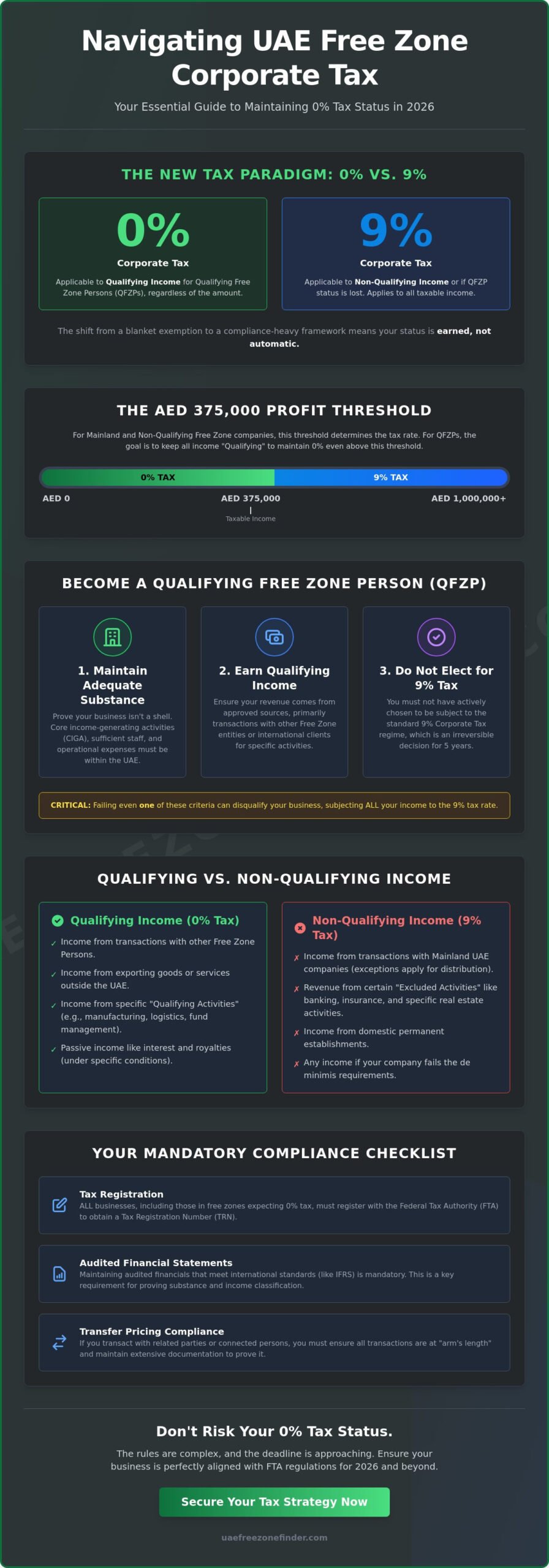
Thinking that your free zone status automatically grants you a 0% tax rate in 2026 is a mistake that could cost your business exactly 9% of its bottom line. Since the new regime’s introduction in June 2023, the corporate tax implications for uae free zone companies have shifted from a blanket exemption to a rigorous, compliance-heavy framework. It’s no longer just about where you’re registered; it’s about what you do and how you document it. You’ve likely felt the pressure of the upcoming September 30, 2026, filing deadline or worried about whether your mainland transactions will trigger a full tax liability.
We understand that the transition from a tax-free environment to one requiring mandatory audits and complex income assessments is stressful. This guide will help you master these complexities and show you how to maintain your 0% corporate tax status through 2026. We’ll provide a clear roadmap for Qualifying Free Zone Person eligibility, explain the AED 375,000 profit threshold, and show you exactly how to align your business activities to stay on the right side of the Federal Tax Authority.
Key Takeaways
- Identify exactly when your profits cross the AED 375,000 threshold so you’re ready for the standard 9% tax rate.
- Secure your 0% tax status by meeting the specific substance rules that prove your business isn’t just a shell company.
- Master the corporate tax implications for uae free zone companies by learning which revenue streams are qualifying and which ones aren’t.
- Stay compliant with the Federal Tax Authority by understanding why you’ll need both registration and annual audited financial statements.
- Use our strategic roadmap to align your license activities with the latest 2026 regulations so you don’t lose your tax benefits.
The 0% vs. 9% Paradigm: How UAE Corporate Tax Affects Free Zones
The UAE has long been the gold standard for tax-free business, but the landscape changed permanently on June 1, 2023. The government introduced a UAE corporate tax framework that balances international compliance with the need to keep the country attractive for foreign investment. This isn’t a “one size fits all” tax. Instead, it’s a tiered system where your success is measured against a specific financial benchmark. For most entities, the standard rate is 9% on taxable income that exceeds AED 375,000. Anything below that amount stays at 0%, providing a vital cushion for startups and smaller enterprises.
However, the corporate tax implications for uae free zone companies are more nuanced than a simple threshold. If you’re registered in a free zone, you have the potential to keep a 0% rate on all your “Qualifying Income,” even if it’s well over that AED 375,000 mark. But don’t assume this is a default right. Incorrectly claiming a 0% status without meeting strict Federal Tax Authority (FTA) criteria can lead to aggressive audits and heavy back-tax penalties that could jeopardize your 2026 growth plans. You must proactively prove your eligibility rather than waiting for the tax man to ask.
The Evolution of UAE Tax Incentives
The shift toward corporate tax wasn’t a sudden decision; it was a strategic move to align with global OECD standards while protecting the unique status of the UAE’s 40+ UAE free zones. In the pre-tax era, the promise was simple: zero tax, period. Today, the law introduces the “Free Zone Person” designation. This means your company is recognized as a resident of the free zone, but your tax rate depends entirely on your specific activities. By 2026, the distinction between “Qualifying” and “Non-Qualifying” income will be the most important factor in your financial reporting. It’s a more regulated environment, but for those who follow the rules, the financial benefits remain substantial.
Impact on Different Business Structures
Your corporate setup dictates how these rules apply to your daily operations. A Free Zone LLC might have different reporting requirements than a branch office of a foreign company. While branches often mirror the tax profile of their parent entities, an LLC must stand on its own two feet regarding substance and local expenditure. This is why the initial stage of free zone company formation is so critical. Choosing the right jurisdiction isn’t just about the license cost anymore; it’s about finding a zone that supports your specific “Qualifying Activities.” We see many businesses restructuring their operations in 2026 to ensure their corporate tax implications for uae free zone companies remain optimized and within the 0% bracket.
Becoming a Qualifying Free Zone Person (QFZP): The Essential Criteria
Securing a 0% tax rate isn’t a passive benefit; it’s an active status you must earn and maintain. In the current landscape, the most significant corporate tax implications for uae free zone companies revolve around whether they meet the strict definition of a “Qualifying Free Zone Person.” If you fail to hit even one of the criteria set by the government, your entire income could be slapped with the standard 9% tax rate. According to the official FTA guidance, this status is the only legal gateway to maintaining your tax-exempt status through 2026 and beyond.
To stay in the clear, your business must satisfy three primary pillars. First, you’ve got to maintain “adequate substance” within the UAE. This means your operations can’t just exist on paper. Second, your revenue must be “Qualifying Income,” which generally includes transactions with other free zone entities or certain international activities. Finally, you must not have “elected” to be subject to the standard 9% regime. Some businesses choose to pay the 9% to simplify their accounting, but for most, the goal is to stay at zero by following these precise rules.
Understanding Adequate Substance in 2026
The days of using a simple flexi-desk to claim tax residency are largely over for high-revenue firms. To satisfy FTA inspectors, you need to prove your “Core Income-Generating Activities” (CIGA) actually happen inside the free zone. This involves having enough qualified employees and incurring a reasonable amount of operating expenditure locally. If you’re managing a global trading firm from a shared desk with no staff on the ground, you’re at high risk of losing your QFZP status. Documenting your local rent, utility bills, and payroll is now a mandatory part of your tax strategy.
The Nexus Between Banking and Tax
Your bank account is more than just a place to hold cash; it’s a primary evidence trail for the FTA. A local account proves that your economic substance is rooted in the UAE. Without it, you’ll struggle to show that your business is a legitimate local entity rather than a “shell” company designed to park offshore profits. This is why securing corporate bank account opening assistance is often the first step in a successful tax plan. It ensures your financial infrastructure supports your tax-exempt claims. If you’re feeling overwhelmed by these requirements, you can consult with our experts to ensure your setup is fully compliant for the 2026 tax year.
Qualifying vs. Excluded Activities: Where Does Your Revenue Fall?
Your bank balance doesn’t tell the whole story under the 2026 tax regime. Understanding the corporate tax implications for uae free zone companies requires a surgical look at where every dirham comes from. Under the latest Ministerial Decisions, revenue is split into three buckets: Qualifying, Non-Qualifying, and Excluded. If you mix these up without a clear strategy, you risk losing your 0% status for the entire tax period. It’s a high-stakes game of revenue segregation that requires precise accounting from day one.
The “De Minimis” rule is your safety net, but it’s a small one. It allows a Qualifying Free Zone Person to earn a tiny amount of non-qualifying income without losing their 0% rate. Specifically, this non-qualifying revenue must be the lower of 5% of your total revenue or AED 5 million. Cross that line by even one dirham, and your entire profit pool could be taxed at 9%. This is why a strategic guide for business owners is essential; it helps you navigate these thresholds before they become a liability in your annual audit.
Common Qualifying Activities for 2026
Manufacturing goods inside a designated zone remains a top-tier qualifying activity. If you’re processing raw materials or assembling products, you’re likely in the clear. Holding companies that manage shares or securities also enjoy the 0% rate, provided they aren’t engaged in active trading that crosses into excluded territory. International consulting and ship management are other safe harbors. However, these services must be rendered to other free zone entities or international clients to maintain their status. Don’t let a single invoice to a mainland individual ruin your tax-efficient structure.
Activities That Trigger the 9% Rate
Certain sectors are flat-out excluded from the 0% benefit, regardless of where the company is registered. If your business involves banking, insurance, or finance, expect to pay the standard 9%. Transactions with “Natural Persons,” which are essentially B2C sales, also generally fall outside the 0% scope. This is a major trap for e-commerce firms selling to individual customers in the UAE mainland. Additionally, while service-based revenue might qualify, income from commercial property is treated with much more scrutiny. It often triggers the higher tax rate if the property is located outside the specific designated free zone.
Mandatory Compliance: Registration, Audited Financials, and Transfer Pricing
Compliance is no longer a “wait and see” game. By 2026, the administrative burden on businesses has reached a peak, and the corporate tax implications for uae free zone companies are now centered on rigorous documentation. Every single entity, whether it’s a massive logistics firm in JAFZA or a solo freelancer in SHAMS, must register for corporate tax. It doesn’t matter if your profit is zero or if you’re eligible for small business relief; the registration on the EmaraTax portal is a non-negotiable legal requirement. Missing your registration deadline can trigger an immediate AED 10,000 penalty, an expensive mistake for a process that takes very little time when handled correctly.
Once registered, the focus shifts to your annual filing. You’ve got nine months from the end of your financial year to submit your return. For companies with a calendar year ending December 31, 2025, your hard deadline is September 30, 2026. Filing isn’t just about clicking a button; it’s the final step in a year-long process of proving your eligibility for the 0% rate. If you fail to file, you’re not just looking at fines; you’re inviting a full FTA audit that could pick apart your entire corporate structure.
The IFRS Requirement for Free Zone Entities
Standard bookkeeping is officially a thing of the past. To maintain Qualifying Free Zone Person (QFZP) status, you’re now legally required to prepare audited financial statements under International Financial Reporting Standards (IFRS). This is the “day-to-day” bookkeeping gap where many businesses stumble. You can’t just hand a box of receipts to an accountant at the end of the year. You need a structured ledger that tracks qualifying versus non-qualifying income in real-time. While hiring professional auditors adds an operational cost, it’s a necessary investment to protect your 0% tax status. Without an audited report, the FTA will default your taxable income over AED 375,000 to the standard 9% rate.
Transfer Pricing: Dealing with Related Parties
If your free zone company does business with a sister company or any entity you have a “significant influence” over, you’re dealing with Related Parties. In 2026, these transactions must follow the “Arm’s Length Principle.” This means the price you charge your sister company must match what you’d charge a third-party stranger. You’re now required to maintain a “Local File” and, for larger groups, a “Master File” to document these transactions. These files are your primary defense during an audit. They prove you aren’t artificially shifting profits to a tax-free entity. If the thought of IFRS and transfer pricing files is overwhelming, you can get professional corporate tax registration support today to ensure your compliance is bulletproof before the next filing deadline.
Optimising Your Tax Position: How UAE Free Zone Finder Supports Your Growth
Your tax bill for 2026 is effectively decided the day you select your jurisdiction. While many entrepreneurs focus solely on the upfront cost of a trade license, the corporate tax implications for uae free zone companies are far more significant. A “cheap” license in a zone that doesn’t specifically cater to your qualifying activity could result in a 9% tax rate on your entire profit pool. We don’t just process paperwork; we act as your strategic partner to match your business model with the jurisdiction that offers the strongest tax protections.
Finding the perfect fit requires more than a cursory glance at a brochure. It involves a deep analysis of your intended “Qualifying Activities” and how they align with current Ministerial Decisions. Our team evaluates your supply chain, your client base, and your physical substance requirements to ensure your setup is bulletproof. By choosing the right zone from the start, you avoid the costly and complex process of restructuring your company later when the Federal Tax Authority (FTA) begins its review.
From Incorporation to Tax Compliance
Maintaining “Adequate Substance” isn’t a “set it and forget it” task. It’s a year-round commitment that involves documented local expenditure and genuine operational presence. Our PRO services are designed to help you maintain this substance without the stress. We integrate your bookkeeping, audited financials, and tax filing directly into your annual license renewal cycle. This ensures that when it’s time to file your return on the EmaraTax portal, all your data is already formatted to satisfy IFRS standards. Having an expert hand to navigate the FTA’s digital systems prevents the simple data entry errors that often lead to unnecessary audits or administrative penalties.
Securing Your Future in the UAE
A robust tax strategy does more than just protect your margins; it secures your long-term place in the UAE’s growing economy. When your corporate structure is optimized and compliant, it creates a stable foundation for your personal residency. You can take full advantage of the UAE’s tax-friendly environment for long-term residency and scaling. There’s a direct link between your corporate standing and your resident visa uae benefits, especially for those looking to scale their presence or apply for a Golden Visa. A healthy, tax-compliant company is your best asset when dealing with immigration and banking authorities.
Don’t let the complexity of the 2026 tax regime slow down your international expansion. We’re here to simplify the bureaucratic hurdles and turn them into a competitive advantage for your business. Take the first step toward a tax-efficient future by getting a free consultation on your 2026 tax strategy today. Let us help you navigate the corporate tax implications for uae free zone companies with the confidence of an insider.
Securing Your Competitive Edge in the 2026 Tax Landscape
The transition to a formal tax regime marks a new era for business in the Emirates. You’ve learned that the 0% rate is a hard-earned privilege that depends on your ability to maintain adequate substance and correctly categorize your revenue. By 2026, the distinction between qualifying and excluded activities will separate the most profitable firms from those facing unexpected 9% liabilities. It’s no longer enough to just have a license; you need a documented trail of compliance that stands up to FTA scrutiny.
Navigating the corporate tax implications for uae free zone companies doesn’t have to be a source of stress. As an authoritative partner for UAE business setup, we offer expert guidance on Ministerial Decisions 229 and 265 to keep your operations aligned with the latest legal standards. We handle the complexities of tax registration and compliance management so you can focus on global expansion. Don’t leave your tax status to chance when you can secure your future today.
Optimise your Free Zone tax strategy with our experts and build your legacy in the UAE with total confidence.
Frequently Asked Questions
Do Free Zone companies still get 0% tax in 2026?
Yes, but the 0% rate is now conditional rather than automatic. You can maintain a 0% rate on “Qualifying Income” if you meet the specific criteria for a Qualifying Free Zone Person. For any income that doesn’t qualify, the standard 9% rate applies once your taxable profit exceeds the AED 375,000 threshold. It’s vital to align your business activities with the latest Ministerial Decisions to secure this benefit.
Is corporate tax registration mandatory for all Free Zone entities?
Registration is absolutely mandatory for every Free Zone entity, regardless of whether you make a profit or qualify for the 0% rate. The Federal Tax Authority requires all taxable persons to register through the EmaraTax portal. Failing to do so can result in an immediate AED 10,000 administrative penalty. This registration is the first step in managing the corporate tax implications for uae free zone companies effectively.
What happens if a Free Zone company earns income from the UAE mainland?
Income sourced from the UAE mainland is generally treated as non-qualifying income and is subject to the 9% tax rate. However, the “de minimis” rule allows you to earn a small amount of non-qualifying revenue without losing your entire 0% status. This limit is the lower of 5% of your total revenue or AED 5 million. Exceeding this threshold means your entire income pool becomes taxable at the standard rate.
Can a Free Zone company claim Small Business Relief?
Free Zone companies can claim Small Business Relief if their revenue is below AED 3 million for the relevant tax period. This relief is available until December 31, 2026. However, you cannot claim this relief if you’ve already elected to be a Qualifying Free Zone Person. You must choose between the 0% QFZP regime or the Small Business Relief based on which fits your 2026 financial projections better.
Are audited financial statements required for all Free Zone businesses?
Audited financial statements are mandatory for any company that wants to maintain its status as a Qualifying Free Zone Person. While general corporate tax law has different thresholds, the specific rules for Free Zones require an annual audit to prove you meet the “adequate substance” and income requirements. These audits must be prepared according to International Financial Reporting Standards (IFRS) to be accepted by the FTA.
What is the deadline for UAE corporate tax registration in 2026?
While registration deadlines were phased throughout 2024 and 2025, the most critical 2026 date is your tax return filing deadline. If your financial year ends on December 31, 2025, you must file your return and pay any tax due by September 30, 2026. Missing this nine-month window results in significant late-filing penalties and potential interest charges on any unpaid tax liabilities.
Does 0% tax apply to dividends paid by a Free Zone company?
Dividends and other profit distributions received from UAE mainland companies or other Free Zone entities are generally exempt from corporate tax. This participation exemption also applies to certain foreign dividends if you hold at least a 5% ownership stake for at least 12 months. This makes the UAE an incredibly tax-efficient location for holding companies and international investment structures throughout the 2026 tax year.
Can I lose my Qualifying Free Zone Person status?
You’ll lose your QFZP status if you fail to meet any of the core requirements, such as maintaining adequate substance or staying within the de minimis threshold. If you lose this status, you’re barred from regaining it for a period of five years. This is why understanding the corporate tax implications for uae free zone companies is a continuous compliance task rather than a one-time setup during incorporation.
Disclaimer
The information provided in this article is intended for general informational purposes only and reflects conditions as understood at the time of publication. Free zone regulations, fees, and requirements in the UAE are subject to change. Readers are advised to verify details with the relevant free zone authority or regulatory body before making any business decisions. For personalised guidance, our business setup experts at UAE Free Zone Finder are available to assist — contact us at info@uaefreezonefinder.com or call +971-507864823.