
8 Hidden Benefits of Setting Up in a UAE Freezone (2026 Guide)
What if the real power of your trade license isn’t the tax exemption, but a specific regulatory sandbox that allows you to test fintech products without a full retail banking license? It’s common to feel overwhelmed by the 40 plus jurisdictions available in the Emirates, especially while trying to decipher the 2023 corporate tax updates. You probably already know about 100% foreign ownership, but you’re likely worried about hidden operational hurdles or picking a zone that won’t scale with your five year plan.
I’ll show you the 8 Hidden Benefits of Setting Up in a UAE Freezone that go far beyond the standard marketing brochures. We’ll look at how these zones provide strategic access to global capital and unique customs exemptions that can save your firm thousands in AED every quarter. This 2026 guide provides the framework you need to move from uncertainty to a fully optimized corporate structure. You’ll gain the confidence to choose a jurisdiction that protects your assets while accelerating your market entry.
Key Takeaways
- Learn how specific jurisdictions offer shareholder confidentiality and robust asset protection to shield your personal wealth from corporate liabilities.
- Master the mechanics of 100% capital repatriation and multi-currency banking to keep your global trade operations efficient and protected from currency shifts.
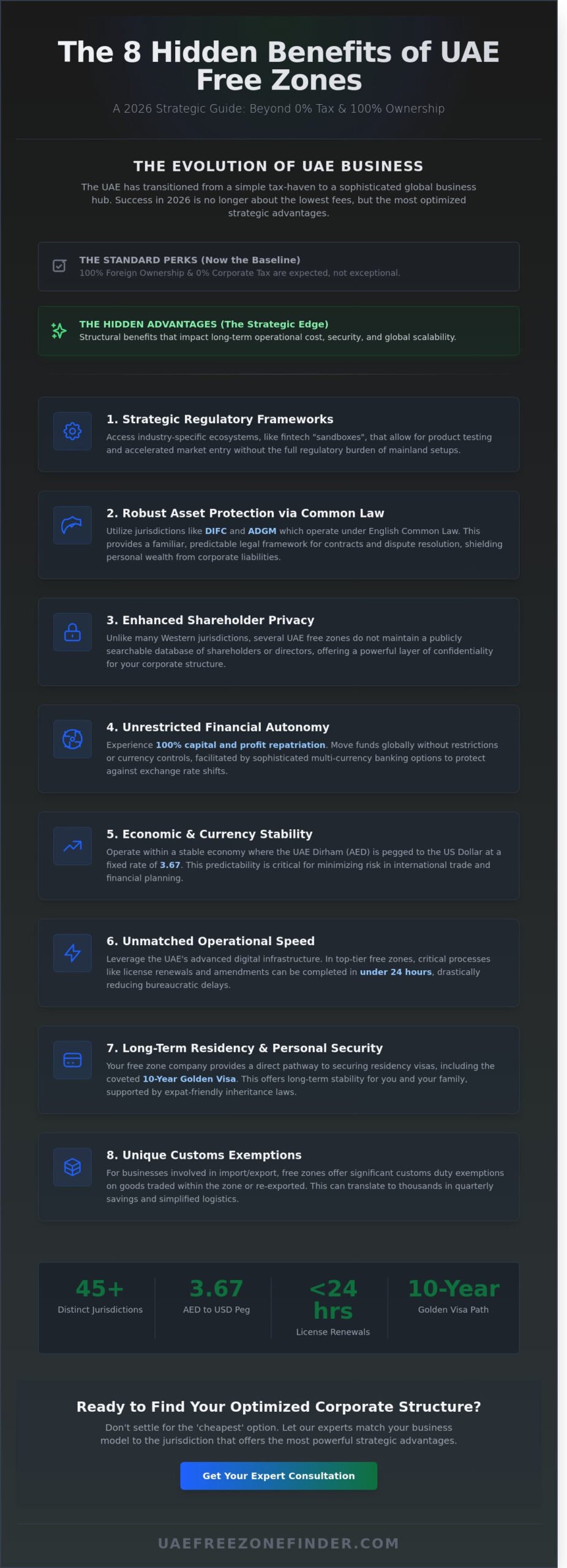
- Uncover the 8 Hidden Benefits of Setting Up in a UAE Freezone that go beyond basic tax exemptions to provide a truly strategic edge in 2026.
- Discover the direct pathways to a 10-year Golden Visa and how you’ll secure your family’s future through expat-friendly inheritance laws.
- Use our expert checklist to evaluate which freezone alignment best fits your specific business model and long-term security goals.
The Evolution of UAE Freezones: Beyond the Basics
By 2026, the definition of a UAE Freezone has matured far beyond simple tax exemptions. It’s now a sophisticated legal ecosystem designed to accelerate specific industries through tailored regulatory frameworks. While the traditional mainland model often requires different sets of approvals and local partnerships, Freezones offer a streamlined path to market entry. If you’re searching for the 8 Hidden Benefits of Setting Up in a UAE Freezone, you’ve likely realized that standard perks like 100% ownership are now the baseline, not the exception.
At UAE Freezone Finder, we act as your expert guide through this intricate landscape. We don’t just provide data; we offer the strategic direction needed to match your business goals with the right jurisdiction. The difference between a successful setup and a costly mistake often comes down to the nuances of the zone you choose. We simplify these bureaucratic hurdles into actionable steps, ensuring your transition into the UAE market is both rapid and compliant.
What Makes a Benefit “Hidden” in 2026?
A benefit is truly “hidden” when it isn’t an advertised line item on a government website but a structural advantage that impacts your long-term operational costs. Many investors fall into the trap of selecting the jurisdiction with the lowest initial license fee. They often overlook how operational flexibility and banking ease affect their bottom line. I’m Abida Siddique, and my strategy-first approach focuses on these overlooked variables. We look at how a zone’s specific regulations interact with your unique business model to find the perfect fit. It’s about moving past the “cheapest” option to find the most “optimized” one.
The Shift from Tax Haven to Global Business Hub
The UAE has successfully navigated the transition from a traditional tax haven to a transparent, globally respected business hub. This shift ensures that companies operating here meet international transparency standards, which is vital for maintaining global banking relationships. The stability of the UAE Dirham (AED), which remains pegged to the USD at a rate of 3.67, provides a predictable environment for international trade. This guide exposes the 8 Hidden Benefits of Setting Up in a UAE Freezone that sophisticated investors use to gain a competitive edge in this stable economy.
When you examine the List of UAE Freezones, you’ll find over 45 distinct jurisdictions, each with its own set of rules. Understanding the foundational free zone company formation pillar is essential, but it’s only the starting point. The real value lies in identifying which specific ecosystem provides the logistical and regulatory shortcuts your business needs to scale effectively across the Middle East and beyond.
- Regulatory Clarity: Zones are now categorized by industry, from biotech to commodities.
- Currency Stability: The AED peg minimizes exchange rate risks for global exporters.
- Operational Speed: Digital transformation in 2026 allows for license renewals in under 24 hours in top-tier zones.
Privacy and Protection: The Structural Advantages You Didn’t Know
Setting up a business in Dubai or Abu Dhabi often brings tax savings to mind first. However, the legal architecture beneath the surface offers security that many jurisdictions simply can’t match. This structural integrity is a core part of the 8 Hidden Benefits of Setting Up in a UAE Freezone that sophisticated entrepreneurs look for when protecting their global interests. By choosing the right zone, you’re not just buying a license; you’re securing a fortress for your intellectual and financial property.
One standout feature is the access to Common Law jurisdictions. Both the Dubai International Financial Centre (DIFC) and Abu Dhabi Global Market (ADGM) operate under English Common Law principles. This means disputes aren’t handled in local civil courts, but by independent, English-language judiciaries. Since the DIFC Courts were established in 2004, and the ADGM followed in 2013, they’ve provided a familiar legal framework for international contracts. This setup shields your wealth from the volatility of external regulatory shifts in your home country; it provides a predictable environment for resolution.
Shareholder Privacy and Confidentiality
Unlike many European or North American jurisdictions, several UAE freezones don’t maintain a public, searchable database of shareholders. Zones like RAKEZ or SHAMS prioritize data security. For high-profile investors, this isn’t about hiding assets from authorities. It’s about preventing identity theft and unsolicited corporate “fishing” expeditions. You get to control who sees your data while staying fully compliant with the UAE’s strict Anti-Money Laundering (AML) laws, which were further strengthened before the UAE was removed from the FATF Grey List in February 2024. This balance of transparency with authorities and privacy from the public is a major draw for family offices.
The Legal Shield: Asset Protection
A freezone company acts as a robust “ring-fence” for your global assets. By creating a clear legal separation between personal wealth and corporate liability, you ensure that business risks don’t bleed into your private life. This is a significant upgrade from more exposed structures found in less regulated offshore hubs. If you need to restructure, transferring shares within these zones is often a matter of a few days rather than months.
- Liability Separation: Corporate debts remain within the entity, protecting personal property and savings.
- Succession Planning: Freezone structures often allow for smoother transition of ownership to heirs compared to mainland setups.
- Regulatory Stability: The UAE’s commitment to business-friendly laws ensures your structure remains valid long-term.
If you aren’t sure which zone offers the best legal framework for your specific needs, you can find your ideal jurisdiction through our guided matching process. Understanding these nuances is essential for any long-term strategy involving the 8 Hidden Benefits of Setting Up in a UAE Freezone.
Financial Freedom: Navigating Repatriation and Global Trade
Entrepreneurs often worry about the “trap” of foreign jurisdictions where capital enters easily but leaves with difficulty. One of the 8 Hidden Benefits of Setting Up in a UAE Freezone is the absolute control you maintain over your financial assets. You aren’t just building a business; you’re building a portable wealth engine. The UAE’s regulatory framework is designed to facilitate, not hinder, the movement of money across borders.
The UAE doesn’t impose foreign exchange controls. This means you can move your capital and 100% of your profits back to your home country without facing the bureaucratic friction common in other emerging markets. Whether you’re dealing with AED 100,000 or AED 10,000,000, the process remains consistent. You won’t need to seek special central bank permissions or navigate complex exit taxes that erode your hard-earned margins.
Managing global trade requires flexibility. Freezone entities typically enjoy multi-currency account capabilities, allowing you to hold balances in AED, USD, EUR, and other major currencies. This is a vital tool for mitigating exchange rate risks. If your suppliers are in Europe and your clients are in the States, you can manage your cash flow without losing a percentage to constant currency conversions.
Current tax regulations also offer a significant edge. While the UAE introduced a 9% corporate tax in June 2023, “Qualifying Freezone Persons” can still access a 0% rate on qualifying income. This status is a pillar of the 2026 strategic financial landscape, ensuring that businesses meeting specific substance requirements remain globally competitive while staying compliant with international transparency standards.
Profit Repatriation Without the Red Tape
Moving funds out of the UAE is a standard procedure rather than a legal hurdle. Since there are no currency restrictions, you can transfer dividends or capital at your discretion. This liquidity is essential for investors who need to reinvest in other global markets or support operations in their home country. To ensure your banking setup is robust enough for these international movements, it’s wise to seek corporate bank account opening assistance early in the incorporation process. A well-structured bank account is the foundation of your financial freedom.
Dual Licensing: The Best of Both Worlds
You don’t have to choose between a freezone’s benefits and the mainland’s market access anymore. Many jurisdictions now have an MOU with the Department of Economy and Tourism (DET). This allows freezone companies to apply for a dual license permit. You can trade on the mainland and bid for government contracts without the expense of a second physical office or a separate legal entity. It’s a lean way to scale. You keep your 100% foreign ownership and tax perks while enjoying the same market reach as a local mainland company. This flexibility is another reason why the 8 Hidden Benefits of Setting Up in a UAE Freezone make it a premier choice for growing enterprises.
Future-Proofing Your Life: Residency and Long-Term Security
A Freezone license is more than just a permit to invoice clients; it’s a foundational residency tool that secures your family’s future in the Emirates. Many founders overlook the fact that their corporate structure is the primary vehicle for obtaining long-term legal status. Beyond the standard two or three-year renewable visas, setting up in the right jurisdiction opens doors to permanent-style living that wasn’t possible a decade ago. This stability is one of the 8 Hidden Benefits of Setting Up in a UAE Freezone that provides true peace of mind for international investors.
The Golden Visa Pathway via Company Formation
The UAE introduced the 10-year Golden Visa in 2019 to attract and retain global talent. For business owners, the criteria often involve a minimum capital investment of AED 2 million or being classified as a high-potential entrepreneur. A Freezone entity serves as the perfect vessel to meet these requirements. Unlike standard visas, the Golden Visa isn’t tied to a specific employer. It allows you to stay out of the country for longer than six months without losing your residency status. This flexibility is vital for global CEOs who manage interests across multiple continents. It ensures your business planning isn’t interrupted by administrative expiry dates.
Succession Planning and Expat Inheritance
Legacy planning is a critical but often ignored aspect of business. In the UAE, personal assets are typically governed by Sharia law unless a specific DIFC or ADGM will is in place. However, when you hold assets through a Freezone company, you can utilize corporate structures to manage succession. Many Freezones allow companies to be owned by offshore trusts or foundations. This ensures that if a shareholder passes away, the business operations don’t freeze. It bypasses complex personal inheritance hurdles and guarantees that your life’s work transitions smoothly to your heirs. It’s about protecting your legacy from day one.
Hiring international talent is also significantly easier within these hubs. Most Freezones offer pre-allocated visa quotas based on your office size. You won’t have to navigate the same labor department complexities found in mainland setups. This streamlined process lets you scale your team quickly by bringing in experts from anywhere in the world. Whether you’re sponsoring a CTO from Berlin or a marketing lead from Singapore, the process is built for speed. It’s a “residency tool” for your team, too, making your company a more attractive employer.
If you’re ready to secure your long-term future, it’s time to find the perfect freezone match for your business and family goals.
Choosing Your Perfect Jurisdiction in 2026
Thinking that one size fits all is the most common mistake entrepreneurs make when entering the Middle East. By 2026, the UAE’s regulatory landscape will be even more specialized. A tech startup in Dubai Internet City has vastly different requirements than a manufacturing firm in RAKYZ. You shouldn’t just pick a zone because it’s popular; you need to weigh the 8 Hidden Benefits of Setting Up in a UAE Freezone against your specific five-year growth plan.
To make an informed decision, use this evaluation checklist before committing your capital:
- Activity Alignment: Does the zone specifically cater to your niche to avoid “activity mismatch” fines?
- Secondary Costs: Are there mandatory office rentals or hidden “knowledge fees” that inflate the initial quote?
- Banking Success Rates: Does the jurisdiction have a strong reputation with local banks like Emirates NBD or ADCB?
- Future Scalability: Can you easily upgrade to a dual-license to trade on the mainland later?
UAE Free Zone Finder simplifies this entire comparison. We strip away the marketing fluff to show you the raw data, ensuring you don’t get stuck in a jurisdiction that limits your operational freedom. Maintaining your license health is equally vital. Professional PRO services handle the heavy lifting of compliance, such as Economic Substance Regulations (ESR) and Ultimate Beneficial Ownership (UBO) filings. Missing these deadlines can result in penalties starting at 50,000 AED, so having a steady hand to guide you is a necessity, not a luxury.
The Expert Matching Process
We don’t just look at the price tag. Many founders fall into “cheap” traps where a low upfront license fee is offset by high visa processing costs or restrictive lease terms. Our matching process filters through 40 plus zones based on your specific activity and hidden perks. We rely on the Virtuzone heritage, a team that has successfully navigated the setup of over 70,000 companies. This deep institutional knowledge allows us to spot pitfalls that a standard brochure would never mention. We prioritize your long-term ROI over a quick setup.
Next Steps for Your UAE Expansion
Ready to find your ideal business home? It’s time to turn these insights into a concrete strategy. You can use our comparison tool to see how different jurisdictions measure up against the 8 Hidden Benefits of Setting Up in a UAE Freezone. Every niche has a “hidden” fit that offers better tax residency terms or easier access to specific global markets.
Don’t leave your international expansion to chance. Book a consultation today to get a tailored roadmap that secures your assets and optimizes your tax profile. Visit UAE Free Zone Finder to compare your options and start your journey with the confidence of a market insider.
Secure Your Competitive Edge in the Emirates
The global trade landscape is shifting rapidly. By 2026, the structural advantages of privacy and long-term residency will be the defining factors for successful international entrepreneurs. You’ve now seen how these 8 Hidden Benefits of Setting Up in a UAE Freezone can protect your assets and provide a stable base for global expansion. It’s about more than just tax efficiency; it’s about building a legacy in one of the world’s most stable economies.
Choosing the right path shouldn’t be a guessing game. Since 2009, the founders of Virtuzone have led the industry, and we’ve distilled that expertise into a transparent, step-by-step incorporation process. We provide expert guidance across 40+ UAE Freezones to ensure you don’t just find a location, but a strategic home that fits your specific goals. We’ve helped thousands of founders navigate these regulations, and we’re ready to do the same for you.
Find your perfect UAE Freezone match today
Your journey toward global business success is just one informed decision away. We’re excited to help you build something remarkable in the UAE.
Frequently Asked Questions
Is it really possible to have 100% foreign ownership in a UAE Freezone?
Yes, 100% foreign ownership is a standard feature across all UAE Freezones. While the 2020 amendment to the Commercial Companies Law allowed this for many mainland activities, freezones have guaranteed full ownership since their inception. You don’t need a local partner or sponsor to hold shares. This remains one of the 8 Hidden Benefits of Setting Up in a UAE Freezone for those seeking complete control over their business operations and assets.
Can a Freezone company trade directly with customers on the UAE Mainland?
Freezone companies can’t trade directly with the mainland without a local distributor or a specific branch license. You’re permitted to trade within your specific zone or internationally. To sell goods to customers in the UAE mainland, you’ll need to work with a mainland agent or set up a Dual License through the Department of Economy and Tourism. This ensures you comply with Federal Law No. 2 of 2015 regarding commercial activities.
Do I need a physical office to maintain a Freezone license in 2026?
You’ll still need a registered physical address for your license in 2026. Most jurisdictions offer flexi-desk or smart office solutions to meet this requirement without the cost of a full warehouse. This address is vital for Economic Substance Regulations compliance. Since the 2019 rollout of these rules, authorities have been stricter about ensuring businesses have a real presence to maintain international transparency standards.
How does the 9% UAE Corporate Tax affect companies in a Freezone?
The 9% corporate tax applies to taxable income exceeding AED 375,000. However, Qualifying Free Zone Persons can still enjoy a 0% rate on qualifying income. You’ve got to maintain adequate substance and comply with transfer pricing rules under Cabinet Decision No. 55 of 2023. It’s a strategic shift, but the UAE remains one of the most competitive tax environments globally for any entrepreneur who understands the 8 Hidden Benefits of Setting Up in a UAE Freezone.
What is the difference between a Freezone and an Offshore company?
A Freezone company is a resident entity that lets you have a physical office and residency visas. An Offshore company is a non-resident entity used mainly for holding assets or international trade outside the UAE. You won’t get a physical office or visas with an offshore setup. Freezone entities are better for active operations, while offshore setups provide a low-cost way to manage global investments or intellectual property.
Can I sponsor my family and domestic staff on a Freezone visa?
You can sponsor your family and domestic staff once your own residency visa is issued. For family members, you’ll generally need a minimum monthly salary of AED 4,000 or AED 3,000 plus company-provided accommodation. Domestic staff sponsorship requires a different set of permits and specific salary thresholds for the sponsor. It’s a straightforward process that makes the UAE a welcoming hub for international entrepreneurs and their households.
How long does the typical Freezone company formation process take?
License issuance typically takes 3 to 7 working days depending on the specific jurisdiction. Once you’ve got the license, the residency visa process takes another 10 to 15 days. Some zones, like IFZA or Meydan, offer faster digital processing for initial approvals. We’ve seen setups completed in as little as 48 hours when all documents are ready. It’s a highly optimized system designed to get your business running without unnecessary delays.
Are there any currency restrictions for transferring profits out of the UAE?
There are zero restrictions on transferring profits or capital out of the country. You’ve got the freedom to repatriate 100% of your earnings in any currency you choose. The UAE Dirham has been pegged to the US Dollar at a rate of 3.6725 since 1997, which provides incredible stability for international transactions. This financial transparency is a core reason why investors choose this market for long-term growth and capital security.
Disclaimer
The information provided in this article is intended for general informational purposes only and reflects conditions as understood at the time of publication. Free zone regulations, fees, and requirements in the UAE are subject to change. Readers are advised to verify details with the relevant free zone authority or regulatory body before making any business decisions. For personalised guidance, our business setup experts at UAE Free Zone Finder are available to assist — contact us at info@uaefreezonefinder.com or call +971-507864823.