The Complete UAE Business License Renewal Process for 2026
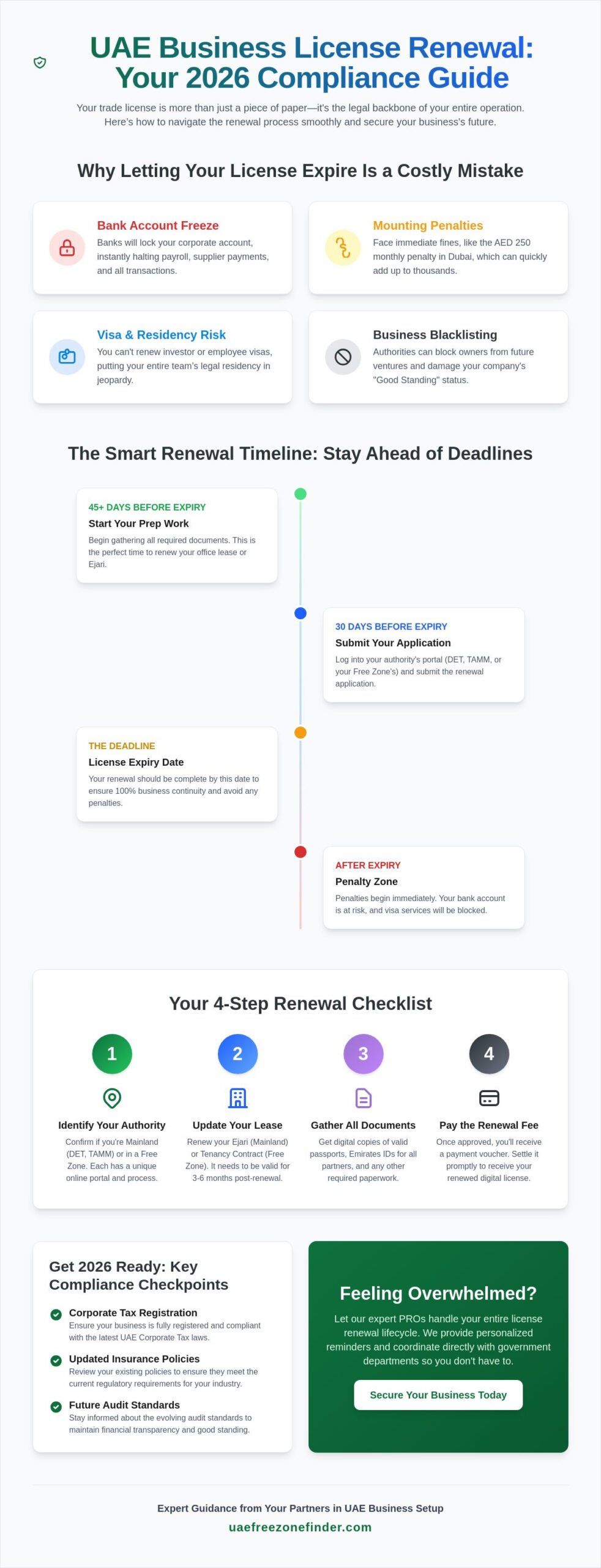
Your trade license is far more than a simple regulatory requirement; it’s the legal foundation for your residency and every corporate transaction you make. If you’ve been feeling the pressure as your expiry date approaches, you’re certainly not alone. Many entrepreneurs find the uae business license renewal process intimidating because the rules for mainland entities often differ significantly from those in free zones like IFZA or DMCC. Whether you’re worried about the mandatory link between your Ejari and license validity or you’re navigating the 2026 audit standards, the stakes for your business continuity have never been higher.
We’ve designed this guide to turn that administrative burden into a clear, manageable checklist. You’ll learn exactly how to manage the timeline for your specific jurisdiction, ensuring you avoid the AED 250 monthly late fees that often catch Dubai-based businesses off guard. We’ll walk you through the essential steps to keep your operations active and your visas secure. From understanding the latest corporate tax registration requirements to coordinating your tenancy renewals, we’re providing the expert direction you need to maintain a compliant, thriving presence in the Emirates.
Key Takeaways
- Secure your corporate bank account’s operational status by completing your renewal before the mandatory 12-month legal deadline.
- Master the uae business license renewal process by identifying your specific licensing authority and renewing your office lease early.
- Stay ahead of 2026 compliance requirements, including updated insurance policies and the latest corporate tax registration protocols.
- Avoid expensive penalties and business disruptions by starting your documentation prep at least 45 days before your current license expires.
- Discover how expert PRO support can simplify your renewal lifecycle through personalized reminders and direct coordination with government departments.
Why Annual License Renewal is Critical for Your UAE Business
In the UAE, your trade license isn’t a “set it and forget it” document. Under the framework of UAE corporate law, every business must adhere to a strict 12-month renewal cycle. This mandatory requirement applies whether you operate in a high-tech free zone or on the mainland. It’s the pulse of your legal existence. If you let that pulse stop, the ripple effects hit your bank account and your staff almost immediately. Staying on top of the uae business license renewal process ensures your company maintains “Good Standing,” a status that’s vital if you ever plan to expand, sell the business, or even handle a clean company liquidation.
Your corporate bank account is tethered directly to your license validity. Banks in the UAE are highly regulated and conduct automated checks against government databases. Once your license expires, most institutions provide a very short grace period before they freeze outgoing transactions. You won’t be able to pay suppliers, settle utility bills, or process payroll. It’s a logistical nightmare that can bring a thriving operation to a standstill in days. Maintaining an active license is the only way to keep your financial channels open and your business reputation intact.
The Legal and Financial Consequences of Non-Renewal
Failing to renew on time triggers an immediate sequence of penalties. In Dubai, for instance, the Department of Economy and Tourism (DET) applies a late renewal penalty of AED 250 for every month the license remains expired. Other jurisdictions have similar structures that can quickly balloon into thousands of dirhams. Beyond the money, there’s the risk of blacklisting. Authorities can block the owners from starting new ventures or even restrict their ability to sponsor new visas. It’s a heavy price for an administrative oversight that’s easily avoidable with the right planning.
Impact on Residency Visas and Corporate Structure
The most personal impact of an expired license involves your people. You simply can’t renew an investor or employment visa if the parent company isn’t in a state of active compliance. This creates a massive headache for the resident visa uae status of your employees and their sponsored family members. If the license is invalid, the Ministry of Human Resources and Emiratisation (MoHRE) systems will block any labor contract updates. It puts your entire team’s legal residency at risk, which is why the uae business license renewal process should always be prioritized well before the expiry date to ensure seamless continuity for everyone involved.
The 2026 Step-by-Step UAE Business License Renewal Process
While the uae business license renewal process has become remarkably digitized, it isn’t a single-click affair. You first need to confirm which governing body oversees your entity. If you’re on the mainland in Dubai, you’ll deal with the Department of Economy and Tourism (DET). In Abu Dhabi, you’ll use the TAMM portal. Free zone companies, however, must interact directly with their specific authority’s investor portal. This distinction is vital because each jurisdiction has its own set of technical requirements and portal interfaces. The system is fast, but it’s also rigid. If you’re managing an LLC with several partners, verify that all Emirates IDs are still valid; an expired ID for a single shareholder can stall the entire submission.
The UAE’s commitment to creating a world-class regulatory environment is reflected in the OECD Investment Policy Perspectives, which highlights the country’s recent legal reforms aimed at boosting investor confidence. These reforms have streamlined administrative hurdles, making it easier for businesses to remain compliant. By settling your government voucher promptly, you ensure your business remains in full compliance with these international standards and avoids the monthly AED 250 late renewal penalty that applies in many jurisdictions.
Step 1: Document Preparation and Ejari/Tenancy Updates
Your physical office space remains the anchor of your legal presence. For mainland businesses, an Ejari certificate registered with the Land Department is non-negotiable. Free zone entities must provide a lease agreement issued by the zone authority. Most regulators require this contract to be valid for at least three to six months beyond the license application date. You’ll also need up-to-date passport copies and Emirates IDs for all active partners. If your lease is nearing its end, renew it before starting the license paperwork to avoid a system rejection. If you’re looking to scale or move, it’s often a good time to review your free zone company formation options to see if a different jurisdiction offers better lease terms.
Step 2: Submission and Payment of Fees
Once your documents are ready, submit your application through the relevant digital platform. You’ll soon receive a payment voucher. This isn’t just a license fee; it often includes Chamber of Commerce registration and, for mainland Dubai companies, a market fee calculated as a percentage of your office rent. If your company carries multiple business activities, ensure the voucher reflects each one correctly. Some activities require external approvals from bodies like the KHDA or the Dubai Health Authority, which must be secured before the voucher can be generated. Once you settle the payment, your updated license is usually issued electronically within minutes.
Key Requirements and Compliance Checkpoints for 2026
The uae business license renewal process has evolved into a sophisticated compliance audit. It’s no longer just a matter of paying a fee and receiving a paper document. By 2026, the UAE’s digital infrastructure has linked licensing authorities directly with federal tax and labor databases. This means your renewal application serves as a “health check” for your entire corporate structure. You’ll need to ensure every piece of your regulatory puzzle is current, from your physical office space to your tax standing, before the system allows you to proceed to the payment stage.
Your tenancy contract remains the primary anchor for your renewal. For mainland entities, a valid Ejari is mandatory. Free zone companies must present a lease agreement issued by their specific authority. In 2026, regulators are more stringent about “real” office requirements; virtual office setups that don’t meet the specific criteria of your activity can lead to immediate rejections. Additionally, if you operate in a regulated sector such as healthcare, legal services, or engineering, you must provide proof of valid professional indemnity insurance. Without these certificates, the system won’t generate your payment voucher.
External approvals are another critical checkpoint. Depending on your business activity, you might need a No Objection Certificate (NOC) from various ministries. For example, transport companies require RTA clearance, while specialized trading might need approval from the Ministry of Economy. In jurisdictions like Ajman, you’ll also need to account for specific local requirements, such as the mandatory AED 1,500 Community Contribution (CSR UAE Fund). Gathering these approvals early is the only way to avoid the last-minute scramble that often leads to late fees.
Financial Audits and Economic Substance Regulations (ESR)
For many free zone entities, particularly those in DMCC or similar hubs, a financial audit report is a mandatory attachment for renewal. You can’t skip this step. You also need to verify your Economic Substance Regulations (ESR) filing status. If your business performs “Relevant Activities,” failing to file your ESR notification or report can trigger penalties that far exceed the cost of your license. Maintaining accurate bookkeeping throughout the year is the only way to ensure these reports are ready when your renewal window opens.
The Role of Corporate Tax and VAT in Renewal
The Federal Tax Authority (FTA) is now deeply integrated into the licensing cycle. You must ensure your corporate tax registration is finalized and your VAT filings are up to date. This fiscal transparency is also vital for your corporate bank account opening assistance records. Banks perform their own annual reviews and will cross-reference your renewed license with your tax status. If there’s a mismatch or a “suspended” status on the FTA portal, your banking facilities could be frozen, even if your license appears active on the surface.
Avoiding Common Pitfalls: Timing and Late Fee Management
Timing is the most critical factor in a successful uae business license renewal process. While some authorities offer a brief grace period, relying on it is a high-stakes gamble. You should ideally initiate your renewal 30 to 45 days before the expiry date printed on your license. This window accounts for potential delays in Ejari registration, third-party approvals, or technical glitches in government portals. While “Automatic Renewal” features exist for some mainland entities, they often fail if your tenancy contract hasn’t been updated in the system or if your business activity requires annual external inspections. Proactive management prevents these automated systems from stalling your operations.
If you’ve moved to a new office during the year, don’t wait for the renewal window to update your address. You must file a formal amendment to change your location before the license can be renewed. Attempting to renew with an outdated address or an expired lease will result in an immediate system block. If you’re currently facing a complex renewal or need to restructure your entity, our expert team provides dedicated Trade License Renewal services to handle the bureaucracy on your behalf, ensuring you never miss a deadline.
Calculating the Real Cost of Delay
The financial impact of a late renewal goes far beyond the initial fine. In Dubai, for example, the Department of Economy and Tourism (DET) applies a penalty of AED 250 for every month the license remains expired. However, the hidden costs are often more damaging. You’ll face additional fees for visa cancellations if your employees’ residency expires during the license lapse. Failure to resolve renewal issues within 90 days of expiry often results in the full suspension of all commercial activities and the potential blacklisting of the company’s legal representatives.
Handling Changes During the Renewal Cycle
Many entrepreneurs try to bundle license amendments, such as adding a new partner or changing a business activity, with their annual renewal. While this seems efficient, it often complicates the uae business license renewal process. Each amendment requires its own set of approvals and legal documentation, which can extend the processing time by several weeks. If your local service agent or sponsor has changed, you must finalize the legal transfer of those responsibilities before the renewal voucher can be issued. Be prepared for a higher total cost, as each amendment carries its own administrative fee on top of the standard renewal price.
Optimizing Your Renewal with UAE Free Zone Finder
While government portals offer a functional path for DIY renewals, they often lack the strategic oversight required for complex corporate structures. Managing the uae business license renewal process becomes exponentially more difficult when you’re balancing multiple entities across different emirates or free zones. We don’t just provide a platform; we act as your dedicated partner, ensuring every step of your free zone company formation and renewal lifecycle is handled with precision. Our team monitors your compliance status year-round, sending personalized reminders long before you hit the 30-day danger zone. This proactive approach eliminates the stress of last-minute document gathering and ensures your operations never skip a beat.
Every business reaches a point where the administrative burden of staying compliant outweighs the benefits of a DIY approach. We provide the steady hand you need to navigate the UAE’s evolving regulatory landscape. Beyond simple paperwork, we offer strategic advice on whether your current license structure remains the most tax-efficient option for 2026. If your business has grown significantly, we might suggest restructuring or adding specific activities that align better with the latest corporate tax incentives, ensuring your renewal is a step toward growth rather than just a recurring expense.
Seamless PRO and Government Liaison Services
Our dedicated PRO team handles the heavy lifting with government departments so you don’t have to. We manage everything from document attestation to the processing of labor cards and establishment cards. This is particularly vital for mainland businesses that must coordinate with the Ministry of Human Resources and Emiratisation alongside their local Department of Economic Development. We understand the shortcuts and the pitfalls of each jurisdiction, whether you’re dealing with the specific CSR fund requirements in Ajman or the market fee calculations in Dubai. By taking over these technical tasks, we allow you to focus entirely on your core business growth.
Beyond Renewal: Long-Term Corporate Support
A successful renewal is just one part of a broader compliance strategy. We integrate your uae business license renewal process with essential back-office functions like VAT registration, bookkeeping, and corporate tax filing. This holistic view ensures that your financial records always match your licensing data, which is a key requirement for maintaining your banking facilities. We also provide comprehensive support for residency visa renewals, ensuring that you, your family, and your employees remain in good legal standing. Don’t leave your business continuity to chance or a basic automated system. Speak with a renewal expert today to secure your company’s future in the UAE.
Securing Your Business Continuity for the Year Ahead
Maintaining a valid trade license is the single most important step you’ll take to protect your assets and your team’s residency in the Emirates. By initiating the uae business license renewal process at least 45 days before your expiry, you eliminate the risk of frozen bank accounts and the accumulation of monthly fines. Keep in mind that 2026 requirements demand tighter integration with corporate tax and VAT filings, making consistent bookkeeping a prerequisite for a smooth approval. A proactive approach doesn’t just save money; it preserves your reputation with local authorities and financial institutions alike.
You don’t have to manage these bureaucratic hurdles alone. Since 2009, our team has provided expert guidance to thousands of entrepreneurs across all UAE free zones and the mainland. We offer comprehensive PRO and tax support to ensure your business remains in good standing without pulling you away from your core operations. Let UAE Free Zone Finder handle your renewal today and experience the confidence that comes with having a steady hand at the helm. Your vision for global growth deserves a foundation that’s legally sound and ready for the future.
Frequently Asked Questions
How much does it cost to renew a business license in the UAE?
Renewal costs vary significantly depending on your jurisdiction and business activity. In Ajman, the economic license renewal fee is AED 300, while Dubai mainland costs typically range between AED 10,000 and AED 20,000 when including market fees and Chamber of Commerce registration. Abu Dhabi trade license fees are generally lower, often ranging from AED 100 to AED 300. Free zone renewals across the Emirates usually fall between AED 10,000 and AED 25,000 depending on the specific authority.
Can I renew my trade license without an office space in 2026?
A valid tenancy contract or office lease is a mandatory requirement for most license types in 2026. Mainland companies must provide a registered Ejari certificate to proceed with the uae business license renewal process. While some free zones offer virtual or flexi-desk packages that satisfy the legal address requirement, you still need a valid lease agreement issued by the zone authority. Operating without a verified physical or desk space can lead to a system block during the renewal stage.
What is the grace period for business license renewal in the UAE?
Most authorities don’t provide a formal grace period that allows for operation without penalty after your license expires. Fines typically begin to accumulate the day after the expiry date. In Dubai, the Department of Economy and Tourism applies a late renewal penalty of AED 250 per month. Some free zones may offer a 30-day window before imposing fines, but your corporate bank account and visa processing facilities could still be restricted during this time.
Is an audit report mandatory for every license renewal?
Audit requirements depend entirely on your specific jurisdiction and the nature of your business activities. While mainland licenses often don’t require an annual audit for renewal, many major free zones, such as DMCC, mandate a financial audit report as a standard attachment. You should check your specific authority’s regulations well in advance. Failing to provide a required audit can stall your renewal and lead to avoidable late fees.
Can I renew my license if I have outstanding VAT or Corporate Tax fines?
You’ll likely face a block in the renewal system if you have unresolved liabilities with the Federal Tax Authority (FTA). By 2026, licensing portals are deeply integrated with tax databases to ensure national compliance. Outstanding VAT or Corporate Tax fines must often be settled before a renewal voucher can be generated. Clearing your tax standing is a vital step in maintaining your business’s “Good Standing” status across the Emirates.
How long does the business license renewal process usually take?
The digital submission and voucher issuance can take as little as a few minutes through portals like TAMM or Invest in Dubai. However, the total uae business license renewal process usually takes 3 to 7 working days when you factor in document preparation. If your business requires external approvals from ministries or No Objection Certificates (NOCs) for regulated activities, you should plan for a longer timeline to ensure your license doesn’t lapse.
What happens if I decide not to renew my license?
Simply letting a license expire without undergoing a formal company liquidation leads to severe legal and financial repercussions. You’ll face monthly fines, and the authorities may eventually blacklist the company owners, preventing them from starting new businesses. This also causes the immediate cancellation of all residency visas sponsored by the company and freezes your corporate bank accounts. Formal liquidation is the only legal way to close a business and avoid these penalties.
Can I change my business activity during the renewal process?
You can certainly amend your business activities during the renewal window, but it requires a formal license amendment. This process involves updating your memorandum of association and potentially seeking new approvals from relevant government bodies. While it’s efficient to bundle these changes with your renewal, it will increase the total cost of your voucher. Be prepared for a slightly longer processing time as the authorities verify the new activities and legal structure.
Disclaimer
The information provided in this article is intended for general informational purposes only and reflects conditions as understood at the time of publication. Free zone regulations, fees, and requirements in the UAE are subject to change. Readers are advised to verify details with the relevant free zone authority or regulatory body before making any business decisions. For personalised guidance, our business setup experts at UAE Free Zone Finder are available to assist — contact us at info@uaefreezonefinder.com or call +971-507864823.