
What if the only thing standing between you and a global digital empire is the 48% chance of picking the wrong jurisdiction? Launching an online business in dubai often feels like a high-stakes puzzle where one wrong move leads to hefty fines or a rejected bank application. You’re likely feeling the pressure to get it right the first time, especially when 2026 projections show the UAE’s e-commerce market hitting unprecedented growth levels.
It’s frustrating to deal with the conflicting advice regarding Free Zone benefits versus Mainland flexibility. We understand that your priority is a lean, efficient setup that doesn’t sacrifice legal security or international payment access. You shouldn’t have to guess which permit fits your specific activity or struggle for months to open a simple corporate account. It’s a common pain point that stalls many talented founders before they even begin.
This guide provides the clarity you need to move forward with absolute confidence. We’ll show you how to secure the most efficient license, navigate the path to tax residency, and build a legal structure that supports global scaling. From choosing your jurisdiction to finalising your visa, here’s your strategic roadmap for success in the Emirates.
Key Takeaways
- Understand why the 2026 economic landscape makes the UAE the ultimate hub for digital nomads and tech-driven startups looking to grow globally.
- Identify whether a Free Zone or Mainland jurisdiction offers the best strategic advantage for your specific digital trade or service model.
- Navigate the legalities of securing an online business in dubai, from distinguishing between investor licenses and E-Trader permits to meeting new compliance standards.
- Follow our simplified five-step roadmap to handle trade name registration and license applications so you don’t get caught in bureaucratic red tape.
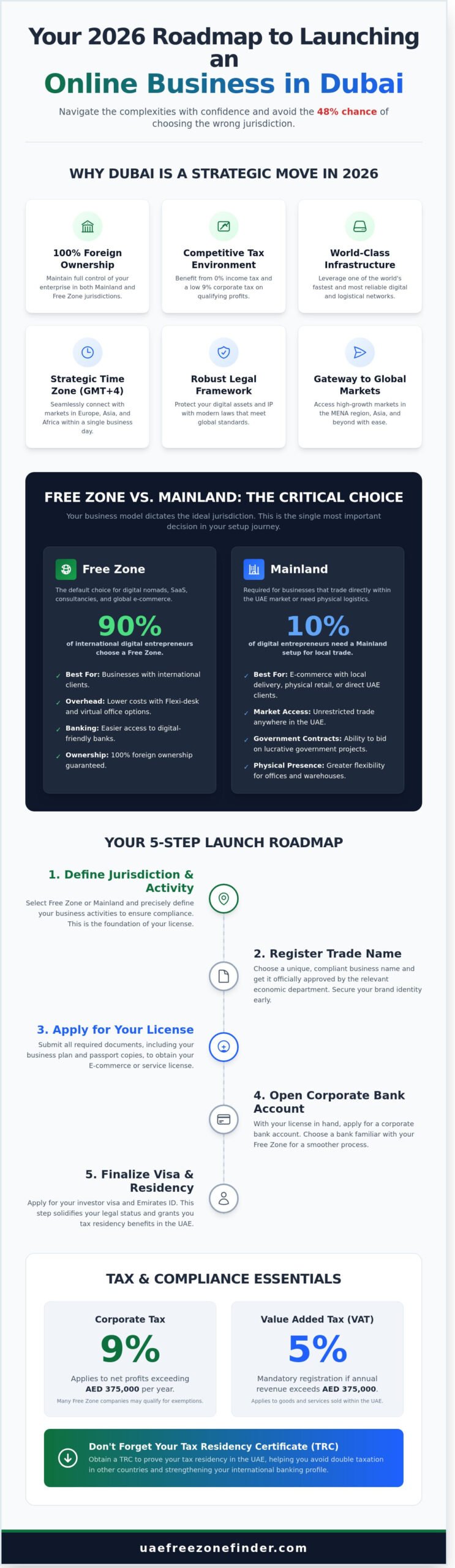
- Get clear on your tax obligations, including the 9% Corporate Tax rules and the mandatory VAT registration threshold of AED 375,000.
Why Starting an Online Business in Dubai is a Strategic Move in 2026
Launching an online business in dubai in 2026 represents a calculated entry into one of the world’s most resilient digital ecosystems. A UAE online business license is the legal foundation for this journey. It’s a formal permit that authorizes you to conduct digital trade, offer professional services, or manage e-commerce platforms within the country and across international borders. While previous years required a physical office for almost every setup, the post-pandemic regulatory shift has firmly established a “digital-first” approach. This means you can now secure a license and operate globally without the immediate overhead of a traditional storefront or office space.
The 2026 economic outlook for the UAE is exceptionally strong, specifically for tech startups and digital nomads. This sustained growth is a direct outcome of Dubai’s economic diversification strategy, which has successfully transitioned the emirate from a resource-dependent economy to a global hub for trade and innovation. Entrepreneurs choose this jurisdiction for several high-impact reasons. You get 100% foreign ownership of your company, a strategic GMT+4 time zone that allows you to communicate with markets in London and Singapore on the same business day, and access to world-class digital infrastructure that ranks among the fastest in the world.
The Digital Economy Framework
The UAE government has committed to becoming a global tech capital through the “D33” economic agenda. By 2026, new regulations have simplified the path for SaaS, FinTech, and e-commerce ventures to scale without the friction of outdated bureaucracy. Legal protections for digital intellectual property are now more robust than ever. These laws ensure that your code, proprietary algorithms, and digital assets are shielded under a legal framework that meets international standards, providing the security that global investors demand.
Tax Incentives and Global Access
The UAE maintains a highly competitive tax environment. While a 9% corporate tax applies to qualifying net profits over 375,000 AED, many digital entities operating within free zones can still benefit from significant exemptions. Beyond the tax numbers, your license acts as a powerful gateway to the high-growth markets of the MENA region and Asia. For international entrepreneurs, the ability to obtain a Tax Residency Certificate is a major advantage. This document helps you avoid double taxation and establishes your business as a legitimate, compliant entity in the eyes of global banking institutions.
Identifying the Ideal Jurisdiction for Your Digital Entity
Choosing where to register your online business in dubai is the most critical decision you’ll make during the setup process. This choice dictates your tax obligations, your ability to hire staff, and how you’ll handle physical logistics. You have two primary paths: the Mainland or one of the 40+ specialized Free Zones. While the Mainland offers unrestricted access to the local market, roughly 90% of international digital entrepreneurs opt for a Free Zone setup because of the lower overhead and specialized support for tech-driven startups.
Your choice depends heavily on your target audience. If you’re running a SaaS platform or a digital consultancy for global clients, a Free Zone is almost always the right move. However, if your business model involves a fleet of delivery bikes or a physical warehouse in Al Quoz to serve local customers, a Mainland license is necessary. You’ll also want to evaluate jurisdictions based on their banking reputation. Some zones have established partnerships with digital banks like Wio or Mashreq Neo, which can cut your corporate account opening time from several months to just a few weeks.
The Free Zone Advantage for Online Startups
For most digital service providers, Free Zone company formation provides the fastest route to market. You don’t need a physical office to get started. Most tech-focused zones offer “Flexi-desks” or “Smart Desks,” which provide a legal business address and satisfy regulatory substance requirements without the high cost of a long-term commercial lease. This setup is perfect for lean startups that only need a laptop and a stable connection to operate. It’s a streamlined approach that prioritizes speed and initial cost-efficiency.
Mainland Considerations for E-commerce
If you plan to sell physical goods directly to consumers across the seven Emirates, you’ll need to register with the Department of Economy and Tourism (DET). A Mainland license allows you to trade anywhere in the UAE without the need for a local distributor. It’s a common misconception that you still need a local partner to own the business; since the June 2021 update to the Commercial Companies Law, 100% foreign ownership is available for over 1,000 commercial and industrial activities. You must follow specific UAE government e-commerce regulations regarding consumer protection, data privacy, and electronic signatures. If you’re unsure which path fits your specific model, you can compare different jurisdiction benefits to find the most cost-effective match for your 2026 launch.
E-commerce License vs. E-Trader Permit: Navigating Legal Requirements
Choosing the right legal framework is the most critical step when launching an online business in dubai. The UAE offers two primary paths: the E-Trader permit and the professional E-commerce license. While they might seem similar at first glance, the differences in operational scope and banking access are vast. Making the wrong choice early on can stall your growth or lead to administrative headaches when you’re ready to hire your first employee.
The E-Trader permit is a specialized solution managed by the Department of Economy and Tourism (DET). It’s designed specifically for UAE and GCC nationals, as well as some foreign residents living in Dubai. This permit allows you to sell products or services through social media and personal websites. It’s an affordable way to test the waters, but it comes with rigid boundaries. You can’t sponsor visas for staff, and you’re limited in the types of physical goods you can trade depending on your nationality.
In contrast, a full E-commerce license creates a robust corporate entity. This is the standard path for international investors who want 100% ownership. These licenses are typically issued through Free Zones, which are tax-efficient hubs tailored for global trade. Because the e-commerce market in the UAE continues to expand at a rapid pace, a corporate license provides the flexibility to scale. It allows you to rent office space, hire a team, and secure residency visas for yourself and your family.
Who Qualifies for What?
Eligibility is primarily determined by your residency status and long-term goals. The DED Trader license is only available to those who already hold a valid Emirates ID. If you’re an entrepreneur moving to Dubai specifically to start a business, you’ll need to opt for a Free Zone or Mainland corporate license. Your visa status is the gatekeeper here; international investors must use their business setup to sponsor their own residency. If you plan to scale beyond a one-person operation, the corporate license is the only viable route.
Activity Selection for Online Ventures
Precision is vital when selecting your business activities. The UAE uses a standardized list of codes to define what your company can and cannot do. If you’re running a hybrid model, like a dropshipping store that also offers marketing consultancy, you must ensure both activities are listed on your license. Most Free Zones allow you to group multiple digital activities under a single license for a small additional fee. Selecting an incorrect activity code frequently results in the immediate rejection of your corporate bank account application. Always verify that your chosen code matches the business description you provide to the bank’s compliance department.
- E-Trader: Best for solo residents testing social media sales.
- E-commerce License: Best for international investors and scalable startups.
- Banking: Corporate licenses generally have a higher success rate with Tier 1 banks.
Your 5-Step Roadmap to Launching an Online Business
Establishing an online business in dubai is a structured process, but it’s one that rewards precision. By 2026, the UAE has digitized nearly every bureaucratic touchpoint, making the journey from idea to incorporation faster than ever before. You’ll need to follow these five specific steps to ensure your entity is legally sound and ready for trade.
- Step 1: Define your legal structure and trade name. Decide if a Free Zone Limited Liability Company (FZ-LLC) or a Mainland Sole Establishment fits your scale. Your trade name must comply with strict UAE naming conventions, avoiding any references to religion, political groups, or existing brands.
- Step 2: Submit your application. You’ll send your initial paperwork to either the Department of Economy and Tourism (DET) for mainland setups or your chosen Free Zone authority.
- Step 3: Secure initial approval and finalize documentation. Once authorities vet your activity, you’ll sign the Memorandum of Association (MoA). This document outlines the ownership structure and operational rules of your company.
- Step 4: Process your residency visa. After receiving your entry permit, you’ll undergo a mandatory medical fitness test (blood test and X-ray) and provide biometrics for your Emirates ID.
- Step 5: Open your corporate bank account and register for Corporate Tax. Since June 2023, all businesses must register with the Federal Tax Authority (FTA). You’ll also need a dedicated business account to manage your capital and satisfy compliance requirements.
Document Preparation and Trade Name Approval
Success starts with a clean paperwork trail. For most jurisdictions in 2026, you’ll need high-resolution passport copies, a brief business plan, and a recent utility bill as proof of address. When choosing a name, don’t use your own surname unless it’s followed by your full first name. Avoid acronyms and ensure the name is available for registration. In top-tier free zones, the timeline for initial approval is now incredibly efficient, typically taking between 24 and 72 hours if your documents are in order.
Banking and Payment Gateway Integration
Your online business in dubai won’t survive without a way to collect funds. Connecting your UAE entity to international gateways like Stripe or Checkout.com is a critical milestone. These providers require a valid business license that matches your website’s activity exactly. To speed up the corporate bank account opening process, which often takes 2 to 4 weeks, consider using digital-first banks like Wio or Mashreq Neo. They offer faster onboarding for startups compared to traditional legacy institutions.
Ready to find the jurisdiction that fits your budget and goals? Compare UAE free zones today to get your license started.
Ensuring Long-Term Success: Compliance and Tax in 2026
Building a sustainable online business in dubai requires a proactive approach to the UAE’s maturing regulatory framework. By 2026, the tax environment has evolved into a sophisticated system managed by the Federal Tax Authority (FTA). You’ll find that staying compliant isn’t just a legal necessity; it’s a strategic advantage that builds trust with international partners and banking institutions. The “set and forget” mentality of previous decades no longer applies in this professionalized market.
Understanding the 2026 Tax Landscape
The 9% Corporate Tax is now a standard reality for the UAE business community. This rate applies to taxable profits exceeding AED 375,000. While many Free Zone entities still benefit from a 0% rate on qualifying income, the distinction between qualifying and non-qualifying revenue is strictly enforced. You must file an annual tax return regardless of whether your business owes a single dirham in tax. The FTA monitors every online business in dubai to ensure these filings are accurate and timely.
Value Added Tax (VAT) remains a critical threshold for digital entrepreneurs. Once your taxable turnover reaches AED 375,000 over a 12-month period, registration is mandatory. Many startups opt for voluntary registration at the AED 187,500 mark to recover VAT on setup costs and equipment. Additionally, digital service providers must assess their status under Economic Substance Regulations (ESR). If you generate income from “Relevant Activities” like Intellectual Property or Service Centers, you’ll need to demonstrate genuine economic activity within the UAE to avoid significant penalties.
- Annual License Renewals: Your trade license must be renewed every 12 months to maintain legal standing and keep bank accounts active.
- Audit Requirements: Specific jurisdictions now require audited financial statements to verify your reported income and tax eligibility.
- Record Keeping: You’re legally required to maintain all financial records for at least five years to satisfy potential FTA inspections.
The Role of Professional Support
Managing government relations shouldn’t distract you from scaling your digital brand. Professional Relations Officer (PRO) services act as the essential bridge between your company and the authorities. They handle the technicalities of visa renewals, document notarization, and license amendments. This support ensures you never miss a deadline or fall foul of new policy updates. It’s about efficiency and risk mitigation.
Our expertise lies in helping you find the perfect fit for your specific digital niche. We don’t just process applications; we offer strategic direction to ensure your corporate structure remains optimized for 2026 and beyond. A single mistake in your initial setup can lead to unnecessary tax exposure or operational limits later. Don’t leave your compliance to chance. Start your journey with a professional consultation today to secure your future in the online business in dubai ecosystem.
Secure Your Competitive Edge in the 2026 Digital Market
The 2026 landscape for digital entrepreneurship in the UAE is defined by strategic clarity and robust regulatory frameworks. Success hinges on selecting the correct jurisdiction and understanding the nuances between an E-commerce license and an E-Trader permit. By following a structured five-step roadmap, you can transform your vision into a compliant, tax-efficient reality within one of the world’s most dynamic markets. Launching an online business in dubai requires more than just a digital presence; it demands a firm grasp of local corporate tax requirements and banking protocols.
We’re here to simplify this transition. As a member of the Virtuzone Group with over 15 years of UAE incorporation expertise, our team provides the steady hand you need to navigate these complexities. We offer dedicated support for everything from initial registration to corporate tax compliance and bank account opening. Don’t let administrative hurdles delay your expansion. Start your online business journey with a free expert consultation and take your first step toward global growth today. Your path to success is ready for you.
Frequently Asked Questions
Can a foreigner start an online business in Dubai?
Yes, foreigners can own 100% of an online business in Dubai through mainland or free zone jurisdictions. Since the 2021 amendment to the UAE Commercial Companies Law, international investors don’t need a local partner for most commercial activities. You can manage your digital operations from anywhere while holding a UAE residency visa, making it an ideal hub for global entrepreneurs looking for full control over their ventures.
How much does an e-commerce license cost in the UAE in 2026?
An e-commerce license in the UAE typically costs between AED 6,000 and AED 15,000 for 2026, depending on the chosen free zone and visa requirements. This fee covers the registration and initial permit but excludes additional costs like office space or security deposits. Choosing a northern emirate free zone often results in lower entry costs compared to premium Dubai-based jurisdictions, providing a budget-friendly entry point for new startups.
Do I need a physical office to run an online business in the UAE?
You don’t need a traditional brick-and-mortar office to run an online business in the UAE. Most free zones offer flexi-desk or coworking packages that fulfill the legal requirement for a registered business address. These solutions are cost-effective for startups and allow you to maintain compliance without the high overhead of a long-term commercial lease, giving you the freedom to work from home or a remote location.
Is an e-trader license the same as an e-commerce license?
An e-trader license is specifically designed for home-based entrepreneurs and freelancers, while an e-commerce license is a full corporate entity. The e-trader option, issued by the Dubai Department of Economy and Tourism, is generally restricted to UAE and GCC nationals for commercial activities. International residents usually require a standard e-commerce license to trade physical goods or provide professional digital services legally within the country’s business framework.
Can I run an online business from a UAE Free Zone and sell to the local market?
Free zone companies can sell to the UAE local market by working with a local distributor or a mainland agent. While your online business in Dubai can target global customers directly, physical deliveries within the UAE mainland require you to pay a 5% customs duty on goods. This structure lets you benefit from free zone tax advantages while still reaching the growing local consumer base through the right legal channels.
What are the taxes for online businesses in the UAE?
Online businesses are subject to a 9% federal corporate tax on net profits exceeding AED 375,000. Additionally, you must register for 5% Value Added Tax (VAT) if your taxable supplies and imports exceed AED 375,000 per year. It’s vital to maintain accurate financial records to ensure compliance with the Federal Tax Authority regulations introduced in June 2023, as penalties for non-compliance are strictly enforced across all jurisdictions.
How long does it take to get a business license for an online store?
You can obtain an online business license in as little as 24 hours through certain Instant License portals or digital free zones. Most standard applications take between 3 to 7 working days once you’ve submitted all required documentation and passport copies. The timeline depends on whether you require additional government approvals or a residency visa as part of the setup, but the process is generally very fast and efficient.
Disclaimer
The information provided in this article is intended for general informational purposes only and reflects conditions as understood at the time of publication. Free zone regulations, fees, and requirements in the UAE are subject to change. Readers are advised to verify details with the relevant free zone authority or regulatory body before making any business decisions. For personalised guidance, our business setup experts at UAE Free Zone Finder are available to assist — contact us at info@uaefreezonefinder.com or call +971-507864823.