5 Costly Mistakes in UAE Company Formation to Avoid in 2026

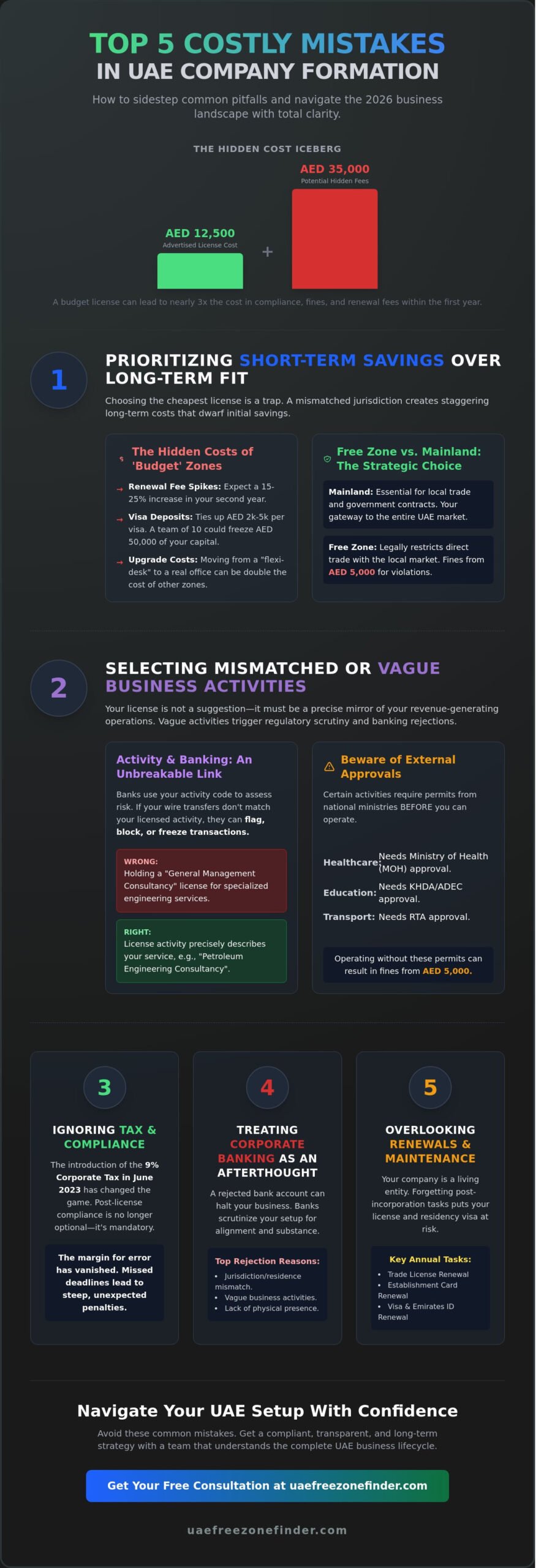
What if the budget license you just purchased for AED 12,500 actually costs you an additional AED 35,000 in hidden compliance fees before your first anniversary? You likely already know that establishing a presence in the UAE’s diverse business environments isn’t just about getting a trade license; it’s about staying on the right side of rapidly evolving regulations. Since the UAE introduced the 9% corporate tax in June 2023, the margin for error has vanished, leaving many founders worried about missing critical deadlines or facing steep, unexpected penalties.
It’s exhausting to deal with the fear of a rejected corporate bank account or surprise VAT fines that appear out of nowhere. At UAE Free Zone Finder, we’ve identified the most common mistakes in uae company formation that lead to these exact headaches for international entrepreneurs. This guide will show you how to sidestep these pitfalls to ensure a clean, compliant setup with total clarity on your annual operating costs. We’re breaking down the five specific errors that could derail your expansion in 2026 and how to fix them before they impact your bottom line.
Key Takeaways
- Stop prioritizing short-term savings and learn how to select a jurisdiction that actually fits your business’s long-term growth and lifecycle.
- Ensure your license activities exactly mirror your daily operations to sidestep common mistakes in uae company formation that trigger unexpected penalties.
- Navigate the transition to the 2026 corporate tax landscape by understanding the compliance steps required after you receive your trade license.
- Identify the top reasons UAE banks reject new entities so you can secure a corporate account without the typical back-and-forth delays.
- Protect your residency status by mastering the post-incorporation renewal process that keeps your company-and your visa-fully compliant.
Prioritizing Short-Term Savings Over Long-Term Jurisdiction Fit
Selecting the cheapest license available is a tempting trap for many entrepreneurs. It’s often the first of several common mistakes in uae company formation that can stall a business before it even begins. While saving AED 5,000 on your initial setup feels like a win, the long-term costs of a mismatched jurisdiction can be staggering. You aren’t just buying a permit; you’re choosing the legal and physical environment where your company will live for years.
Smart investors look at the three-year cost of ownership rather than just the day-one price. A jurisdiction that offers a low entry point might lack the specific activity approvals you need for future growth. If you start a consulting firm in a remote Northern Emirate to save money, you might find that opening a corporate bank account in Dubai becomes a six-month ordeal. Banks often scrutinize the distance between your office and your residence. This lack of alignment slows down your cash flow and limits your ability to scale effectively within the Economy of the United Arab Emirates, which is built on efficiency and rapid diversification.
The Hidden Costs of ‘Budget’ Free Zones
Low-cost packages often come with a “teaser rate” that expires after twelve months. It’s not unusual to see renewal fees jump by 15% to 25% in the second year. You should also account for visa deposits. Some budget zones require a refundable deposit of AED 2,000 to AED 5,000 per visa. If you plan to hire a team of ten, you’re tying up AED 50,000 in capital that could have been spent on operations. Additionally, many cheap licenses only include a “flexi-desk” or “hot desk” arrangement. If your business grows and requires a physical office, the cost to upgrade within that same zone might be double what you’d pay elsewhere.
Free Zone vs. Mainland: A Strategic Mismatch
Choosing between a Free Zone and a Mainland setup is a decision that dictates your entire market reach. Mainland companies are the primary vehicle for national trade, allowing you to bid for government contracts and sell directly to the local UAE market without a middleman. If you choose a Free Zone but your primary customers are local retail shops in Abu Dhabi, you’re legally restricted. Operating outside your geographical scope can lead to fines starting at AED 5,000 per violation. Don’t let a lower setup fee prevent you from actually reaching your customers. It’s better to pay more upfront for a Mainland license than to lose 100% of your potential local revenue because of a structural mismatch.
Selecting Mismatched or Vague Business Activities
One of the most frequent hurdles entrepreneurs face involves the misclassification of their business scope. Choosing a license activity that doesn’t perfectly mirror your daily operations is among the most common mistakes in uae company formation. You can’t just pick a broad category and hope for the best. If you’re providing specialized engineering advice but hold a general “Management Consultancy” license, you’re inviting legal scrutiny. Your license must be a precise reflection of how you generate revenue.
The link between your activity and your corporate bank account is unbreakable. UAE banks use specific activity codes to assess your risk profile. A “Trading” license might require different documentation or a higher minimum balance than a “Service” license. If your incoming wire transfers don’t match your licensed activity, compliance departments will likely flag or block your transactions. According to the World Bank’s Doing Business in the UAE report, the efficiency of starting a business is tied directly to how well you navigate these procedural requirements. Vague descriptions lead to constant queries from the Department of Economy and Tourism (DET) or Free Zone authorities, which can add weeks to your timeline.
Avoid the temptation to stack unrelated activities on a single license to “save money.” While some jurisdictions allow multiple activities, mixing “Food Trading” with “IT Services” creates a messy profile that confuses regulators and insurers alike. It’s better to stay lean and focused.
Regulatory Conflict with Third-Party Authorities
Some activities look simple on paper but trigger “external approvals” from national ministries. If you’re in healthcare, education, or transport, you’ll need the green light from authorities like the Ministry of Health or the Road and Transport Authority (RTA). Starting operations before these permits are secured can result in fines starting from AED 5,000. It’s also vital to distinguish between ‘Consultancy’ and ‘Trading.’ A consultant cannot legally hold stock or manage a physical supply chain; doing so violates the terms of a professional license and can lead to immediate suspension.
The Ripple Effect on Visa Quotas
Your chosen activity dictates your physical space requirements, which in turn determines your visa quota. For example, certain industrial or high-headcount activities require specific square footage per employee. You shouldn’t just think about your needs today. Amending a license later to add activities is a costly process that often requires a total update of your legal documents and Memorandum of Association. We recommend planning a 3-year hiring roadmap before you even submit your application. To ensure your activity matches your growth plans, you can consult with our specialists for a precise mapping of your business goals.
Ignoring the New Landscape of Corporate Tax and Compliance
Getting your trade license is a massive milestone, but it’s far from the end of the journey. Many founders fall into the trap of thinking their administrative work is done once the certificate arrives. This is one of the most common mistakes in uae company formation today. The UAE has shifted from a tax-free haven to a robust, tax-compliant environment. With the full implementation of Federal Decree-Law No. 47 of 2022, the landscape for 2026 and beyond requires a proactive approach to regulation. You aren’t just running a business; you’re managing a regulated entity that the Federal Tax Authority (FTA) monitors closely.
Ignoring your registration window for Corporate Tax carries a heavy price. The penalty for late registration is currently set at AED 10,000. This is an avoidable expense that can drain your initial capital. Beyond the fine, failing to comply creates a red flag on your corporate record. A clean history is essential for smooth license renewals and successful future audits. You’ll also find that banks and institutional partners often demand proof of tax registration before opening accounts or approving credit lines. Treat compliance as a core business function from day one to ensure your expansion stays on track.
Mandatory UBO and ESR Filing Oversights
New companies must register their Ultimate Beneficial Owner (UBO) within 15 days of receiving their license. This identifies the individuals who truly own or control the business. Additionally, you must assess if your company falls under Economic Substance Regulations (ESR). This applies to activities like banking, shipping, and intellectual property. International service providers must demonstrate that their core income-generating activities are physically performed and managed within the UAE to satisfy ESR requirements and avoid massive penalties.
Corporate Tax and VAT Registration Deadlines
Don’t wait for your first audit to organize your finances. Mandatory VAT registration is required once your taxable supplies and imports exceed AED 375,000 over a 12-month period. However, you can opt for voluntary registration at AED 187,500 to claim back input tax on your setup costs. Setting up professional bookkeeping from your first transaction is vital. The FTA requires you to maintain records for at least five years. Using cloud-based accounting software allows you to track every AED and ensures you meet FTA timelines without the last-minute stress of a common mistakes in uae company formation scenario.
Treating Corporate Banking as an Afterthought
Securing a trade license is a major milestone, but it doesn’t automatically open the doors to the UAE banking system. Many entrepreneurs mistakenly believe that government approval of their business activity guarantees a corporate account. This is a critical oversight. Banks operate under strict Central Bank of the UAE regulations and international AML (Anti-Money Laundering) standards. They view every new entity through a lens of risk, not just opportunity. A license is simply a permit to operate; a bank account is a private commercial relationship that must be earned through transparency.
Rejection rates for new startups can be high if the application isn’t perfect. Compliance officers look for “Proof of Substance,” which means you need to show your business is more than just a paper company. Having a physical office space and a local phone number can make the difference between an approval and a flat rejection. Your nationality and residency status also play a massive role. Investors from countries on the FATF grey or black lists face significantly higher scrutiny. These individuals may find their options limited to specific digital banks or local institutions with higher minimum balance requirements, often starting at AED 50,000 or even AED 200,000 for certain high-risk categories.
Documentation Discrepancies that Lead to Rejection
One of the most common mistakes in uae company formation is a lack of alignment between your trade license and your business plan. If your license mentions “General Trading” but your bank application focuses on “IT Consultancy,” compliance teams will flag this as a discrepancy. You must also provide clear, verifiable source-of-wealth documentation. If you’re investing significant capital into the company, the bank needs to see exactly where that capital originated through six months of personal bank statements or audited financial reports from your home country.
Managing Expectations for Banking Timelines
Forget the idea of opening an account in 48 hours. While digital platforms are faster, traditional tier-one banks usually take between 4 and 12 weeks to complete their due diligence. If your first application is declined, don’t panic. You should request a formal reason for the rejection, though banks aren’t always required to provide one. Often, the best path forward is expert matching. We analyze your specific profile to identify which bank has the highest “appetite” for your industry and nationality at that specific moment, saving you months of wasted effort.
Overlooking Post-Incorporation Maintenance and Renewals
Securing your trade license is a major milestone, but the legal upkeep that follows is where many entrepreneurs stumble. A frequent oversight involves forgetting that a UAE business requires rigorous annual maintenance. One of the most common mistakes in uae company formation is treating the setup as a one-time event rather than an ongoing commitment to compliance. If you let your license lapse, the consequences aren’t just administrative; they’re operational. Banks often freeze corporate accounts within 48 hours of an expired license. Because your residency visa depends on a valid company status, an expired license puts your personal legal standing and your family’s visas in immediate jeopardy.
Renewal Realities and Amendment Friction
You’ve got to plan for the financial side of staying active. Annual government renewal fees typically range from AED 8,000 to over AED 40,000 depending on your specific jurisdiction and business activity. It’s not just about the money, though. Making changes later, such as adding a manager or shifting shareholding percentages, involves significant red tape and legal drafting. If you don’t handle document attestations or Board Resolutions correctly, fines can mount quickly. In some jurisdictions, late renewal penalties start at AED 200 per month and can escalate to much higher figures if the delay persists for over 90 days.
Structural changes require a methodical approach. You’ll often need to coordinate with multiple government bodies to update your Memorandum of Association (MOA). Failing to synchronize these updates across your bank, the immigration department, and the licensing authority leads to massive administrative bottlenecks. Many founders realize too late that correcting a poorly structured initial setup is twice as expensive as doing it right the first time.
Partnering with an Expert Guide for Success
This is where a professional PRO partner becomes essential for your peace of mind. Navigating the nuances of free zone company formation requires more than just filling out digital forms. It’s about staying ahead of regulatory shifts as the UAE moves toward even more sophisticated corporate tax and compliance standards in 2026. We act as your steady hand, managing the heavy lifting of renewals and amendments so you can focus on scaling your operations.
Another one of the common mistakes in uae company formation is trying to DIY the post-incorporation phase without local boots on the ground. Our team provides the step-by-step guidance needed to ensure your business isn’t just set up, but remains fully compliant, optimized, and ready for long-term growth. We track your deadlines, handle the government liaison tasks, and ensure every attestation is filed before a penalty ever triggers. By choosing UAE Free Zone Finder, you’re not just getting a license; you’re gaining a dedicated partner committed to your success in the Emirates.
Build a Future-Proof Foundation for Your UAE Business
Setting up in the Emirates for 2026 requires more than just filing paperwork. You’ve got to navigate the 9% corporate tax rate introduced by the Ministry of Finance for financial years starting June 2023 and ensure your business activities align perfectly with your actual operations. Ignoring these details or treating your corporate bank account as a minor task often leads to rejected applications and expensive delays. By addressing these common mistakes in uae company formation early, you save your business from unnecessary fines and administrative headaches down the road.
At UAE Free Zone Finder, we provide strategic guidance backed by the Virtuzone family of experts. We don’t believe in hidden surprises, so you’ll always find transparent fee structures when working with us. Our team focuses on expert matching to find the specific jurisdiction that fits your industry’s unique requirements. Don’t let a simple oversight stall your growth in this dynamic market.
Get a free consultation to avoid costly formation mistakes today
The UAE market is full of potential. Let’s make sure your entry is as solid as your vision for the future.
Frequently Asked Questions
What is the most common mistake made during UAE business setup?
The most frequent error is selecting an incorrect business activity or jurisdiction that doesn’t align with your long-term goals. Many entrepreneurs choose a free zone based solely on the lowest price, only to realize later they can’t legally trade with mainland companies. This is one of the primary common mistakes in uae company formation that leads to unexpected operational hurdles and additional licensing costs down the line.
Can I change my business activity after my license is issued?
Yes, you can change or add activities, but it requires formal approval from the issuing authority. You’ll need to submit an amendment application and pay a fee, which typically starts around AED 500 depending on the specific free zone or Department of Economy and Tourism (DET) requirements. It’s often faster to get this right at the start, as changing activities might also require you to update your memorandum of association.
Is it possible to open a UAE company without a physical office?
You can definitely start a business without a traditional office by opting for a flexi-desk or virtual office package. These options are standard in most free zones and are perfect for consultants or startups that don’t need a permanent physical presence. However, if you plan to sponsor more than three employees, the Ministry of Human Resources and Emiratisation usually requires you to lease a physical office space with a minimum square footage.
What happens if I miss the Corporate Tax registration deadline?
Missing your registration deadline results in a fixed penalty of AED 10,000. This fine was established by the Federal Tax Authority under Cabinet Decision No. 75 of 2023 to ensure all businesses comply with the new tax regime. Since the registration windows are based on the month your license was issued, you should check the official FTA timeline immediately to ensure you aren’t already behind schedule.
Why was my corporate bank account application rejected?
Rejections usually stem from a lack of transparency regarding your business source of funds or a weak business plan. UAE banks follow strict “Know Your Customer” protocols and often reject applications if the applicant can’t provide a six month personal bank statement or proof of residency. If your chosen business activity is on the Central Bank’s high-risk list, the scrutiny is even more intense, making professional guidance essential during the application phase.
Do I need a local partner for a mainland company in 2026?
You don’t need a local Emirati partner for the vast majority of commercial and industrial activities in 2026. Since the 2021 update to the Commercial Companies Law, the UAE allows 100% foreign ownership for over 1,000 different business activities on the mainland. While professional licenses still require a local service agent to handle administrative signatures, they don’t own any shares in your company and don’t have a claim to your profits.
How much does it cost to renew a free zone license annually?
Annual renewal fees generally fall between AED 8,000 and AED 25,000. This cost varies based on your specific free zone and whether you’re renewing a flexi-desk lease alongside your license. Underestimating these recurring expenses is another of the common mistakes in uae company formation, so it’s wise to budget for renewal costs that are often nearly identical to your initial setup fees.
Can I run my business from home with a UAE license?
You can run a business from home if you obtain a specific license type like the Dubai E-Trader license or a “Tajer” license in Abu Dhabi. These are specifically designed for freelancers and home-based entrepreneurs who operate through social media or websites. Just keep in mind that these licenses have specific nationality requirements and often restrict you from renting a commercial office space or sponsoring a large number of staff.
Disclaimer
The information provided in this article is intended for general informational purposes only and reflects conditions as understood at the time of publication. Free zone regulations, fees, and requirements in the UAE are subject to change. Readers are advised to verify details with the relevant free zone authority or regulatory body before making any business decisions. For personalised guidance, our business setup experts at UAE Free Zone Finder are available to assist — contact us at info@uaefreezonefinder.com or call +971-507864823.