Imagine you’re scrolling through the free‑zone portal, heart racing because you finally found the perfect spot for your startup, only to hit a wall: the paperwork asks for the ultimate beneficial owner (UBO) details. You’re not alone – that moment of “wait, what exactly do they need?” hits most entrepreneurs the first time they register a free‑zone company.
In the UAE, the UBO filing isn’t just a bureaucratic checkbox; it’s the government’s way of knowing who truly controls the business. For foreign investors, especially those in tech or crypto, this can feel like an extra layer of scrutiny. But here’s the good news: the process is pretty straightforward once you break it down.
First, gather the basics: full legal name, passport number, nationality, and a clear description of ownership percentage. If you own multiple entities, you’ll need to map the chain of ownership back to the natural person who ultimately benefits. Think of it like tracing a family tree, but for shares.
Next, prepare a concise UBO declaration. It should state the individual’s role, the percentage of voting rights they hold, and any other direct or indirect interests. Many free‑zone authorities now accept this as a digital PDF uploaded through their portal, so you don’t have to mail a stack of paper.
Here’s a quick actionable checklist:
- Identify every individual who holds 25% or more of the company’s shares.
- Collect passport copies, proof of address, and a signed declaration form.
- Map any intermediate entities (e.g., a holding company) back to the natural person.
- Upload the compiled file to the free‑zone authority’s online portal.
- Confirm receipt and keep a copy for your records – you’ll need it for future audits.
Real‑world example: a Dubai‑based fintech startup discovered that its investor, a holding company registered in Cyprus, needed to disclose the actual shareholders behind it. By laying out the ownership chain clearly, the filing was approved in under 48 hours, and the company could move on to opening a corporate bank account.
And don’t forget that the UBO information ties directly into your overall corporate structuring. A well‑planned structure not only satisfies regulators but also positions you for tax efficiency and smoother expansion. For deeper insight on how to align your ownership layout with UAE free‑zone rules, check out our guide on CORPORATE STRUCTURING – UAE Free Zone Finder.
Bottom line: the UBO filing is a one‑time effort that pays off in peace of mind and compliance confidence. Gather your documents, map the ownership, upload, and you’re set to focus on growing your business.
TL;DR
The ultimate beneficial owner UAE filing free zone is a one‑time, straightforward process that, once you gather the required personal documents, map any ownership chains, and upload the declaration, clears compliance hurdles and lets you focus on growing your business.
Follow our quick checklist—identify shareholders with 25%+ stakes, collect passports and proof of address, link intermediate entities to natural persons, submit via the portal, and keep a copy for audits—to ensure smooth approval within days.
Step 1: Understand UBO Legal Requirements in UAE Free Zones
First thing’s first – the term “ultimate beneficial owner” sounds fancy, but at its core it’s just the natural person who ultimately controls a company. In the UAE free‑zone world, the regulator wants to know who that person is, what share they hold, and how they exercise voting rights.
Why does it matter? If you’re an entrepreneur or a foreign investor, the authorities will ask for this info during the company registration or any subsequent amendment. Miss a detail and you could face delays, fines, or even a forced amendment later on.
So, what does the law actually require? Across most free zones the rule of thumb is any individual owning 25 % or more of the share capital—or exercising equivalent control—must be disclosed. Some zones also ask for anyone who can ultimately benefit, even if their direct share is below 25 % but they sit behind a holding company.
Here’s the checklist you’ll need to satisfy the legal requirement:
- Full legal name (as it appears on the passport).
- Passport number, nationality, and date of birth.
- Exact percentage of voting rights or share ownership.
- Proof of address (utility bill, bank statement, or tenancy contract).
- Signed UBO declaration form (usually a one‑page PDF).
And if your ownership structure includes intermediate entities—say a Cyprus holding company— you’ll have to map that chain back to the natural person. Think of it like tracing a family tree, but each branch is a corporate entity.
Need a quick visual? Most free‑zone portals let you upload a simple spreadsheet that links each entity to its ultimate owner. Keep it clean: one row per person, one column for each entity, and a final column for the ownership percentage.
Now, a common pitfall: forgetting to include directors who also hold significant voting power. Even if a director only has 10 % of shares, but they can direct the company’s decisions, they’re considered a UBO in many zones. Double‑check the free‑zone’s specific guidance.
What about documentation? You’ll usually upload a scanned passport, a recent utility bill, and the signed declaration. Make sure the passport copy is clear—no blurry edges—because the portal’s OCR can reject poor images.
Once you hit “submit,” the authority typically reviews the file within 48‑72 hours. If everything lines up, you’ll receive a confirmation email and the UBO info gets stamped onto your company’s record. Keep a copy for your own records; you’ll need it for future audits or bank account opening.
Need more context on how the ownership layout fits into the broader picture? Our Corporate structuring guide walks you through aligning your shareholding with UAE free‑zone rules, so you don’t end up re‑structuring later.
If you’re in the crypto or fintech space, you might wonder whether there’s any extra legal nuance. That’s where specialized counsel can make a difference. NeosLegal UAE Crypto Lawyers have experience navigating UBO disclosures for blockchain ventures, ensuring you stay compliant without over‑complicating the paperwork.
And don’t forget the practical side of getting those forms printed neatly. While you could DIY the PDFs, a crisp, professionally‑printed set of documents looks more credible to the free‑zone authority. JiffyPrintOnline offers affordable custom printing for business forms, labels, and certificates – perfect for a polished UBO submission package.
Bottom line: understand who the UBO is, gather the exact documents, map any indirect ownership, and submit a clean, well‑formatted file. Follow the checklist, use the right legal and printing partners, and you’ll breeze through the UBO filing without a hitch.
Step 2: Gather Required Documents for UBO Filing
Alright, you’ve already figured out who the ultimate beneficial owners are – now it’s time to hunt down the paperwork that proves it. Think of it as assembling a puzzle: each piece has to fit perfectly, otherwise the regulator will spot the gap and ask you to start over.
Core documents you can’t skip
First up, personal identification. For every UBO you need a clear, colour‑correct copy of their passport (or Emirates ID if they’re already resident). The file should show the bio‑data page, plus any visa stamps if the person isn’t a UAE citizen. A recent utility bill or bank statement works as the proof‑of‑address piece – the regulator likes to see a date within the last three months.
Next, ownership evidence. This is where things get a bit “detective‑y”. You’ll need:
- Share certificates or the electronic share register that displays the exact % of shares held.
- Board resolutions or shareholder agreements that confirm the allocation of voting rights.
- If an intermediate entity (like a Cyprus holding company) sits in the chain, grab its register of shareholders and the ultimate individuals behind it.
Don’t forget the signed UBO declaration form that every free‑zone authority provides. It’s usually a one‑page PDF where you fill in name, passport number, nationality, % ownership and a short statement confirming control.
Step‑by‑step checklist
- Make a master folder. Create a cloud folder named “UBO‑Files‑[CompanyName]”. Inside, set up sub‑folders: “IDs”, “Ownership”, “Declarations”. This keeps you from scrambling when the portal asks for a specific file.
- Collect IDs. Ask each UBO for a passport scan and a utility bill. Verify that the names match exactly across both documents – even a missing middle initial can raise a red flag.
- Gather share evidence. Pull the latest share register export from your company’s cap table software. If you’re using a spreadsheet, double‑check the % totals add up to 100 % and that any indirect holdings are calculated correctly.
- Trace indirect owners. For every entity that sits between your free‑zone company and the UBO, request its shareholder list. In practice, a Dubai fintech partnered with a Malta SPV had to ask the Maltese registry for a “Beneficial Owner Register” – a quick email got them a PDF that cleared the audit.
- Complete the declaration. Fill out the free‑zone’s template, sign it electronically, and ask each UBO to sign as well. Most portals accept a single combined PDF under 5 MB.
- Run a quick quality check. Open the final PDF and verify: all names are spelled identically, passport numbers are legible, and the total ownership percentages reflect the 25 % threshold.
- Upload and confirm. Log into the free‑zone portal, navigate to the “Beneficial Ownership” section, attach the PDF, and hit submit. You’ll receive an acknowledgment number – copy it to a spreadsheet alongside the filing date.
Real‑world examples that illustrate the nuance
Example A: A Dubai‑based e‑commerce startup raised seed money through a UAE‑registered SPV. The SPV’s shareholder list showed two individuals each holding 49 % of the SPV, but the startup’s initial filing only listed the SPV as a single UBO. The regulator sent a clarification request, the founders added the two natural persons, and the filing was approved within 24 hours. The lesson? Always break down the “entity” layer to the natural person.
Example B: A renewable‑energy firm in Abu Dhabi Media City transferred 30 % of its shares to a family trust. The trust’s trustee’s name appeared on the trust deed, but the trust itself was listed as the UBO – the regulator flagged it. After a brief phone call with the free‑zone compliance team, the company submitted the trustee’s passport and the trust deed, and the update was processed in five business days, avoiding a potential AED 50,000 fine.
Tips from the field
In our experience, a simple spreadsheet with columns “Entity”, “Shareholder”, “Direct %”, “Indirect %”, “UBO?” saves hours of back‑and‑forth. When you spot a percentage hovering around the 25 % line, treat it as a UBO – the regulator prefers over‑reporting.
Also, keep an eye on the official deadline that many free‑zones still reference – the Ministry of Economy originally set 30 June 2021, but extensions keep rolling out. Missing the deadline can trigger fines ranging from AED 10,000 to AED 1,000,000, according to Cabinet Decision No. 58 of 2020.
Finally, if you’re feeling overwhelmed by the paperwork, remember that platforms like CORPORATE STRUCTURING – UAE Free Zone Finder can help you map ownership layers before you even open the portal. A clear structure means a smoother UBO filing and more time to focus on scaling your business.
Take a breath, follow the checklist, and you’ll have the UBO package uploaded before you know it. Once it’s in the system, you can move on to the fun part – building your brand, hiring talent, and expanding across the Gulf.
Step 3: Submit Your UBO Declaration – Process Walkthrough
Alright, you’ve gathered every passport scan, share certificate, and trust deed. The next question most founders ask is: “How do I actually get this into the free‑zone portal without it blowing up in my face?” Trust me, the upload part is simpler than the detective work that got you here.
1. Log in and locate the UBO upload hub
First, fire up the free‑zone’s e‑services portal with the credentials you received when you applied for the licence. Once you’re in, head to the “Beneficial Ownership” tab – it’s usually tucked under “Compliance” or “Company Services.” If you can’t spot it, use the portal’s search bar and type “UBO”.
Pro tip: bookmark that page right away. The next time you need to amend a share transfer, you’ll already know where to go.
2. Prepare the master PDF
All the pieces you collected should sit in a single PDF no larger than 5 MB – most portals reject anything bigger. Combine IDs, proof‑of‑address, share registers, and the signed declaration in the exact order the portal asks for them. If you’re not sure about the order, open the portal’s sample upload (many authorities provide a dummy file you can download).
Here’s a quick checklist to run before you hit “Submit”:
- Names match perfectly across passport, utility bill, and share register (even a missing middle initial can cause a rejection).
- All passport numbers are legible – blurry scans get sent back for clarification.
- Ownership percentages add up to 100 % and any indirect stakes are clearly noted.
- The PDF is under the size limit; if it’s too big, compress the images or split the file into two parts (the portal usually accepts a zip).
3. Upload and capture the acknowledgment
Click “Attach File,” browse to your master PDF, and confirm the upload. The system will generate a reference number instantly – copy that into a spreadsheet alongside the filing date, the name of the person who uploaded it, and a link to the stored PDF in your cloud folder.
Why keep that number? It’s your safety net if the regulator asks for proof of submission later. Think of it as a receipt you’d keep for a tax audit.
4. Respond to any follow‑up queries within 48 hours
Most free‑zones run a quick automated validation. If something doesn’t line up – maybe a passport number typo or a missing signature – you’ll receive an email with a short list of what to fix. The key is speed: the longer you wait, the more likely your licence renewal gets delayed.
In practice, a Dubai‑based fintech we helped submitted its UBO bundle on a Friday afternoon, got a clarification request on Monday, replied by Tuesday, and got the approval by Wednesday. That three‑day turnaround saved them weeks of bank‑account waiting.
5. Store the final filing package securely
After you get the “Submission Accepted” notification, download the final acknowledgement PDF and store it in two places – a secured cloud drive (e.g., Google Drive with 2‑factor authentication) and an encrypted local backup. The regulator can ask for this record for up to five years.
Quick comparison of common pitfalls vs. smooth filing
| Typical Pitfall | What Happens | How to Avoid It |
|---|---|---|
| Mismatch of names across documents | Portal rejects the upload, you get a clarification request. | Double‑check spelling, use a master spreadsheet to verify consistency. |
| File size exceeds limit | Upload fails, you lose time re‑compressing. | Compress images, split into a zip, keep PDF under 5 MB. |
| Missing indirect‑owner details | Regulator flags hidden ownership, may impose a fine. | Map every layer in a simple spreadsheet; treat anything near 25 % as a UBO. |
Real‑world examples that illustrate the steps
Example 1: A renewable‑energy startup in Abu Dhabi Media City had a family trust own 30 % of the shares. They initially listed the trust as the UBO, which the portal rejected. By adding the trustee’s passport and the trust deed as separate documents, they cleared the submission in 24 hours and avoided a potential AED 50,000 fine.
Example 2: A crypto‑focused venture capital fund used a Maltese SPV to hold its shares. The portal flagged the SPV because it obscured the natural persons behind it. The founders obtained the Maltese register, added the two individual owners (each 50 % of the SPV) to the declaration, and the filing was approved within 36 hours – crucial for opening a corporate bank account.
Expert tip you won’t find in the official guide
In our experience, a single line in the UBO declaration that reads “I confirm that I have ultimate control over the listed shares and understand the regulatory obligations” can smooth the regulator’s review. It shows you’re taking responsibility and reduces the chance of a back‑and‑forth.
If you ever feel stuck, the Economic Substance Regulations guide walks you through how the free‑zone authorities assess ownership depth – a handy companion when you’re mapping complex layers.
Take a breath, follow the checklist, and you’ll have your UBO declaration submitted, acknowledged, and safely archived before you know it. Once that’s done, you can shift your focus to building product‑market fit, hiring your first team, and scaling across the Gulf.
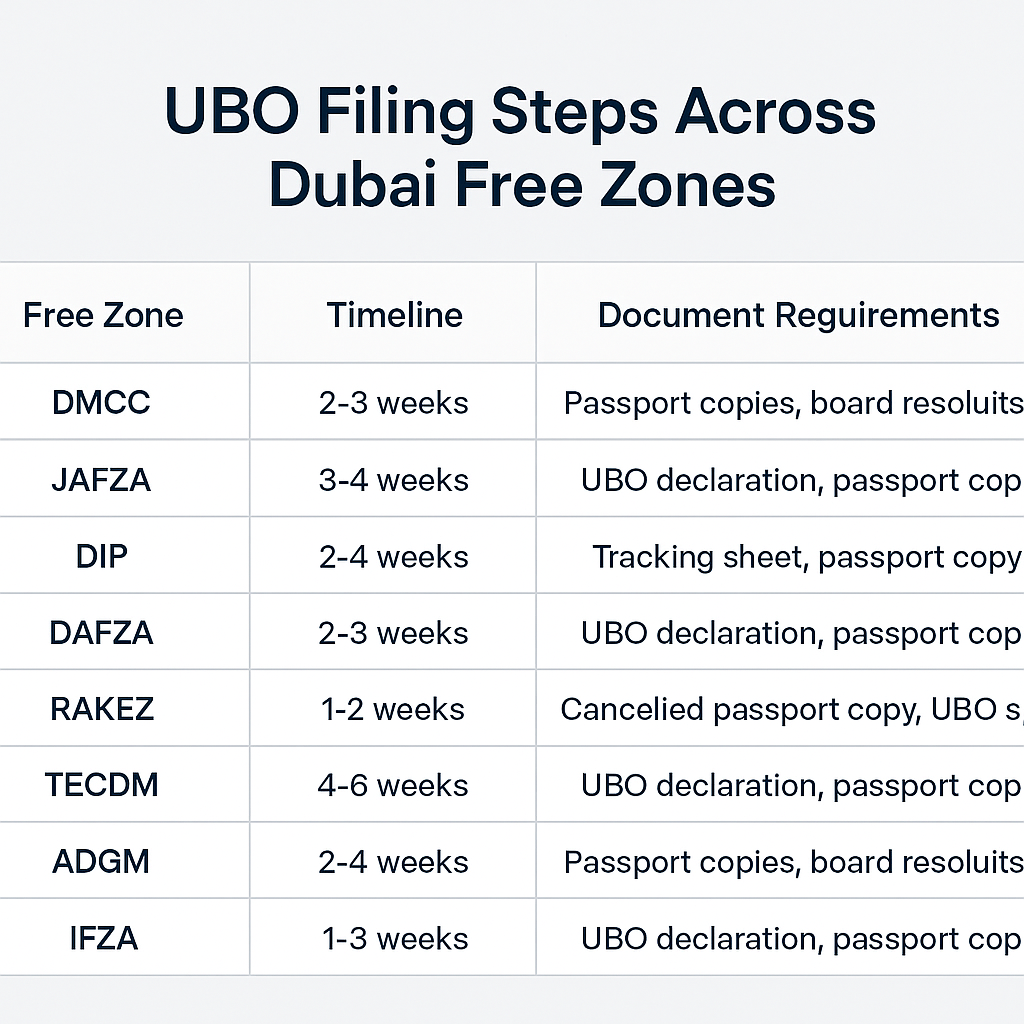
Step 4: Compare Filing Procedures Across Major Dubai Free Zones
Now that you’ve got the UBO basics under your belt, the real question is: how does the paperwork actually differ from one free‑zone authority to another? The short answer is – it varies, but the underlying goal is the same: prove who ultimately controls the business.
Let’s start with Dubai Internet City (DIC). DIC asks for a single PDF bundle that includes the UBO declaration, passport copies, and a shareholder register export. Their portal runs an instant validation script, so if any field is missing you’ll get a red flag within minutes. The turnaround is usually 24‑48 hours, provided the PDF is under 5 MB.
In contrast, Dubai Multi Commodities Centre (DMCC) wants each document uploaded separately – passport, proof of address, and the declaration each get their own slot. DMCC also asks for a “source of funds” letter if the UBO owns more than 30 % of the shares. Because of the extra step, you should budget three business days for their review.
Then there’s Dubai Silicon Oasis (DSO). DSO’s approach is a hybrid: they accept a combined PDF like DIC, but they also require a short video selfie of the UBO confirming the details. Yes, a video – but it’s just a 30‑second clip, not a production. The video is reviewed manually, so expect a 48‑hour lag if you miss the formatting guidelines.
What about the newer free zones like Dubai South? They’ve streamlined everything into a single online form that pulls data straight from the UAE’s national business registry. If your UBO is already registered in the system, the form auto‑fills, and you only need to upload a passport scan. The whole thing can be done in under an hour, but only if your ownership structure is simple.
Actionable checklist for each zone
- Identify the specific document format each free zone demands (single PDF vs. separate uploads).
- Check the file size limits – most portals reject anything over 5 MB.
- Prepare a “source of funds” letter if the UBO holds >30 % (required by DMCC and some others).
- For zones that need a video (e.g., DSO), record a clear 30‑second selfie with the UBO stating their name and passport number.
- Log the acknowledgement reference number immediately after submission; store it alongside your master filing folder.
Real‑world example: an Australian fintech set up in DIC, then later decided to open a branch in DMCC. In DIC the filing was approved in 24 hours, but DMCC sent back a clarification request because the source‑of‑funds letter was missing. The founders added the letter, re‑uploaded the separate documents, and got clearance after three days. The delay cost them a week of bank‑account onboarding.
Another scenario: a crypto‑focused startup chose Dubai South for its speed. Because the UBO was already in the national registry, the auto‑fill worked perfectly, and the whole filing wrapped up in 45 minutes. The only hiccup was a tiny typo in the passport number that the system caught instantly, allowing a quick correction.
Here’s a quick side‑by‑side view:
| Free Zone | Document Requirement | Typical Review Time | Special Note |
|---|---|---|---|
| Dubai Internet City | Single PDF (≤5 MB) | 24‑48 hrs | Instant validation |
| DMCC | Separate uploads + source‑of‑funds letter if >30 % | 48‑72 hrs | Manual check for funds |
| Dubai Silicon Oasis | Single PDF + 30‑sec video selfie | 48‑96 hrs | Video review adds time |
| Dubai South | Online auto‑fill form + passport scan | Under 1 hr | Only for simple structures |
Tip: keep a master spreadsheet that tracks each free zone’s quirks – columns for “PDF vs. separate”, “size limit”, “video needed?”, and “source‑of‑funds?”. That way you can copy‑paste the same data when you expand into a new zone.
When you’re ready to compare the tax implications of each filing route, Corporate Taxation – UAE Free Zone Finder breaks down how the UBO declaration feeds into the free‑zone’s tax residency assessment.
If your business operates in the crypto space, you might also want a legal safety net. For specialized advice on how UBO filings intersect with crypto regulations, check out NeosLegal’s expertise at NeosLegal UAE Crypto Lawyers.
Finally, remember to archive every acknowledgement number, PDF, and video file in two secure locations – a cloud drive with 2‑factor authentication and an encrypted local backup. Regulators can ask for proof up to five years later, and you’ll thank yourself for being organized.
Step 5: Post‑Filing Compliance and Ongoing UBO Obligations
You’ve hit “submit” and the portal gave you that sweet acknowledgment number. Congrats – the heavy lifting is done, but the story isn’t over. The UAE regulator expects you to keep the ultimate beneficial owner (UBO) record fresh, accurate, and ready for inspection for the next five years.
So, what does “post‑filing compliance” actually look on a day‑to‑day basis? Think of it as a low‑maintenance garden: you water it occasionally, pull the weeds when they appear, and you’ll always have a tidy patch that passes any audit.
1. Set a calendar reminder for every change
Any time a shareholder sells a stake, a new investor comes on board, or a family trust is restructured, you have to update the UBO register within 30 days. It’s easy to forget because the paperwork feels like a one‑off task, but a quick spreadsheet column titled “Next Review” does the trick.
- Mark the exact date you received the change notice.
- Assign one team member (or your service provider) to trigger the update.
- Log the amendment in the same master folder you used for the original filing.
In our experience, clients who treat the register like a living document never get hit with a surprise fine.
2. Keep the supporting documents handy
Regulators love to see the original passport copy, the latest share certificate, and a brief board resolution that proves the shift in ownership. Store these PDFs in two places – a 2FA‑protected cloud drive and an encrypted USB that lives in your office safe.
If you’re wondering where to get help double‑checking the format, Zahads Chartered Accountants outlines a solid compliance checklist on their UBO service page UBO compliance guide. They’re not a competitor, just a specialist you can reference for best‑practice documentation.
3. Annual self‑assessment – not a boring chore
Each year, before the next audit window opens, run a quick self‑assessment:
- Export the UBO register from your portal.
- Cross‑check every entry against the latest shareholder register.
- Confirm that passport numbers, nationalities, and percentages still match the source documents.
- Update the “last verified” date in your spreadsheet.
This five‑minute ritual catches mismatches before the regulator does. And if you spot a discrepancy, correct it right away – the penalty for late updates can reach AED 50,000.
4. Watch for regulatory updates
The Ministry of Economy tweaks the UBO thresholds from time to time. The most recent amendment in 2023 lowered the reporting threshold for certain financial free zones to 10 %. Subscribe to the official UAE Ministry of Economy newsletter or set a Google Alert for “UAE UBO regulation” so you hear about changes as soon as they’re published.
When a new rule lands, you’ll usually have a 30‑day grace period to bring existing records in line. That window is your safety net – don’t let it slip.
5. Leverage technology, don’t over‑complicate it
Simple tools like Google Sheets with data‑validation rules can flag any % that dips below 25 % or jumps above 100 %. If you prefer a more robust solution, a cloud‑based compliance platform can push automatic reminders and store encrypted files. The key is to choose something your team actually uses, not a fancy system that gathers digital dust.
6. What to do if the regulator contacts you
Usually the request is a short clarification – maybe a blurry passport scan or a missing signature. Respond within 48 hours, attach the clean copy, and reference the original acknowledgment number. A swift reply keeps the process moving and shows you’re taking the obligations seriously.
If the regulator asks for a full audit, they’ll want:
- The original UBO filing acknowledgment.
- All supporting documents for each listed UBO.
- A log of every amendment made since the initial filing.
Having that log already prepared means you spend a few minutes pulling a file instead of scrambling for weeks.
Quick checklist to keep you compliant
- Update UBO register within 30 days of any ownership change.
- Store passport, share certificates, and board resolutions in two secure locations.
- Run an annual self‑assessment and mark the “last verified” date.
- Subscribe to official regulatory updates and act within grace periods.
- Use simple spreadsheet alerts to catch threshold breaches.
- Respond to regulator queries within 48 hours, citing your acknowledgment number.
Bottom line: post‑filing compliance is less about endless paperwork and more about building a habit of tiny, regular checks. Treat it like a quick health check for your company’s ownership structure, and you’ll never feel the sting of a surprise fine again.
FAQ
What exactly is an “ultimate beneficial owner” for a UAE free‑zone company?
An ultimate beneficial owner (UBO) is any natural person who ultimately owns or controls at least 25 % of the shares, voting rights, or the ability to direct decisions in your free‑zone entity. The definition comes from Cabinet Resolution No. 58 and applies across Dubai, Abu Dhabi and Sharjah free zones. If someone sits behind a holding company, you still have to trace through that layer until you reach the real person.
Do I need to file a UBO declaration if I’m the sole 100 % shareholder?
Yes. Even a single‑person company must submit a UBO filing. The regulator wants a record that confirms you’re the one pulling the strings. In practice you upload a passport copy, proof of address and the signed declaration form. The process takes under an hour once your documents are ready, and it protects you from future “missing owner” queries.
How often do I have to update the UBO register after the initial filing?
Any change that affects ownership or control must be reported within 30 days. That includes share transfers, adding a new investor, or restructuring a family trust. Most free zones accept a simple amendment PDF, so you don’t need to redo the whole filing. Setting a calendar reminder the day you receive a board resolution can save you a costly fine – penalties start at AED 10 000.
What documents should I keep on hand for a regulator’s audit?
Keep a master folder with three sub‑folders: IDs, Ownership evidence, and Declarations. Inside you’ll store passport scans, utility bills, share certificates or cap‑table exports, and the signed UBO declaration. Also retain the acknowledgment receipt the portal gives you after submission. Having these PDFs in two secure locations (cloud with 2FA and an encrypted USB) means you can pull a complete audit pack in minutes.
My company uses a Cyprus‑registered holding company. How do I disclose the UBO?
Treat the Cyprus entity as another layer you must peel back. Request its shareholder register from the Cyprus registrar, then identify the natural persons behind those shares. Add each individual who meets the 25 % threshold to your UBO declaration, and attach both the Cyprus register PDF and the passport copies. In a recent case a Dubai fintech saved three days by doing exactly this before the regulator even asked.
What are the penalties for a late or incomplete UBO filing?
Regulators can impose fines ranging from AED 10 000 to AED 500 000, depending on the free zone and the severity of the breach. In extreme cases, the licence can be suspended until the filing is corrected. That’s why a quick 48‑hour response to clarification requests is crucial – it shows goodwill and often stops the fine from escalating.
Can I use a spreadsheet to track UBO obligations?
A simple Google Sheet with columns for “Entity,” “Shareholder,” “Direct %,” “Indirect %,” “UBO?,” “Last updated,” and “Acknowledgement #” works wonders. Set conditional formatting to highlight any percentage that hits the 25 % line. When a change occurs, just update the row and export a new PDF for the regulator. This low‑tech approach is what we see entrepreneurs rely on for ongoing compliance.
Conclusion
Congratulations—you’ve just completed the ultimate beneficial owner uae filing free zone process, and the acknowledgement number is sitting in your spreadsheet.
Now, what’s the next move? The filing isn’t a one‑off chore; it’s the foundation for a smooth, penalty‑free run with the regulator.
Remember the three pillars that got you here: (1) a clean master PDF with matching IDs and ownership tables, (2) a 48‑hour response window for any clarification, and (3) a secure double‑backup of every supporting document.
Set a calendar reminder for any share transfer, new investor or trust amendment—30 days is the legal deadline to update the UBO register. A quick Google Sheet row update and a refreshed PDF keep you compliant without breaking a sweat.
In our experience, entrepreneurs who treat the UBO register like a living document never face surprise fines. A tiny habit of monthly checks can save you thousands.
And if you ever wonder whether you’ve missed a hidden owner, just pull the latest shareholder register, run the 25 % filter, and you’ll see instantly if another name needs to be added.
Ready to keep the momentum going? Reach out to UAE Free Zone Finder for a quick review of your filing package, or simply download our free compliance checklist to stay ahead of the next regulator request.