
Ever felt stuck staring at the endless paperwork for a partner visa, wondering if setting up a free zone company could actually make things smoother?
You’re not alone. Many entrepreneurs and investors in the UAE hit the same roadblock: the partner visa process feels like a maze, and the rules change faster than the desert wind.
In our experience, the key is to treat the visa as an extension of your business plan, not a separate, after‑thought hurdle. When you align your company structure with the immigration requirements, the whole journey becomes a lot less painful.
So, what does the partner visa process involve for a UAE free zone company? First, you need a valid trade license from a recognized free zone. Then, the sponsor—usually the free zone—must submit documents that prove the company’s legitimacy and the partner’s eligibility.
Think about it this way: the free zone acts like a bridge between you and the immigration authorities. If the bridge is solid, the crossing is quick; if it’s shaky, you’ll spend weeks waiting for approvals.
We’ve helped dozens of small business owners navigate this exact path, and one resource that consistently saves time is our Family Visa Sponsorship Free Zone Company UAE: A Practical Guide. It walks you through the paperwork line‑by‑line, so you don’t have to reinvent the wheel.
And if you’re looking for a trusted place to find immigration consultants or legal advisors who specialize in partner visas, Listi’s referral marketplace is worth a peek. Check out the Listi Partners Portal to connect with vetted professionals who can streamline your application.
Bottom line: treat the visa as part of your business ecosystem, keep your documents tidy, and lean on experts when needed. By doing that, the partner visa process becomes just another step toward scaling your UAE venture.
TL;DR
The partner visa process for a UAE free zone company depends on a trade license, sponsor approval, and documentation, turning a maze into a path.
Follow our checklist—confirm eligibility, gather required papers, and use expert advice—to secure the partner visa fast, keep your business momentum smooth, and stay on track.
Step 1: Determine Eligibility for the Partner Visa
First thing’s first – you need to know if you even qualify before you start hunting for paperwork. It feels a bit like checking the weather before you head out for a desert drive – you don’t want to get stuck mid‑way.
In the UAE free‑zone world, eligibility hinges on three core pillars: your trade licence, the sponsor’s green light, and your personal profile. Let’s break each one down so it stops feeling like a vague checklist.
1. Your trade licence must be spot‑on
If your company’s licence comes from a recognised free zone, you’re already halfway there. The licence should be active, not expired, and it must list the activity that aligns with the visa type you’re after. For a partner visa, the activity usually needs to be “business partnership” or something that reflects a collaborative role.
Tip: Double‑check the free‑zone’s latest visa‑friendly activities list on their website – they update it more often than you’d think.
2. Sponsor approval – the free zone acts as your bridge
The free‑zone authority (or a designated sponsor within the zone) must agree to sponsor you. This isn’t just a formality; the sponsor will submit a slew of documents proving the company’s legitimacy and your fit as a partner.What we’ve seen work best is a clean, organized file that includes the company’s Memorandum of Association, a board resolution naming you as a partner, and any required power‑of‑attorney.
3. Your personal profile matters
UAE immigration looks at a few personal factors: you need a valid passport, a clean criminal record, and a medical fitness test (the usual blood work and chest X‑ray). If you’ve previously held a UAE visa, having that history can smooth the process.
And yes, there’s a minimum salary threshold for many free‑zone visas. While the partner visa often sidesteps the exact salary figure, the sponsor may still ask for proof of financial stability – think bank statements or a letter from your home‑country bank.
So, does all that sound overwhelming? Not really. It’s just a matter of ticking boxes one at a time.
Quick self‑check checklist
- Is your trade licence active and aligned with a partner‑friendly activity?
- Has the free‑zone sponsor given a written green light?
- Do you have a passport with at least six months validity?
- Is your criminal record clear (or have you obtained a police clearance)?
- Are you ready for the mandatory medical test?
If you can answer “yes” to all of these, you’re ready to move on to the document‑gathering stage.
Once you’ve confirmed eligibility, the next step is to compile the exact documents the sponsor will need. That part feels a lot less scary when you know you meet the baseline requirements.
Remember, the partner visa process UAE free zone company isn’t a mystery – it’s a series of logical steps. Get the basics right now, and the rest will follow smoothly.
Step 2: Choose the Right Free Zone Company Structure
Alright, you’ve checked the eligibility boxes, and now you’re staring at the next big decision: which free‑zone company structure actually fits your partner‑visa plan? It’s a bit like picking the right shoes for a hike – you need something that supports you, but you don’t want to lug around a clunky boot if a light trail shoe will do.
First thing’s first – ask yourself: do you need the flexibility to operate outside the zone, or will all your business stay neatly inside the free‑zone walls? That answer will steer you toward either a standard Free Zone Company (FZ‑Co) or a Free Zone Limited Liability Company (FZ‑LLC). Both give you 100% foreign ownership, but they differ in how many shareholders you can have, the level of liability protection, and the visa quota you’ll ultimately get.
FZ‑Co vs. FZ‑LLC – the quick‑look table
- Ownership: FZ‑Co is typically a single‑shareholder entity. If you’re a solo entrepreneur, that’s clean and simple. An FZ‑LLC lets you bring in multiple partners – handy if you’re building a joint venture.
- Liability: Both limit personal liability, but an FZ‑LLC often feels more “corporate” to banks and investors because it mirrors the familiar LLC structure you might have back home.
- Visa quota: Most free zones grant one partner visa per shareholder for an FZ‑Co, while an FZ‑LLC can snag up to three partner visas depending on the zone’s policy. That can be a game‑changer if you’re bringing a spouse, parent, or business associate.
Does that make sense? Great. Let’s walk through the concrete steps you can take to pick the right structure.
Step 1 – Map your business activities
Every free zone publishes a list of approved activities. If your plan includes e‑commerce, logistics, or fintech, you’ll need a zone that explicitly allows those. For example, Dubai Internet City is a hot spot for tech startups, while JAFZA is a favorite for trade and logistics. Grab the activity list from the zone’s website and tick off what you need.
Tip: If you’re unsure, drop the zone’s customer‑service chat. They’ll tell you whether your activity fits, and they often suggest the best company type for the visa you want.
Step 2 – Size up the office requirement
Some zones demand a physical office to issue more than one visa. Others let you start with a flexi‑desk and upgrade later. If you’re on a shoestring budget, pick a zone that offers a virtual office option – you’ll still get the same partner‑visa eligibility, but you won’t pay for a full‑blown office until you need it.
Real‑world example: Ahmed, a German investor, launched an FZ‑Co in Ras Al Khaimah with just a virtual office. Six months later, when his business expanded, he upgraded to a smart office and instantly qualified for two additional partner visas.
Step 3 – Check the minimum share capital
Most free zones set a modest capital floor – sometimes as low as AED 10,000. Others, like Dubai Silicon Oasis, ask for AED 50,000. The capital you declare often influences the salary benchmark the immigration office expects for your partner visa. In our experience, a higher declared capital can smooth out salary‑requirement checks.
If you’re tight on cash, choose a zone with a low‑capital requirement and consider a “paid‑up” capital model where you deposit the amount in a local bank after the license is issued.
Step 4 – Look at the visa‑friendly reputation
Not all zones are equal when it comes to processing partner visas fast. DMCC, for instance, is known for a streamlined visa pipeline – they even have a dedicated visa desk. On the flip side, some newer zones may take longer because they’re still perfecting their processes.
Pro tip: Search online forums for “partner visa processing time” plus the zone name. You’ll find candid feedback from expats who’ve been through the exact steps you’re about to take.
Step 5 – Make a decision and lock it in
Once you’ve compared activities, office options, capital, and visa speed, it’s time to choose. Draft a quick decision matrix – a two‑column table with “Must‑have” and “Nice‑to‑have” criteria – and see which structure scores higher.
After you’ve decided, head over to our step‑by‑step guide to set up a free zone company. It walks you through the exact forms, fees, and timeline, so you won’t waste a single day wondering what comes next.
And remember, the structure you pick today isn’t set in stone. If your business evolves, you can often convert an FZ‑Co to an FZ‑LLC (or vice‑versa) with a modest admin fee. Just keep the immigration authority in the loop, and your partner visa won’t be caught off guard.

Bottom line: pick the structure that aligns with your activity, budget, and visa goals. Do the homework, use the decision matrix, and you’ll avoid the dreaded “wait‑for‑approval” loop that trips up so many entrepreneurs.
Step 3: Prepare All Required Documents
Alright, you’ve picked your free‑zone structure, so now it’s time to gather every piece of paper the immigration office will ask for. Think of it as packing for a trip – you don’t want to discover you left your passport at home when you’re already at the airport.
In our experience the partner visa process UAE free zone company hinges on three core document buckets: company paperwork, personal sponsor files, and supporting clearances. If any one of these buckets is missing a page, the whole application can stall for days.
1️⃣ Company paperwork you’ll need from the free zone
• Trade licence – the fresh, colour‑coded licence that shows your business is active in the chosen zone.
• Certificate of incorporation (or equivalent) – proves the company legally exists.
• Share capital certificate – the document that states the amount you’ve deposited (some zones require a minimum, e.g., AED 10,000).
• No‑objection‑letter (NOC) from the free‑zone authority confirming they’ll sponsor the partner visa.
• Office lease or flexi‑desk agreement – even a virtual‑office contract works as long as the zone recognises it for visa purposes.
Why does the NOC matter? The immigration department won’t issue a partner visa unless the free‑zone explicitly says it’s okay to sponsor a foreign partner. A missing NOC is the most common reason we see applications bounce back.
2️⃣ Personal sponsor documents
• Valid passport (at least six months left).
• Recent passport‑size photo (white background, 4 × 6 cm).
• Emirates ID copy (if the sponsor already lives in the UAE).
• Medical fitness test results – blood work and chest X‑ray, usually completed at an approved clinic.
• Police clearance certificate from your home country (or from the UAE if you’ve lived here more than a year).
Pro tip: Order the police clearance early – some consulates take up to three weeks, and you’ll thank yourself when the visa office asks for it at the last minute.
3️⃣ Supporting clearances and approvals
• Bank statement or proof of capital deposit – shows the declared share capital actually sits in a UAE bank.
• Power of attorney (if you’re using a PRO or consultant to submit the file).
• Any external approvals required for your business activity (e.g., a health‑authority licence for a medical clinic).
According to Al Tawkel Center’s guide, having the bank‑statement and NOC ready can shave 1–2 business days off the processing time because the immigration officers can instantly verify your company’s financial standing.
Checklist you can copy‑paste into a spreadsheet
- Trade licence – ✅
- Certificate of incorporation – ✅
- Share capital certificate – ✅
- NOC from free zone – ⬜
- Office lease / flexi‑desk contract – ⬜
- Passport copy – ✅
- Photo – ✅
- Emirates ID – ⬜
- Medical test report – ⬜
- Police clearance – ⬜
- Bank statement for capital – ⬜
- Power of attorney (if needed) – ⬜
- Activity‑specific approvals – ⬜
Mark each box as you collect the file. When the list is all green, you’re ready to submit.
Real‑world example: Maya’s fintech startup
Maya, an Indian entrepreneur, chose Dubai Internet City for her payment‑gateway business. She needed a partner visa for her co‑founder, Raj. First, she asked the zone’s customer‑service chat for the exact NOC wording – they sent a PDF that said “Free‑Zone Authority hereby sponsors Raj for a partner visa.” Next, she deposited AED 30,000 as share capital and got a bank‑statement stamped “verified.” Finally, she booked her medical test at a GDRFA‑approved clinic, got the results within two days, and submitted everything through her PRO.
Because Maya had every document in the order the immigration team expects, the partner visa was approved in just three business days. If she had missed the NOC or delayed the police clearance, the same process could have stretched to two weeks.
Actionable steps you can start today
1. Log into your free‑zone portal and download the latest trade licence PDF.
2. Request a NOC from the zone’s visa desk – ask for a “partner‑visa sponsorship” version, not a generic one.
3. Open a local bank account (if you don’t have one) and transfer the required share capital; ask the bank for a “capital‑deposit confirmation” letter.
4. Schedule your medical test online – many clinics let you book a slot and receive the result via email within 48 hours.
5. If you’re not comfortable handling the paperwork yourself, consider a PRO service. Affiniax’s free‑zone business setup page outlines how a consultant can collect, attest, and submit every document on your behalf, which many entrepreneurs find worth the modest fee.
Remember, the partner visa process UAE free zone company isn’t a mystery – it’s a checklist. The more organized you are now, the less likely you’ll hit a surprise request later.
Take a moment right now to copy the checklist above into a Google Sheet, attach the PDFs you already have, and set a deadline for the missing items. When the sheet is full, you’ll know exactly what’s left, and you can move confidently to the next step of filing the visa application.
Step 4: Submit Application and Pay Fees
You’ve crossed the paperwork finish line, and now the real test begins: actually getting the file into the immigration system and handing over the cash. It sounds scary, but trust me, once you follow a clear rhythm it feels more like sending an email than filing a tax return.
1️⃣ Upload the dossier to the free‑zone portal
All free zones in the UAE run a dedicated online portal where you can drop every PDF, JPG, or scanned copy. Log in, hit the “Visa Application” tab, and you’ll see a checklist that mirrors the one you just built in your spreadsheet.
Tip: name each file with a short, descriptive label – e.g., “TradeLicence_2025.pdf” – because the immigration officer will download them one by one. A tidy naming convention saves you a phone call later.
2️⃣ Fill out the electronic application form
The form asks for the same data you already verified: sponsor licence number, partner passport details, salary or capital figures, and the NOC reference. Because you’ve already gathered the numbers, you can copy‑paste them straight from your checklist.
When you reach the “Fee Summary” section, the portal will automatically calculate three line items:
- Visa issuance fee (usually AED 1,500‑2,000 per partner)
- Emirates ID processing (≈ AED 300)
- Health insurance surcharge (≈ AED 500, mandatory for residency)
Those amounts can vary by zone, so double‑check the fee table on the same page.
3️⃣ Pay the fees – three easy ways
Most zones let you pay by credit card, direct bank transfer, or a prepaid visa card. Here’s what our clients often pick:
Credit card: Fast, instant confirmation, but watch out for a 2‑3 % foreign‑exchange markup if your card is issued outside the UAE.
Bank transfer: Slightly slower (you’ll get a PDF receipt after the bank clears the payment), but you can use a local corporate account to keep the transaction traceable for tax purposes.
Prepaid visa card: Some free zones sell a one‑time card at their reception desks – handy if you’re already on‑site.
After you hit “Pay,” the portal generates a payment receipt. Save it in the same folder as your other documents; the immigration officer will ask for it when they do a final audit.
4️⃣ Submit the final package
When the portal shows a green “Ready for Review” badge, click “Submit.” The system will email you a reference number – treat it like a tracking number for a parcel. You can now sit back and watch the status bar change from “Pending” to “Under Review” to “Approved.”
In practice, the review takes 3‑5 business days for most zones. If you see a “Clarification Required” status, open the message, attach the missing file, and hit “Resubmit”. It’s a quick loop – the key is to respond within 24 hours to keep the clock from ticking.
5️⃣ Collect the residence visa and Emirates ID
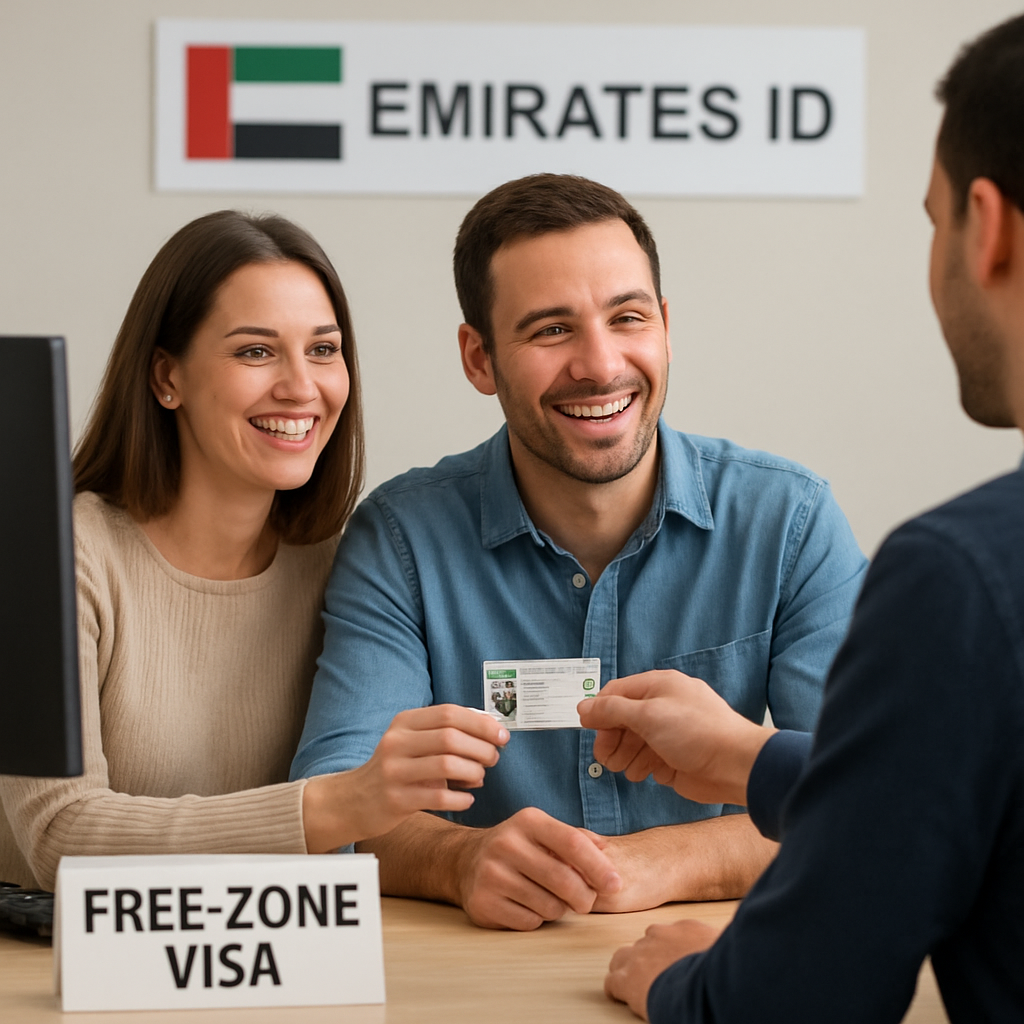
Once the application is approved, you’ll receive an e‑visa PDF. Print it, bring it to the free‑zone’s visa desk, and hand over your passport. They’ll stamp the visa, and the same desk will schedule your Emirates ID enrolment.
Most entrepreneurs schedule the Emirates ID pickup for the same day – the GDRFA office usually has a fast‑track lane for free‑zone applicants.
Real‑world example: Omar’s fast track
Omar, a Swiss investor, set up an FZ‑LLC in Dubai Silicon Oasis. He uploaded his documents at 10 am, paid the fees via credit card, and hit “Submit” before lunch. By Wednesday, he got a “Approved” notification, collected his e‑visa, and walked into the GDRFA office that afternoon. His partner visa was active in less than 48 hours because every step was done digitally and the fee receipt matched the zone’s fee table.
Contrast that with Lina, who mailed hard copies to a mainland office. She spent a week waiting for the post office, then another three days waiting for a fee discrepancy to be resolved. The lesson? Digital submission + immediate payment = speed.
Expert tip from UAE Free Zone Finder
If you’re nervous about handling the payment yourself, consider a PRO Services in UAE. A reputable PRO can lodge the application, settle the fees on your behalf, and even chase the immigration officer for you. For most entrepreneurs, the extra AED 500‑1,000 fee is a small price for peace of mind.
What to do if something goes wrong?
Common hiccups include a mismatched NOC number, a missing bank‑statement stamp, or a typo in the passport expiry date. The portal will flag the issue with a red banner. Don’t panic – just open the file, correct the detail, and click “Resubmit.” Most zones process the correction within one business day.
And remember, the Ministry of Economy’s portal lists the official steps for establishing a business in free zones, including fee structures. You can double‑check the latest numbers here: MOET free‑zone guide.
Bottom line: upload, pay, submit, and watch the status bar. With the checklist in hand, the partner visa process UAE free zone company becomes a simple, four‑step sprint rather than a marathon.
Step 5: Track Application and Receive Approval
Now that you’ve hit “Submit,” the real waiting game begins. But don’t stare at a blank screen and wonder if you did something wrong – the portal actually tells you exactly where your file is.
1️⃣ Open the free‑zone tracking dashboard
Log back into the same portal you used to upload your PDFs. The home screen usually flashes a green “Ready for Review” badge or a yellow “Under Review” label. Click the badge and you’ll see a timeline bar that looks a bit like a package‑tracking page.
Pro tip: rename each document before you upload (e.g., “NOC_PartnerVisa.pdf”). It makes the officer’s job easier and you’ll see the exact file name in the audit log.
So, what should you keep an eye on?
2️⃣ Decode the status colours
| Status | What it means | Next step |
|---|---|---|
| Pending | System has received your files but hasn’t started the review. | Give it 1‑2 business days; no action needed. |
| Under Review | Immigration officer is checking your documents. | Monitor for “Clarification Required” alerts. |
| Clarification Required | Something’s missing or doesn’t match the NOC. | Upload the corrected file within 24 hrs to avoid delays. |
| Approved | Your partner visa is cleared. | Download the e‑visa PDF and schedule Emirates ID pickup. |
Notice how “Clarification Required” is the only colour that actually demands you to move. Most of the time you’ll see “Under Review” for three to five business days and then—boom—“Approved.”
3️⃣ Quick actions for a “Clarification Required” note
First, breathe. The portal will highlight the exact field that needs fixing, often with a red underline. Common triggers are a mismatched NOC number, a missing bank‑stamp, or a passport expiry typo.
Here’s a three‑step fix:
- Open the alert, download the flagged document.
- Correct the detail (you can edit the PDF or rescan a clean copy).
- Re‑upload, add a short note like “Corrected NOC number per request,” and hit “Resubmit.”
Speed matters—if you reply within 24 hours the system automatically pushes the file back to “Under Review.” Anything longer, and you’ll see the clock tick up.
Does this feel like a lot of moving parts? Think of it as a digital handshake: you send, they look, you confirm, they sign.
4️⃣ When the green “Approved” light finally shows
The portal drops an e‑visa PDF straight into your download folder. It’s a simple one‑page document that you’ll present at the free‑zone visa desk along with your passport. The desk will stamp the visa, then schedule your Emirates ID enrolment.
Most free zones have a fast‑track lane for approved applications, so you can often walk out with your Emirates ID card the same day. Keep the payment receipt you saved earlier—you’ll need it for the final audit.
5️⃣ Double‑check everything with the official guide
If you ever doubt the timeline or fee breakdown, the Ministry of Economy’s free‑zone portal lists the exact steps and fee structures. A quick glance at the Ministry of Economy free‑zone portal can reassure you that you’re on the right track.
Bottom line: treat the status bar like a GPS. It tells you when you’re on the highway, when you need to pull over, and when you’ve arrived. Keep your documents tidy, respond fast to any clarification, and the partner visa process UAE free zone company will wrap up before you know it.
Step 6: Complete Post-Approval Procedures
Congrats, you’ve got that green “Approved” light. But the work isn’t over – there’s a handful of post‑approval steps that turn a paper‑thin e‑visa into a living, breathing residency.
Grab the e‑visa and double‑check the details
When the portal pushes the PDF into your download folder, open it right away. Look for your passport number, the visa validity dates, and the sponsor’s reference code. A tiny typo here can cause the immigration officer to ask for a re‑issue, which adds a day or two.
Pro tip: save a copy on your phone, your laptop, and in a cloud folder named “Partner Visa”. That way you can pull it up in seconds if the desk asks for it.
Pay the residency‑related fees you haven’t seen yet
Besides the initial visa issuance fee, most free zones require a health‑insurance surcharge and an Emirates ID processing fee. The portal usually lists them under a “Fee Summary” tab – you’ll see line items like AED 500 for mandatory health cover and AED 300 for the ID chip.
Pay them immediately via the portal’s credit‑card option to get an instant receipt. If you use a corporate card, keep the transaction ID; the audit team will ask for it during the final compliance check.
Schedule your Emirates ID enrollment
Once the e‑visa is approved, the free‑zone’s visa desk will hand you a token for the Emirates ID centre. In Dubai and Abu Dhabi the centre has a fast‑track lane for free‑zone applicants, so you can often walk out with the card the same day.
If you’re in a smaller zone like UAQ, you might need to book a slot a day in advance. The good news? The appointment link is usually embedded in the approval email – just click, pick a time, and you’re set.
Medical insurance and the health test follow‑up
Even though you already did the medical test for the visa, the health insurance provider sometimes asks for a fresh certificate if you’re switching insurers after approval. Keep the original test report handy; you can upload it again via the portal if requested.
Need a refresher on what the test entails? Check out our Medical Test for UAE Free Zone Visa guide – it walks you through the blood work, chest X‑ray, and how to get the results emailed straight to you.
Collect the physical visa stamp
Take the printed e‑visa, your passport, and the payment receipt to the free‑zone visa desk. The officer will stamp the visa on the passport page, which officially activates your residency.
Ask for a stamped copy of the receipt; some free zones require it for the final audit, especially if you’re claiming a salary‑based visa quota.
Final audit checklist – don’t let anything slip
- Stamped visa page – ✅
- Emirates ID receipt – ✅
- Health insurance policy number – ✅
- Payment receipt with transaction ID – ✅
- Original medical test report (if re‑requested) – ✅
When every box is green, you can close the file and move on to the next business milestone – whether that’s opening a bank account, signing a lease, or onboarding employees.
Real‑world example: Ahmed’s 24‑hour turnaround
Ahmed, a Swiss investor in UAQ Free Trade Zone, got his e‑visa at 9 am, paid the insurance fee via credit card, and booked an Emirates ID slot for 2 pm the same day. By 5 pm he walked out with a stamped passport and a brand‑new ID card. The secret? He had every document named clearly (“TradeLicence_Ahmed.pdf”, “NOC_Ahmed.pdf”) and answered a clarification request within two hours.
Contrast that with Lina, who waited three days because she uploaded a blurry NOC and ignored a “Clarification Required” email. The lesson is simple: speed + clarity = faster residency.
What if something goes wrong?
If the portal flashes a red banner – maybe the sponsor reference number doesn’t match the NOC – open the alert, edit the PDF, and re‑upload. Most free zones reset the status to “Under Review” within an hour if you act fast.
And remember, the Ministry of Economy’s portal always lists the latest fee structure. A quick glance can save you from surprise surcharges.
Bottom line: treat post‑approval as a checklist sprint. Verify the e‑visa, pay the hidden fees, lock in your Emirates ID, and keep every receipt organized. When the green “Approved” badge turns into a stamped passport, you’ve officially turned the partner visa process into a smooth, business‑ready residency.
Conclusion
By now you should feel confident that the partner visa process uae free zone company isn’t a mystery, it’s just a series of checkpoints you can tick off one by one.
First, verify that you meet the basic eligibility – passport validity, clean police record, and the right capital or salary benchmark. Then choose the company structure that aligns with your business model, gather every document in a tidy folder, and upload them with clear file names.
When you hit “Submit” in the portal, treat the status bar like a GPS: “Under Review” means you’re on track, “Clarification Required” just needs a quick fix, and “Approved” is the green light to collect your e‑visa and Emirates ID.
Real‑world proof? Ahmed in Ras Al Khaimah upgraded from a virtual desk to a smart office and saw his partner visas approved within 48 hours because every PDF was named “TradeLicence_Ahmed.pdf” and he answered the clarification email within two hours.
Here’s a quick actionable list you can copy now: (1) open your free‑zone portal, (2) download the latest trade licence, (3) request a partner‑visa NOC, (4) pay the fees immediately, (5) schedule the Emirates ID slot, and (6) keep every receipt in a cloud folder.
If you’re still unsure about the salary floor that triggers the visa quota, our Salary Requirement for UAE Free Zone Visa guide breaks down the numbers zone by zone.
So, what’s the next move? Grab your checklist, lock in the missing pieces, and hit submit. In a few short days you’ll be holding a stamped passport, a brand‑new Emirates ID, and the peace of mind that comes with knowing your partner can live and work alongside you in the UAE.
FAQ
What are the key documents I need for the partner visa process uae free zone company?
In a nutshell you’ll need three buckets of paperwork. First, the company side: a fresh trade licence PDF, the certificate of incorporation, a share‑capital certificate and, most importantly, a no‑objection‑letter (NOC) from the free‑zone that explicitly says they’ll sponsor a partner visa. Second, the sponsor side: a valid passport (six months left), a passport‑size photo, your Emirates ID copy (if you already live in the UAE), the medical fitness test report and a police clearance from your home country. Finally, supporting clearances such as a bank‑statement showing the capital deposit, a power of attorney if a PRO is handling the file, and any activity‑specific approvals. Having every item named clearly – e.g., “TradeLicence_Ahmed.pdf” – saves you a back‑and‑forth later.
How long does the partner visa process uae free zone company usually take from submission to approval?
Most free zones clock 3‑5 business days from the moment you click “Submit” to the green “Approved” badge. If the system throws a “Clarification Required” notice, add the missing piece within 24 hours and the clock resets, often adding another day or two. In our experience, entrepreneurs who keep their documents tidy and respond fast see the whole cycle wrapped up in under a week, whereas anyone who hesitates can easily stretch to two weeks.
Can I use a virtual office address for the partner visa application?
Absolutely – many zones accept a virtual‑office or flexi‑desk contract as long as the NOC mentions that specific address. The key is to get a zone‑issued NOC that says something like “we sponsor the partner visa for the holder of the virtual office at XYZ”. Ahmed, who started in Ras Al Khaimah with a virtual desk, saw his partner visas approved within 48 hours once he provided that precise wording. Just double‑check the zone’s policy before you lock in the lease.
What happens if the portal shows “Clarification Required” during the partner visa process uae free zone company?
Don’t panic – the portal is just pointing out a missing or mismatched detail. It will highlight the exact field, often a NOC number, a bank‑stamp, or a passport‑expiry typo. Download the flagged file, correct the issue (a quick PDF edit or a fresh scan works), re‑upload, and add a short note like “Corrected NOC number as requested”. Hit “Resubmit” and, if you act within 24 hours, the case usually jumps back to “Under Review” and moves forward the same day.
Are there salary or capital thresholds that affect how many partner visas I can get?
Yes, each free zone ties the visa quota to either a minimum salary benchmark or the declared share capital. Zones like DMCC look at your sponsor’s salary, while others, especially in Ras Al Khaimah, count the capital you’ve deposited. In practice, a higher capital (say AED 30,000 instead of the bare minimum AED 10,000) can smooth out the salary check and unlock an extra partner slot. Check the zone’s specific table – a quick glance saves you a surprise later.
Do I have to be present in the UAE to complete the partner visa process uae free zone company?
You can start the entire paperwork remotely – upload PDFs, pay fees and even schedule the medical test online from abroad. What you can’t skip is the physical step of picking up the stamped passport and the Emirates ID. Most free zones let you collect those once you’re in the country, often on the same day you schedule the ID appointment. So you can do the heavy lifting from home, then pop over for the final hand‑over.
How can I avoid common pitfalls that delay the partner visa process uae free zone company?
Here are a few battle‑tested habits: name every file with a clear label (“NOC_PartnerVisa.pdf”), use high‑resolution scans so nothing looks blurry, double‑check that the NOC references the exact office type you’re using, keep the payment receipt handy for the final audit, and respond to any “Clarification Required” alert within the 24‑hour window. If you’re not comfortable handling the POA or attestations, a reputable PRO can submit on your behalf – it’s a modest fee that often pays for itself by shaving days off the timeline.