
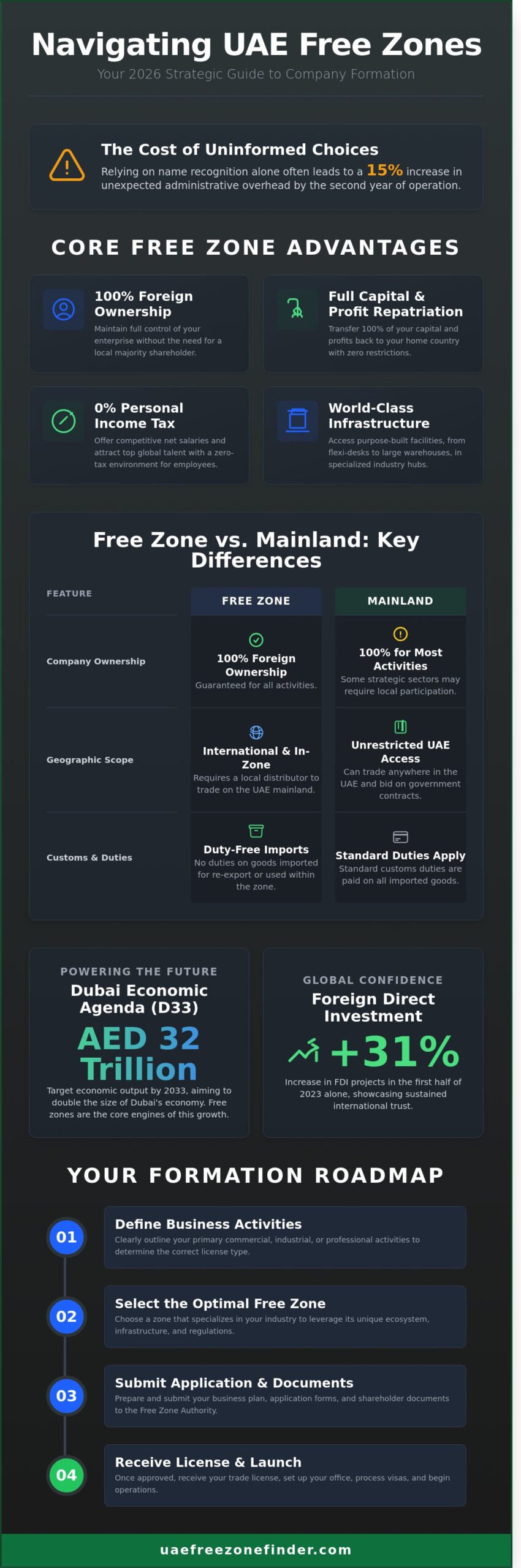
What if the most popular business hub isn’t actually the most profitable one for your specific trade? With over 40 distinct free zones across the United Arab Emirates, making a choice based on name recognition alone often leads to a 15% increase in unexpected administrative overhead by the second year, according to 2024 licensing data. It’s understandable why you might feel hesitant. Between the June 2023 updates to Corporate Tax regulations and the varying requirements for physical office space, the path to a UAE trade license can feel cluttered with fine print and potential pitfalls.
You’ve likely realized that a low initial setup fee doesn’t always mean a lower total cost of ownership over time. This 2026 guide from UAE Free
Key Takeaways
- Unlock the secrets to 100% foreign ownership and full profit repatriation while navigating the UAE’s tax-free landscape for your team.
- Pinpoint the perfect match for your sector by evaluating the specialized ecosystems across various freezones in dubai.
- Follow a clear, step-by-step roadmap to handle your company formation, ensuring you pick the right legal entity and license activities from day one.
- Calculate your true startup costs in AED using our Total Cost of Ownership framework, so there aren’t any surprises during your first year or at renewal.
- Future-proof your investment by learning how to scale your operations in line with Dubai’s ambitious D33 Economic Agenda.
What Are Free Zones in Dubai and Why Do They Exist?
Dubai’s rise as a global financial hub didn’t happen by accident. It started in 1985 with the creation of Jebel Ali Free Zone (Jafza), a move that redefined how the Middle East does business. These specialized economic areas, commonly known as freezones in dubai, are jurisdictions that sit outside the standard UAE customs territory. They were built to attract international capital by offering 100% foreign ownership, a perk that was historically unavailable on the mainland. By removing the need for a local majority shareholder, Dubai transformed itself into a magnet for entrepreneurs who want full control over their corporate destiny.
These zones are the engines driving the Dubai Economic Agenda (D33). This ambitious government strategy aims to double the size of Dubai’s economy by 2033, targeting an economic output of AED 32 trillion. Free zones play a vital role here because they act as testing grounds for new regulations and technology. By 2026, the landscape has shifted toward high-tech and sustainable industries. The regulatory framework has also matured, particularly with the full implementation of the 9% Corporate Tax for certain income types. This makes choosing the right jurisdiction more than just a matter of location; it’s a strategic tax and operational decision.
The Legal Foundation of Free Zone Authorities
Every free zone is governed by its own Free Zone Authority (FZA). These entities are powerful because they have the autonomy to issue licenses and set their own internal regulations. While they must comply with federal laws and Ministry of Economy standards, they provide a focused environment where the rules are tailored to specific industries. This independence is why these areas remain the top choice for Foreign Direct Investment (FDI), which saw a 31% increase in projects in the first half of 2023 alone. The FZA acts as your primary point of contact, handling everything from company registration to employee visas, which simplifies the administrative burden for newcomers.
Free Zone vs. Mainland: A Quick Comparison
Deciding where to plant your flag depends on your specific business goals. While both structures are now more accessible than ever, the differences in trade scope and customs are significant. You can check this comprehensive list of free zones to see how diverse these options have become. Here is how they stack up in 2026:
- Ownership: Free zones guarantee 100% foreign ownership. Mainland companies also allow this for over 1,000 commercial and industrial activities, though some strategic sectors still require local participation.
- Geographic Scope: A mainland company can trade anywhere in the UAE and bid for government contracts. A company registered in freezones in dubai is generally restricted to trading within the zone or internationally, unless they work through a local distributor or open a mainland branch.
- Customs and Duties: Free zones are considered “offshore” for customs purposes. This means you don’t pay import or export duties on goods as long as they stay within the zone or are re-exported. Mainland companies must pay standard customs duties on all imports.
The choice isn’t about which is “better” but which fits your trade pattern. If your primary goal is global export or digital services, the free zone model offers a level of efficiency and tax optimization that’s hard to beat.
Core Benefits of Incorporating in a Dubai Free Zone
Dubai’s business ecosystem isn’t just about flashy skyscrapers; it’s built on a foundation of legal frameworks that protect your capital. When you set up in one of the many freezones in dubai, you keep what you earn. There aren’t any restrictions on moving your profits back to your home country. This 100% repatriation policy applies to both the original capital you invested and every dirham of profit you’ve generated since day one.
Personal income tax remains at 0% for everyone, from the CEO to the newest intern. This makes talent acquisition much easier. You can offer competitive net salaries without the burden of tax deductions found in most Western jurisdictions. According to the official benefits of UAE free zones, this fiscal environment is designed to stimulate foreign direct investment by removing personal tax hurdles. It’s a powerful tool for retaining high-level global talent who want to maximize their take-home pay.
Infrastructure is another major win. You aren’t just renting a room; you’re buying into a specialized hub. Whether you need a simple flexi-desk for a tech startup or a 5,000 square meter warehouse for logistics, the options are purpose-built. Recruitment is also streamlined. The free zone authority acts as your sponsor for employment visas, which cuts down the red tape significantly. This centralized system means you don’t have to deal with multiple government departments to get your team on the ground.
The 2026 Corporate Tax Landscape for Free Zones
As of 2026, the tax environment has matured. While the UAE introduced a 9% corporate tax on June 1, 2023, most free zone entities still enjoy a 0% rate on qualifying income. To keep this 0% status, your business must maintain “adequate substance.” This means you need a physical office and enough qualified employees within the zone. If your annual taxable income stays below the AED 375,000 threshold, you’re generally exempt from the 9% rate. VAT at 5% only applies if you’re trading goods or services with the UAE mainland.
Customs and Trade Incentives
Trading entities benefit from being outside the UAE’s customs territory. You won’t pay customs duties on goods imported into the zone for processing or re-export. This is a massive advantage for companies located near Jebel Ali Port or Dubai South. You can move cargo from the ship to your warehouse with minimal paperwork. Choosing between the various freezones in dubai requires a clear understanding of these logistics links. If you’re unsure which hub fits your supply chain, you can find your ideal jurisdiction here to maximize these trade links.
Categorizing Free Zones in Dubai by Industry Focus
Selecting a jurisdiction isn’t just a checkbox on an administrative form. It’s a strategic decision that defines your company’s growth trajectory. Many entrepreneurs fixate on finding the lowest license fee, but this approach often overlooks the ecosystem value. If you’re a FinTech founder and you set up in a zone focused on heavy manufacturing, you’re missing out on the vital networking events, specialized talent pools, and venture capital access that drive success. The right freezones in dubai act as business accelerators, providing industry-specific infrastructure that general-purpose zones simply can’t match.
Choosing a zone that aligns with your specific activity simplifies your operations from day one. Specialized zones offer regulations tailored to your field. For example, a media company in a dedicated media hub won’t face the same rigid physical storage requirements as a logistics firm. By 2026, the trend has shifted toward multi-commodity hubs that accommodate general trading and consulting, but the most successful firms still prioritize locations where their neighbors are their potential partners or clients.
Technology, Finance, and Professional Services
High-tier jurisdictions like the Dubai International Financial Centre (DIFC) and Dubai Silicon Oasis (DSO) cater to the knowledge economy. The DIFC is unique because it operates under its own civil and commercial laws based on English Common Law. This provides a familiar legal framework for international investors. For tech firms, DSO offers specialized licenses for AI, robotics, and software development. These zones provide regulatory sandboxes where startups can test emerging tech in a controlled environment before a full market launch. This is a critical advantage as Dubai aims to double the contribution of the digital economy to its GDP by 2031.
Trading, Logistics, and Manufacturing
If your business involves moving physical goods, Jebel Ali Free Zone (JAFZA) and Dubai Multi Commodities Centre (DMCC) are the primary contenders. JAFZA is physically integrated with the Jebel Ali Port, which handles over 14 million TEUs (twenty-foot equivalent units) annually. This proximity is vital for companies requiring light industrial units or massive showrooms. These freezones in dubai provide direct integration with Dubai Customs, which can reduce cargo clearance times to just a few hours. For those in the gold, diamond, or tea trade, the DMCC offers a dedicated ecosystem including secure vaults and specialized trading platforms, ensuring that your supply chain is as efficient as possible.
- Networking: Locate near competitors to access a shared pool of specialized labor.
- Custom Regulations: Benefit from legal frameworks designed specifically for your industry’s risks.
- Infrastructure: Access purpose-built labs, studios, or cold-storage facilities.
- Efficiency: Utilize pre-integrated customs and banking services to speed up your daily operations.
The Step-by-Step Company Formation Process
Setting up a business within freezones in dubai follows a structured path designed for efficiency. You’ll first decide on your legal structure. A Free Zone Establishment (FZE) suits solo entrepreneurs, while a Free Zone Limited Liability Company (FZ-LLC) is built for two or more shareholders. Both offer 100% ownership, so your choice depends entirely on your partnership goals and the scale of your initial investment.
Next, you’ll define your business activities. Most jurisdictions allow you to group 3 to 5 related activities under a single license. After this, you’ll submit your trade name for approval. Don’t pick names that conflict with existing brands or use restricted terms. Once the authority grants initial approval, you’ll sign the legal documents and your lease agreement. Whether you choose a physical office or a virtual flexi-desk, this lease is the foundation for your final license issuance. This process is usually completed within 5 to 10 working days depending on the specific zone’s digital infrastructure.
Residency Visa and Emirates ID Lifecycle
Your trade license acts as the anchor for your residency. Each license comes with a specific visa quota, usually starting at 2 or 3 slots for small setups. The process is a clear three-step sprint. First, you’ll receive an entry permit. Second, you’ll visit a government center for a medical fitness test and blood work. Finally, you’ll provide biometrics for your Emirates ID. For 2026, high-value investors bringing AED 2 million or more into the economy can often qualify for the 10-year Golden Visa, which offers long-term stability and eliminates the need for frequent renewals.
Corporate Banking and Financial Setup
Opening a corporate bank account is often the most demanding part of the journey. Banks in the UAE maintain strict Know Your Customer (KYC) protocols to protect the financial system’s integrity. You’ll need a comprehensive business plan, proof of address, and a clear source of wealth narrative. Expect the bank to review six months of personal or previous business statements. Professional consultants provide a massive advantage here. They match your specific business profile with the right bank, ensuring your application doesn’t get stuck in a compliance loop for months. This strategic matching turns a potentially frustrating hurdle into a manageable task.
Optimizing Your Choice: How to Find the Perfect Free Zone
Selecting one of the many freezones in dubai isn’t just about finding the lowest entry price. It’s a strategic calculation that affects your bottom line for years. You must look at the Total Cost of Ownership (TCO). This figure combines your initial trade license fee, office lease requirements, residency visa costs, and the mandatory annual renewals. A jurisdiction that looks cheap on day one might become a financial burden if renewal fees jump by 20 percent in the second year.
Scalability is your next priority. Many entrepreneurs start with a “Flexi-desk” setup to keep overheads low, but you should check how easily you can upgrade to a physical office. If your 2026 growth plan involves hiring a team of ten, you need a zone that allows for quick visa quota increases without forcing you to migrate to a different jurisdiction. Choosing based on price alone rather than an activity match is a common pitfall. If your license doesn’t precisely cover your operations, you risk bank account freezes or fines from the Department of Economy and Tourism.
UAE Free Zone Finder simplifies this complex landscape. We provide a side-by-side comparison of costs and regulations, ensuring your chosen path aligns with your specific business goals. Our data-driven approach removes the guesswork from the equation.
Hidden Costs and Renewal Considerations
Don’t let the “all-inclusive” marketing packages fool you. You need to account for annual audit requirements which can cost between AED 3,000 and AED 7,000 depending on the firm you hire. Some authorities mandate these audits to renew your license. You should also budget for:
- Amendment Fees: Adding a new business activity or a partner later usually costs between AED 2,000 and AED 5,000.
- Establishment Card Renewals: These are typically required every one to three years.
- PRO Service Fees: Professional liaison services are vital for managing government paperwork and ensuring you don’t miss deadlines.
Why Expert Consultation is Essential
There are over 40 different authorities in the UAE, each with its own set of rules. Navigating these nuances without help often leads to expensive mistakes. By 2026, compliance with Federal Tax Authority (FTA) regulations has become even more rigorous. To qualify for the 0 percent Corporate Tax rate, your business must maintain “adequate substance” in its zone. We ensure your corporate structure meets these 2026 standards so you don’t lose your tax-exempt status.
Getting it right the first time saves you months of administrative headaches. Start your free zone comparison with our expert team today to secure a compliant, cost-effective future for your business in the UAE.
Launch Your Dubai Venture with Confidence
Selecting the right jurisdiction among the many freezones in dubai is the most critical step for your 2026 expansion. You now understand how these specialized hubs offer 100% foreign ownership and world-class infrastructure. However, the real value lies in matching your specific business activity with a zone that supports your long-term scaling needs. The regulatory landscape is evolving; staying ahead means ensuring your setup is compliant with the latest corporate tax laws from day one.
UAE Free Zone Finder brings 15+ years of incorporation expertise to your project. We’re an official partner to all major UAE Free Zone Authorities, which means we know the internal requirements that others might miss. Our team provides end-to-end support, managing everything from your trade license application to your ongoing corporate tax obligations. We don’t just give you data; we provide a clear roadmap that eliminates the stress of navigating a foreign legal system. You can focus on your business strategy while we handle the administrative heavy lifting.
Take the first step toward your global headquarters today. Get a Personalized Free Zone Comparison & Quote to find your perfect fit. Your success in the UAE starts with an expert partner by your side.
Frequently Asked Questions
How many free zones are there in Dubai as of 2026?
Dubai currently hosts over 30 active free zones, each designed to support specific industrial sectors like technology, commodities, or media. These jurisdictions play a vital role in the Dubai Economic Agenda D33, which aims to double the size of the city’s economy by 2033. You’ll find specialized hubs ranging from the Dubai Multi Commodities Centre (DMCC) to the Dubai Internet City.
Can a Free Zone company trade within the UAE mainland?
You can’t sell physical goods directly to the UAE mainland from a free zone without using a local distributor or agent. To trade directly, you’d need to establish a mainland branch or pay a 5% customs duty on goods moving out of the zone. However, service-based companies can often work with mainland clients, provided the work is performed within the free zone or virtually.
What is the cheapest free zone license currently available in the UAE?
The most affordable license packages currently start around AED 12,500 for a zero-visa setup in various cost-effective jurisdictions. These competitive entry points make freezones in dubai an attractive option for freelancers and digital startups, and UAE Free Zone Finder can help you identify the best fit. Costs will naturally rise if you require visa allocations or physical office space for your operations.
Do I need a physical office to open a Free Zone company?
You don’t need to rent a dedicated physical office to start your business. Most jurisdictions offer “flexi-desk” or “smart office” solutions that provide a legal registered address without the high overhead of a traditional lease. This flexible approach allows you to satisfy regulatory requirements while working remotely or from a co-working space.
How long does the company formation process take in a Dubai free zone?
The registration process typically takes between 3 and 10 working days from the moment you submit your documents. Some digital-focused zones can issue a business license in as little as 48 hours if the activity doesn’t require third-party approvals. You should allow an additional 10 to 15 days for the subsequent visa processing and Emirates ID registration.
Are Free Zone companies exempt from the 9% UAE Corporate Tax?
Free zone companies aren’t automatically exempt from the 9% corporate tax that took effect for financial years starting after June 1, 2023. You can only qualify for a 0% tax rate if you meet the criteria for a “Qualifying Free Zone Person” and generate “Qualifying Income.” It’s vital to maintain audited financial records to prove your compliance with these Federal Tax Authority rules.
Can I sponsor my family under a Free Zone investor visa?
You can sponsor your spouse, children, and parents once your own investor visa and Emirates ID are processed. To initiate this, you must meet the minimum salary requirement, which is generally AED 4,000 or AED 3,000 plus accommodation. The process is efficient and requires a medical fitness test and health insurance for each dependent you bring to the UAE.
What is the difference between an FZE and an FZ-LLC?
The main difference between these two structures is the number of shareholders involved in the company. A Free Zone Establishment (FZE) is formed with a single shareholder, which can be either an individual or a corporate entity. A Free Zone Limited Liability Company (FZ-LLC) is designed for two or more shareholders, providing a flexible structure for partners starting a business together.
Disclaimer
The information provided in this article is intended for general informational purposes only and reflects conditions as understood at the time of publication. Free zone regulations, fees, and requirements in the UAE are subject to change. Readers are advised to verify details with the relevant free zone authority or regulatory body before making any business decisions. For personalised guidance, our business setup experts at UAE Free Zone Finder are available to assist — contact us at info@uaefreezonefinder.com or call +971-507864823.