
Selling products on Instagram without a legal permit is no longer just a minor risk; in 2026, it’s a direct path to a AED 50,000 fine. You’ve likely spent months building your online brand, only to feel paralyzed by the high setup costs of traditional mainland licenses or the confusing rules around expat eligibility. It’s frustrating to watch your business potential stall because you aren’t sure if you qualify for a home-based setup. We understand that you want the freedom to trade without the heavy overhead of a physical office or the constant fear of regulatory crackdowns.
This guide provides the exact roadmap to securing your e trader license dubai. By following this framework, you’ll gain the legal status required to use professional payment gateways and sell across social media platforms with total peace of mind. We’ll break down the updated 2026 eligibility criteria for both UAE nationals and expats, explain the step-by-step application process, and show you how to turn your digital presence into a compliant, scalable enterprise.
Key Takeaways
- Learn how to legally trade on social media and websites without the high costs of renting a physical office in the UAE.
- Determine if you meet the residency and age benchmarks to qualify for your e trader license dubai through the Department of Economy and Tourism.
- Evaluate the differences between home-based permits and freelance setups to ensure you’re choosing the right path for your residency and visa needs.
- Follow a simplified, step-by-step process for registering your trade name and securing your permit via the Invest in Dubai platform.
- Identify the strategic milestones that signal your business has outgrown its home-based roots and is ready for a full corporate transition.
Understanding the E-Trader Licence: The Gateway to Legal Online Selling
Starting a business in the UAE once required significant overhead, including the mandatory leasing of physical office space. The Department of Economy and Tourism (DET) changed this dynamic by introducing the e trader license dubai. This regulatory scheme allows UAE and GCC nationals, as well as certain other nationalities, to conduct business activities from home. It’s a strategic move to bring informal trade happening on platforms like Instagram, Facebook, and TikTok into a structured legal framework. By formalizing these micro-businesses, the government ensures consumer protection and builds a more transparent marketplace.
The 2026 outlook for this license is exceptionally strong. Dubai’s D33 Economic Agenda aims to double the size of the city’s economy over the next decade, with a heavy emphasis on digital transformation. This initiative supports Dubai’s diversified economy by empowering solo entrepreneurs to contribute to the non-oil GDP. Since the UAE Digital Economy Strategy aims to increase the digital sector’s contribution to GDP to 20% by 2031, the E-Trader framework remains the most efficient entry point for digital-first startups. You don’t need an Ejari (tenancy contract) or a dedicated commercial unit to get started, which removes the biggest financial hurdle for most new founders.
Who can benefit from an E-Trader Licence?
This license isn’t a one-size-fits-all solution; it’s tailored for specific professional and commercial profiles. Freelancers offering specialized services, such as social media management, photography, or business consulting, find this pathway ideal. It’s also perfect for home-based artisans who create handmade jewelry, fashion items, or bespoke crafts. Many entrepreneurs use it as a “sandbox” to test a business concept. It allows you to validate your product-market fit before committing to the higher costs and administrative requirements of a full Limited Liability Company (LLC).
Key advantages for startups
The most immediate benefit is the reduction in startup friction. Securing an e trader license dubai provides a legal umbrella that protects your trade name, preventing others from using your brand identity in the local market. It also opens doors that are usually closed to informal sellers. You gain the right to participate in local exhibitions and government-sponsored events, which are vital for networking. Additionally, the initial investment is significantly lower than traditional mainland licenses because it bypasses the need for physical infrastructure. This lean approach allows you to allocate your capital toward marketing and product development instead of rent and utilities.
Eligibility Criteria and Professional vs Commercial Activities
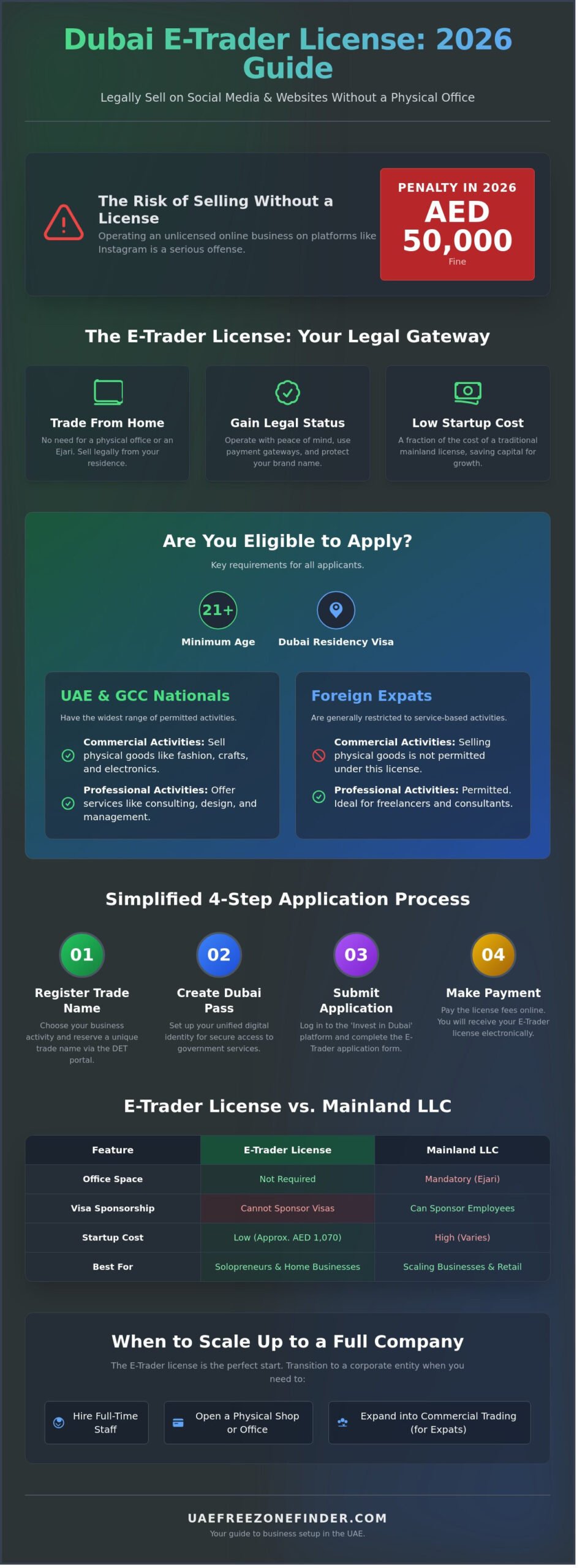
Securing an e trader license dubai requires meeting specific legal benchmarks that ensure your business operates within the city’s regulatory framework. You’ve got to be at least 21 years old to apply. This isn’t a flexible guideline; it’s a legal necessity for entering into commercial contracts in the UAE. Additionally, you must be a resident of Dubai. This means holding a valid Emirates ID and a residency visa issued by the Dubai authorities. If your visa is from another emirate, you’ll need to explore the specific e-commerce permits offered by those jurisdictions to stay compliant.
Expats vs. UAE Nationals: The Rules
The distinction between nationalities is the most critical factor in your application process. UAE and GCC nationals have the widest range of options. They can engage in both commercial and professional activities. This allows them to sell physical goods through social media or provide specialized services. Foreign expats face different boundaries. Generally, expats are restricted to professional services. This covers non-trading activities where you’re selling your expertise rather than a physical inventory. In the 2026 regulatory environment, these rules remain firm to protect local retail markets while encouraging the gig economy for residents.
Permitted business activities
Your business activity must align with the official Department of Economy and Tourism (DET) list. Professional activities are skill-based. Popular options include web design, social media management, and lifestyle coaching. These are ideal for freelancers who work from home. Commercial activities involve trading physical products like clothes, jewelry, or electronics. Because these often require physical space or specific trade protections, they’re reserved for locals and GCC citizens under this specific license type.
Choosing the wrong activity code is a common reason for application delays. You can find direct regarding the latest permitted codes for home-based entrepreneurs. Accuracy here is essential. The DET currently manages a list of over 2,000 activities, so precision matters. If you’re struggling to identify the correct category for your startup, you can use our step-by-step guidance to find the perfect fit for your specific goals.
- Professional License: Focuses on services, consultancy, and intellectual output. It’s the primary path for the 200+ nationalities residing in Dubai.
- Commercial License: Covers the sale and distribution of tangible goods. It’s restricted to UAE and GCC nationals for this specific license type.
- Nationality Restrictions: Expats are limited to professional services to ensure they don’t compete directly with local retail trade regulations.
Comparing the E-Trader Licence with Other UAE Business Setups
Choosing the right legal framework is the most vital step for your venture’s longevity. While the e trader license dubai is a popular entry point, it serves a very specific niche. You should understand how it stacks up against other popular structures to avoid costly pivots later. The decision depends on your nationality, your need for a residency visa, and whether you intend to trade internationally or stay local.
E-Trader vs. Freelance Permit
The primary divider here is residency. An e trader license dubai is strictly a business permit; it doesn’t provide the owner with a residency visa. If you’re an expat looking to secure your stay, a Freelance Permit from a free zone like DDA is the better path as it includes visa sponsorship options. While the E-Trader allows direct B2C sales in Dubai, freelance permits often restrict you to B2B services within specific sectors.
When we look at physical requirements, the E-Trader setup is unbeatable for those starting small. You won’t need a physical office, which is a mandatory requirement for a Mainland LLC. A standard LLC requires a signed Ejari for a commercial space. This makes the E-Trader’s AED 1,070 annual fee highly attractive compared to the overhead of a mainland office, which often exceeds AED 25,000 annually. For international traders, a Free Zone setup remains the gold standard. Free zones allow 100% foreign ownership for all nationalities and provide specialized logistics and customs benefits that a home-based license simply cannot match.
The Corporate Tax factor in 2026
By 2026, every business owner in the UAE must prioritize tax compliance. Even with an E-Trader permit, you’re required to register for Corporate Tax with the Federal Tax Authority. If your annual revenue stays below the AED 3 million threshold, you can still benefit from Small Business Relief, keeping your tax rate at 0%. However, you must still register and file annual returns. Proper bookkeeping is now a legal requirement to prove your eligibility for this relief.
To summarize the cost-benefit analysis, the E-Trader licence is the most efficient way to test the Dubai market without heavy capital investment. It’s perfect for 100% GCC national ownership or expat professional services. However, if your 2026 business plan involves hiring a team or importing goods from overseas, the limitations on visas and physical space mean you’ll likely outgrow this setup within 12 to 18 months. We recommend this license as a launchpad rather than a permanent home for high-growth startups.
How to Apply for Your E-Trader Licence in 2026
Obtaining an e trader license dubai is a streamlined digital process designed for speed. The Department of Economy and Tourism (DET) has optimized the system so entrepreneurs can move from idea to legal operation in under ten minutes. You’ll primarily interact with the Invest in Dubai platform or the DED Trader portal. These centralized hubs manage everything from name reservation to final payment. Success depends on having your digital documents ready before you begin the session.
Choosing a trade name is the first critical step. Dubai authorities maintain strict naming conventions to ensure market clarity. You can’t use prohibited words related to religion, political groups, or “Global” and “International” unless you meet specific capital requirements. Your name should ideally reflect your business activity. If you’re using your own name, it must be your full name as it appears on your passport, not just a nickname or initials.
Document submission is entirely paperless. You’ll need to upload high-resolution scans of your passport and Emirates ID. For residents, proof of residency is often required to confirm you’re operating within the correct jurisdiction. Once you submit these and the system verifies your identity, the platform generates a payment voucher. After you settle the fees, the digital licence is issued instantly to your dashboard. You can download it and start trading the same hour.
Step-by-step application guide
Start by registering your digital identity through UAE Pass. It’s the most efficient way to access government services without creating multiple accounts. During the application, you must link your specific social media handles. This ensures the DET can monitor compliance and protect consumers. The initial licence fee is approximately AED 1,070. You’ll need to renew this annually to keep your business active and avoid fines that can reach AED 5,000 for expired permits.
Post-licensing requirements
Once your licence is active, your first priority is opening a business bank account. Digital-first banks like Wio or Mashreq Neo are highly startup-friendly; they often approve e-trader accounts within 48 hours. You must also monitor your revenue closely. If your taxable supplies and imports exceed AED 375,000 in a 12-month period, registering for VAT with the Federal Tax Authority (FTA) becomes mandatory. Finally, switch your Instagram or TikTok profiles to “Business” accounts. This allows you to add your licence details and use professional growth tools legally.
Ready to start your digital journey in the UAE? Get expert matching for your Dubai business setup and ensure your application is perfect the first time.
Scaling Your Online Venture: From E-Trader to Full Corporate Entity
Starting small with an e trader license dubai is a strategic move for solo entrepreneurs. It keeps initial overheads low while you test your product-market fit. However, this license has a hard ceiling. It’s strictly designed for home-based, single-owner operations. You cannot hire staff, sponsor employee visas, or open a large-scale warehouse. If your 2026 business plan involves hiring a marketing manager or a logistics coordinator, you’ve already reached the limits of this entry-level permit.
The signs that you’ve outgrown your home-based roots are usually financial and operational. When your monthly transaction volume exceeds the capacity of a personal bank account, or when you need to sign contracts with international distributors, it’s time to upgrade. Transitioning to a free zone company formation unlocks 100% foreign ownership and removes the geographical restrictions on where you can trade. It transforms you from a local seller into a global corporate player.
Moving to a Free Zone or Mainland LLC
To build a sustainable team, you need a license that supports residency visas. Most UAE Free Zones offer packages that include 2 to 6 visas even with a basic flexi-desk setup. This is a critical step for entrepreneurs who need boots on the ground to manage daily operations. Beyond hiring, a formal corporate structure makes your venture “investor ready.” Professional investors and venture capital firms rarely provide funding to solo e-traders; they require the legal protection and share structure of a Limited Liability Company (LLC) or a Free Zone Establishment (FZE).
Physical presence also changes how the market perceives you. Moving from a residential address to a dedicated office space or a professional co-working hub in a Free Zone builds immediate credibility with banks and high-value clients. It provides a registered office address that is essential for opening a comprehensive corporate bank account, which offers better credit facilities than the basic accounts available to e trader license dubai holders.
Expert guidance for your journey
Our role is to act as your expert guide through this transition. We don’t just provide a list of jurisdictions; we match your specific business activity to the most cost-effective location. Some zones offer better infrastructure for e-commerce logistics, while others provide lower renewal fees for consultancy services. We manage the administrative burden and the complex paperwork so you can stay focused on your revenue targets.
We ensure your upgrade is handled with the quiet confidence of an insider, avoiding common pitfalls that lead to delays or rejected applications. Our team provides step-by-step support to ensure your new corporate structure is fully compliant with the latest UAE regulations. Get a free consultation today to find the perfect fit for your growing business.
Launch Your Digital Venture in 2026
Securing your e trader license dubai represents more than a legal formality; it’s the first step toward building a scalable brand in the UAE’s thriving digital economy. Data from the Dubai Department of Economy and Tourism in 2024 showed a consistent rise in home-based business registrations, a trend that continues to shape the 2026 market. This license offers a strategic pathway for solo entrepreneurs to test their concepts while remaining fully compliant with local regulations. It bridges the gap between a side project and a professional commercial entity.
Navigating these administrative requirements doesn’t have to be a source of stress for your new business. Our team of Virtuzone-backed specialists provides the expert guidance needed to avoid common pitfalls. We have facilitated thousands of successful incorporations across the Emirates, ensuring every investor finds their perfect fit. You’ll benefit from transparent pricing with no hidden administrative fees, allowing you to focus your resources on growth. Start your business journey with UAE Free Zone Finder today. Your path to global success is ready for you to take it.
Frequently Asked Questions
Can expats get an E-Trader licence in Dubai?
Yes, expats can obtain an e trader license dubai, but their activity options are limited to professional services. While UAE and GCC nationals can trade physical goods, foreign residents are restricted to services like consulting, web design, or social media management. You must be at least 21 years old and reside in Dubai to qualify for this specific permit.
Does the E-Trader licence provide a UAE residency visa?
No, the e trader license dubai doesn’t provide a UAE residency visa. This permit is specifically designed for individuals who already hold a valid Emirates ID and residency status, such as those on a spouse’s visa or an employment visa. If your goal is to secure residency through your business, you’ll need to explore mainland or free zone company incorporation options instead.
How much does an E-Trader licence cost in 2026?
The registration fee for an e trader license dubai is AED 1,070 according to the Dubai Department of Economy and Tourism (DET) fee structure. You’re also required to pay a Dubai Chamber of Commerce membership fee of AED 300. These costs are fixed government charges that apply to the initial application and must be paid in a single installment to activate the license.
Can I sell physical products with an E-Trader licence?
Only UAE and GCC nationals have the legal right to sell physical products through this license. If you’re an expat entrepreneur, your activities are strictly limited to professional services and freelancing. To sell physical goods as a foreign resident, you must establish a limited liability company (LLC) or a free zone entity, which requires a different legal structure and higher startup capital.
Do I need a physical office or Ejari for this licence?
You don’t need a physical office space or an Ejari certificate to secure an e trader license dubai. This license is specifically regulated for home-based businesses, allowing you to operate legally from your residential address. This setup eliminates the high overhead costs of commercial rent, making it a highly efficient entry point for 1 person startups and digital nomads.
Can I open a corporate bank account with an E-Trader licence?
Yes, you can open a corporate bank account with an e trader license dubai, though the process requires specific documentation. Most local banks will request your license copy, Emirates ID, and proof of residence. Digital banking platforms in the UAE often provide a faster, more accessible approval process for home-based entrepreneurs compared to traditional brick and mortar institutions.
Is it mandatory to renew the licence every year?
Yes, you must renew your license every 12 months to maintain your legal standing in Dubai. The renewal process is straightforward and should be completed within 30 days of the expiry date to avoid administrative fines. Staying current with your renewal ensures you don’t face service disruptions or legal complications with the Department of Economy and Tourism.
What are the penalties for selling online without a licence?
Selling products or services online without a valid license can result in immediate fines starting at AED 5,000. In more severe cases of non-compliance, the Dubai Department of Economy and Tourism has the authority to block your social media accounts and websites. These penalties are strictly enforced to maintain market integrity and ensure consumer protection across the UAE’s digital economy.
Disclaimer
The information provided in this article is intended for general informational purposes only and reflects conditions as understood at the time of publication. Free zone regulations, fees, and requirements in the UAE are subject to change. Readers are advised to verify details with the relevant free zone authority or regulatory body before making any business decisions. For personalised guidance, our business setup experts at UAE Free Zone Finder are available to assist — contact us at info@uaefreezonefinder.com or call +971-507864823.