UAE Business Setup for Expats: The 2026 Complete How-To Guide

Your biggest hurdle to launching a company in Dubai isn’t the paperwork; it’s the paralyzing fear of choosing the wrong jurisdiction. You’ve likely spent hours researching the uae business setup for expats, only to end up more confused about the 9% corporate tax compliance or hidden visa costs. It’s frustrating when the path to your trade license feels buried under layers of bureaucracy. We understand that you want a clear, efficient route to starting your venture without the stress of unexpected regulatory hurdles.
This expert guide simplifies the process by providing a transparent roadmap to securing your license and residency by 2026. You’ll master the process of selecting the right jurisdiction while ensuring your corporate bank account is ready for operation. We’ll break down the latest regulatory changes and the exact steps to secure residency for your family. By the end of this article, you’ll have the strategic direction needed to transform your business vision into a legally compliant reality in the Emirates.
Key Takeaways
- Understand how you’ll benefit from 100% foreign ownership and the UAE’s attractive 0% personal income tax regime for international founders.
- Determine the ideal jurisdiction for your venture by weighing the strategic advantages of Free Zone versus Mainland licenses.
- Master the uae business setup for expats through a structured process that eliminates administrative guesswork and speeds up your launch.
- Explore the direct link between company registration and long-term residency options, including the sought-after 10-year Golden Visa.
- Navigate post-setup requirements with expert insights on opening corporate bank accounts and staying compliant with Federal Tax Authority regulations.
Why the UAE Remains the Premier Destination for Expat Entrepreneurs in 2026
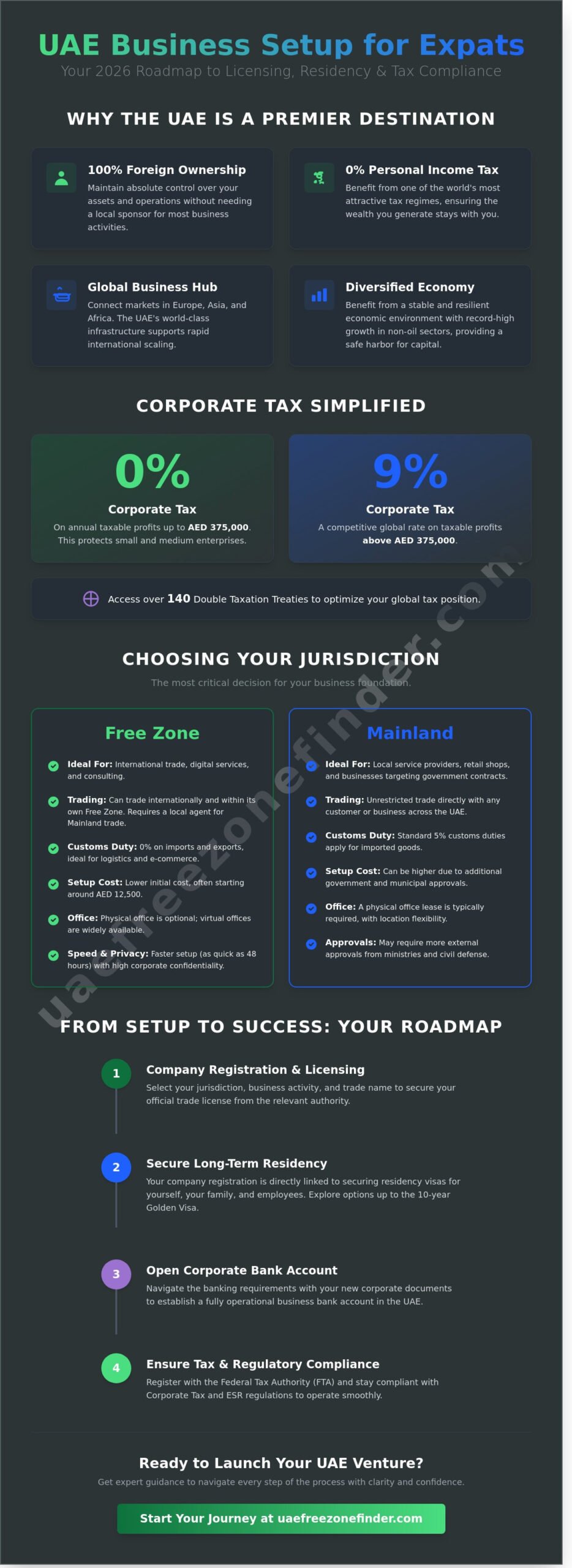
Starting a business in the Emirates is no longer the bureaucratic maze it was a decade ago. For international founders, uae business setup for expats represents a structured legal pathway to full operational control and long-term residency. By 2026, the nation has solidified its role as a global capital hub, offering a 0% personal income tax environment that remains untouched despite global fiscal shifts. This policy ensures that the wealth you generate as an individual stays in your pocket, making it one of the most attractive jurisdictions for high-net-worth entrepreneurs and digital nomads alike.
The Economy of the UAE has diversified successfully beyond oil, with non-oil GDP growth hitting record highs in early 2026. This stability creates a safe harbor for global capital. Investors choose this jurisdiction because it acts as a logistical bridge, connecting markets in Europe, Asia, and Africa within an eight-hour flight. Whether you’re moving goods or providing digital services, the infrastructure here is designed to support rapid scaling without the typical friction found in other emerging markets.
The 100% Foreign Ownership Revolution
The most significant change for investors is the total removal of the local sponsor requirement for the vast majority of commercial and industrial activities. You don’t need to surrender 51% of your company to a local partner anymore. 2026 regulatory updates have refined this further, ensuring that expat entrepreneurs maintain absolute decision-making power over their assets and operations. This shift has triggered a 25% increase in new license registrations compared to three years ago, as founders prioritize autonomy. Total control means you can sell, merge, or liquidate your company without needing third-party consent from a local shareholder.
Strategic Tax Advantages for New Ventures
While the UAE introduced a federal corporate tax, it’s designed to protect small and medium enterprises. You won’t pay a single dirham in corporate tax if your annual taxable profit stays below AED 375,000. For profits above this limit, a competitive 9% rate applies, which is still among the lowest globally. uae business setup for expats allows you to legally optimize your global tax position. By establishing tax residency here, you can benefit from over 140 double taxation treaties. These agreements prevent your income from being taxed twice by different governments, securing your margins as you expand into international markets. This fiscal framework provides the clarity you need to plan your five-year growth strategy with confidence.
Choosing the Right Jurisdiction: Free Zone vs. Mainland
Deciding where to plant your business roots is the most critical step in your journey. In the UAE, you’re essentially choosing between a Mainland entity, governed by the Department of Economy and Tourism (DET) in each Emirate, and one of over 40 specialized Free Zones. Your choice dictates how you trade, where you can open an office, and how much you’ll pay in customs duties. For any uae business setup for expats, the jurisdiction is the foundation that supports every future transaction.
You’ve got to look at your target audience before signing any papers. If your primary customers are local consumers in Dubai or government bodies like DEWA, a Mainland license is your best bet. If you’re an international consultant or a tech startup, a Free Zone often provides a more cost-effective entry point. Initial setup fees vary based on your visa requirements; a basic Free Zone package might start around AED 12,500, while a Mainland license often requires additional municipal fees and approvals that can push initial costs higher. However, Mainland renewals are tied to your office lease value, whereas Free Zone renewals are typically fixed and predictable.
The Benefits of Free Zone Company Formation
Free Zones are designated areas that exist outside the UAE’s standard customs territory. This status allows for 0% customs duty on goods moving through the zone and 100% import and export tax exemptions. It’s an ideal setup for businesses focused on international trade or digital services. The free zone company formation process is optimized for speed; many specialized zones offer digital portals that can issue a license in as little as 48 hours. Beyond speed, these zones provide robust asset protection and confidentiality, keeping your corporate structure private from public registers.
When to Opt for a Mainland License
A Mainland license removes the geographical ceiling on your operations. While Free Zone companies usually need a local distributor to sell goods on the mainland, a Mainland entity trades directly with the local market and government entities without restrictions. Since the June 2021 amendments to the Commercial Companies Law, expats can now enjoy 100% ownership for over 1,000 commercial and industrial activities on the mainland. This setup also offers more flexibility in office space; you can lease a physical office anywhere in the city rather than being confined to the Free Zone’s perimeter. It’s the standard choice for retail shops, restaurants, and firms that need to be physically present where their clients are.
Navigating these regulatory waters doesn’t have to be a solo effort. If you’re feeling stuck between two options, using an expert matching service can help you compare real-time costs and requirements across different Emirates to ensure you find the perfect fit for your specific goals.
UAE Residency for Entrepreneurs: Securing Your Future
A primary motivation for uae business setup for expats is the immediate path it creates toward legal residency. In the UAE, your business license acts as the foundation for your right to live, work, and open bank accounts. You aren’t just registering a company; you’re establishing a legal foothold in one of the world’s most stable economies. Once your trade license is issued, the process moves into the immigration phase, where your role as a shareholder or partner qualifies you for a specific residency status.
The transition from a visitor to a resident follows a strict, logical sequence. You’ll first receive an entry permit. After this, you must undergo a medical fitness test, consisting of a blood test and X-ray, at a government health center and apply for your Emirates ID. This physical ID card is essential for everything from renting an apartment to setting up utility services. Most entrepreneurs complete this entire cycle within 15 to 21 working days, depending on the chosen jurisdiction and the efficiency of the specific free zone authority.
Your license also grants you the right to sponsor others. You can bring your spouse, children, and parents to the UAE under your own visa. Additionally, you’re eligible to hire and sponsor domestic staff, such as nannies or drivers. For those managing vehicles in the region, professional window tinting from dadautozcare.com is a practical solution for the intense heat. This ability to consolidate your family’s legal status under your business umbrella provides the long-term security needed to focus on growth without worrying about separate sponsorship hurdles.
The Investor Visa Path
The standard investor visa remains the most popular choice for those initiating uae business setup for expats. It typically offers a two-year renewable residency. You’ll need to maintain valid health insurance, which is a mandatory requirement for visa issuance in Emirates like Dubai and Abu Dhabi. If you’re currently in the country on a tourist visa, you can perform a “status change” without exiting the UAE, though this involves a specific government fee of approximately AED 1,150.
The 10-Year Golden Visa Opportunity
For those with significant capital or high-growth startups, the Golden Visa offers a decade of stability. Eligibility often requires a minimum investment of AED 2,000,000 in property or a certified business venture. This elite status removes the need for a local sponsor and allows you to stay outside the UAE for more than six months without losing residency. UAE Free Zone Finder provides the expert matching needed to identify which free zones offer the most direct pathways to this prestigious 10-year permit.
How to Register Your Company in the UAE: A Step-by-Step Guide
Establishing a corporate presence in the Emirates is a logical sequence of administrative milestones. While the process is efficient, it requires precision to avoid delays. For most entrepreneurs, uae business setup for expats begins with a clear decision on the legal structure. You’ll choose between a Mainland LLC, which allows for local trade, or a Free Zone entity, which often provides 100% foreign ownership and specialized infrastructure.
- Step 1: Selection. Identify your exact business activities. The UAE National Economic Register (NER) lists over 2,000 activities; your choice determines your license type.
- Step 2: Trade Name. Submit your preferred name for approval. It must be unique and free of references to political or religious organizations.
- Step 3: Legal Documentation. Draft your Memorandum of Association (MOA). This document outlines the share capital, ownership percentages, and management structure.
- Step 4: Office Space. Secure a physical or virtual lease. Mainland companies require a certified Ejari contract, while Free Zones offer flexible “flexi-desk” options.
- Step 5: Final Issuance. Submit your final application to the relevant authority and pay the required fees to receive your trade license and initiate visa processing.
Document Preparation for Expats
Success depends on having your paperwork ready before you land. You’ll need high-resolution passport copies with at least six months of validity remaining. Proof of address, such as a utility bill from your home country dated within the last 90 days, is also standard. If you’re forming a subsidiary of an existing international company, all corporate documents must undergo attestation. This involves verification by the Ministry of Foreign Affairs in your home country and the UAE Embassy. A common mistake in the trade name process is using “Global” or “International” without meeting the high minimum capital requirements often required for such titles. Keep your name simple and descriptive to speed up the uae business setup for expats.
Licensing and Final Approvals
The final phase involves direct interaction with the Department of Economy and Tourism (DET) for mainland setups or specific Free Zone authorities like DMCC. You’ll receive a payment voucher for government fees, which can range from AED 10,000 to over AED 50,000 depending on your activity and location. Most authorities now issue digital trade licenses within 24 to 48 hours of payment. Once this document is in your hand, your company is a legal person. You can then proceed to open a corporate bank account and apply for your residency visa. If you’re unsure which path offers the best value, find your ideal jurisdiction with our expert comparison tool.
Post-Setup Essentials: Banking and Tax Compliance
Once you’ve secured your trade license, the focus shifts to operational longevity. For most entrepreneurs, the final hurdles of a uae business setup for expats involve securing a reliable banking partner and meeting the UAE’s evolving fiscal requirements. These steps aren’t just administrative chores; they’re the foundation of your company’s legal standing in the Emirates. Ignoring these essentials can lead to frozen accounts or heavy administrative penalties before your first year concludes.
Opening Your Corporate Bank Account
Opening a corporate account remains a significant bottleneck, affecting roughly 65% of new expat-owned businesses. Banks in the UAE, such as Emirates NBD or Wio, enforce strict Know Your Customer (KYC) protocols to comply with global anti-money laundering standards. You’ll need a comprehensive business plan that outlines your revenue streams, expected transaction volumes, and key suppliers. Banks want to see that your business is genuine and carries low risk.
Speed up this process by maintaining a physical office space. Data shows that 90% of traditional banks are hesitant to approve accounts for businesses using only “flexi-desk” or virtual office setups for certain high-risk activities. Having a local lease agreement proves you’ve established a real presence. You should also ensure your residency visa is stamped and your Emirates ID is in hand, as banks won’t finalize an application without these original documents.
Managing Corporate Tax and VAT in 2026
Managing the fiscal side of a uae business setup for expats requires a proactive approach to bookkeeping. Since the introduction of Corporate Tax in June 2023, all entities must register with the Federal Tax Authority (FTA). You’ll typically face a 9% tax rate on annual taxable profits exceeding AED 375,000. Registration deadlines are strictly tied to your license issuance month. Missing these windows results in a late registration fine of AED 10,000.
For VAT, registration becomes mandatory once your taxable supplies and imports exceed AED 375,000 over a 12-month period. You can voluntarily register if your expenses or turnover exceed AED 187,500. Using automated accounting software is the most effective way to track these figures in real-time. It prevents the AED 20,000 fines often levied for incorrect filing or failing to maintain proper financial records for the required five-year period.
Staying compliant doesn’t end with taxes. Ongoing Public Relations Officer (PRO) services manage your relationship with the Ministry of Human Resources and Emiratisation (MoHRE). They ensure your employee visas, labor contracts, and annual license renewals happen on time. Missing a license renewal date can result in monthly fines starting from AED 200, while labor law violations can lead to your company portal being blocked.
Expert matching with a dedicated PRO can save you hundreds of hours. Our team focuses on finding the perfect fit for your specific jurisdiction, ensuring you never miss a compliance deadline. We turn complex bureaucratic hurdles into a few easy steps so you can focus on your global expansion.
For founders who want to leverage their new UAE base for regional success, Grad-Ex Consultancy provides the specialized strategic advisory needed to navigate the broader GCC market landscape.
Secure Your Competitive Edge in the UAE Market
The UAE continues to evolve as a global commercial hub, and 2026 presents unique opportunities for those who understand the latest regulatory shifts. Whether you opt for the total ownership of a Free Zone or the broad market access of a Mainland license, your choice defines your operational success. Securing residency and establishing robust corporate banking are the final steps to solidifying your presence in this high-growth environment.
Navigating the complexities of uae business setup for expats doesn’t have to be a source of stress. UAE Free Zone Finder acts as your expert guide, drawing on over 15 years of consultancy experience within the UAE Free Zone Finder group. We provide end-to-end support that covers everything from your initial license application to your final residency visa. As a specialized digital brand, we simplify the bureaucratic hurdles so you can focus on scaling your enterprise.
Don’t leave your international expansion to chance. Get a personalized consultation for your UAE business setup today and let us handle the administrative heavy lifting. Your future in the Emirates starts with a single, well-informed decision.
Frequently Asked Questions
Can an expat own 100% of a business in the UAE?
Yes, you can own 100% of your company in the UAE. Since the 2020 amendment to the Commercial Companies Law, the government removed the requirement for a local Emirati partner to hold 51% of shares for over 1,000 industrial and commercial activities. Whether you choose a Free Zone or a Mainland setup, you maintain full legal control of your enterprise.
How much does it cost to set up a business in the UAE for an expat?
Costs vary based on your chosen jurisdiction and license type. A basic Free Zone license in 2026 starts at approximately AED 5,500 in northern Emirates like Sharjah or Umm Al Quwain. For a Mainland setup in Dubai, you should expect to pay at least AED 15,000 for the initial trade license, excluding office rent and visa processing fees.
What is the best Free Zone for expat entrepreneurs in 2026?
The ideal choice depends on your specific industry and budget. Various jurisdictions remain top picks for their flexible packages, while DMCC is the preferred hub for global commodities and tech firms. For media professionals, Sharjah Media City (Shams) offers some of the most cost-effective entry points for uae business setup for expats this year.
Do I need to live in the UAE to maintain my business license?
You don’t need to reside in the country to keep your business license active. However, if you hold a residency visa linked to that license, you must enter the UAE at least once every 180 days. This rule ensures your visa remains valid under current Federal Authority for Identity and Citizenship regulations.
Can I get a residency visa if I start a freelance business?
Yes, you can obtain a residency visa through a freelance permit. Many Free Zones, such as Dubai Media City, issue these permits for specific professional activities. Once your permit is approved, you’re eligible to apply for a residency visa, allowing you to live and work legally while sponsoring your family members.
How long does the entire UAE business setup process take?
Most Free Zone licenses are issued within 48 to 72 hours. The entire process, including your residency visa and corporate bank account opening, typically takes four to six weeks. Mainland setups might take slightly longer because they often require additional approvals from various government departments like the Department of Economy and Tourism.
Is it mandatory to have an office space for a new UAE company?
Physical office space isn’t always mandatory for new companies. Many Free Zones offer “Flexi-desk” or “Virtual Office” solutions that meet the legal requirement for a registered business address. This is a practical way to keep startup costs low while you’re beginning your uae business setup for expats.
What are the corporate tax implications for a new expat business?
The UAE implements a federal corporate tax of 9% on business profits exceeding AED 375,000. Small businesses with a turnover below AED 3 million may qualify for Small Business Relief, which keeps their tax rate at 0% until the end of 2026. Free Zone companies also benefit from 0% tax on Qualifying Income if they maintain adequate substance.
Disclaimer
The information provided in this article is intended for general informational purposes only and reflects conditions as understood at the time of publication. Free zone regulations, fees, and requirements in the UAE are subject to change. Readers are advised to verify details with the relevant free zone authority or regulatory body before making any business decisions. For personalised guidance, our business setup experts at UAE Free Zone Finder are available to assist — contact us at info@uaefreezonefinder.com or call +971-507864823.